
When property damage strikes, what you do in the first 24 hours can make or break your insurance claim. It's all about stopping further damage and documenting everything. Get this part right, and you set the stage for a much smoother claims process.
Your First 24 Hours After Property Damage
The moments after a storm, fire, or major water event are chaotic. We get it. But your focus needs to shift immediately to two critical tasks: mitigation and documentation. Acting fast doesn’t just protect your property—it strengthens your entire claim.
Your smartphone is your best friend right now. Before you touch or clean a single thing, pull it out and start recording. Take wide-angle photos to show the full scope of the damage, then get close-ups of specific problems. If a tree hit your roof, you need pictures of the impact point, the cracks it caused, and any water stains already showing up inside. This visual proof is your undisputed record.
Prioritize Safety and Emergency Repairs
Once you have your photos and videos, the next job is to stop things from getting worse. This is where emergency repairs come in, but you have to know the difference between a temporary fix and a permanent one.
Your insurance policy actually requires you to take reasonable steps to mitigate further damage. This means you’re expected to do things like boarding up a broken window or putting a tarp over a damaged roof to keep the elements out.
However, you should never start permanent repairs before the insurance adjuster has inspected the damage. Tearing out a water-soaked room or starting a full roof replacement can kill your claim because the insurer can no longer see the original loss. Stick to temporary measures that just stabilize the property.
This simple infographic shows the first three steps you should take immediately after property damage occurs.
As you can see, documenting the scene, securing the property, and then calling your insurer are the foundational actions for any successful claim.
Knowing When to Call for Help
Some quick fixes might feel manageable, but many emergency situations are dangerous and need a professional. Think about a storm-damaged roof. Getting up on a high, steep, or wet roof without proper safety gear is a huge risk.
This is where professional insurance claims assistance isn't just a good idea—it’s essential. Reputable services can dispatch a team immediately for urgent needs like tarping. You can explore professional emergency services to see how experts handle these first-response situations safely and effectively. They are equipped to manage high-risk tasks, protecting your property without putting you in harm’s way.
Here are a few times when calling in the pros is the only smart move:
- Significant Roof Damage: Any hole in your roof needs to be tarped immediately. A professional crew can do this safely and prevent massive water damage inside your home.
- Major Water Intrusion: If you have standing water from a flood or burst pipe, you need professional water extraction fast to stop mold before it starts.
- Structural Concerns: If a tree or other object has hit your house, the structure could be compromised. Don't go in until an expert says it's safe.
By focusing on these immediate, logical steps, you take control of a tough situation. You protect your property, keep yourself safe, and build a rock-solid foundation for the insurance claim ahead.
When to Call for Professional Claims Assistance
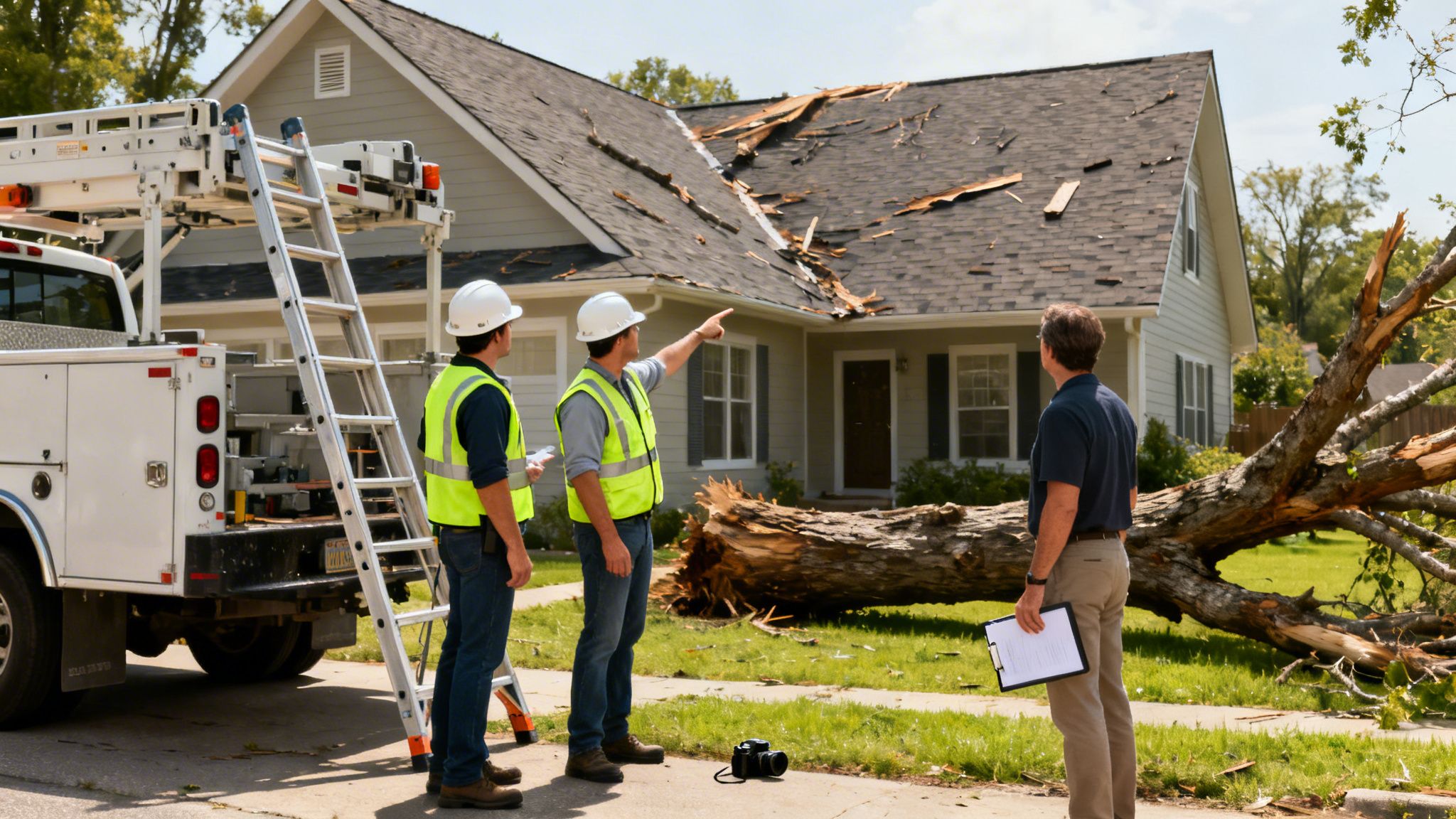
After a storm, knowing the right moment to call for professional insurance claims assistance can be the single most important decision you make. Your initial photos are a good starting point, but they rarely tell the whole story, especially when the damage is severe or hard to see.
The most obvious trigger is safety. If a massive oak tree just crashed onto a two-story home, nobody should be climbing up there to snap pictures. The same goes for any roof that's high, steep, or slick from rain. Those situations demand a professional with the right safety gear and certifications.
But it’s not just about staying safe—it’s about accuracy. A quick look can easily miss subtle but critical damage that a trained inspector is wired to spot. Getting it right from the start is vital for making sure your claim covers the full scope of repairs.
Key Scenarios Demanding Expert Help
Some situations are a clear signal that it’s time to pick up the phone. If you’re facing any of these, professional help isn't just a good idea; it's essential for protecting your property and getting your claim paid correctly.
Widespread storm damage is a classic example. When a hurricane or hailstorm plows through an entire area, insurance carriers get buried. Bringing in a dedicated partner like Fox Claims Consultants ensures your property gets the focused attention it deserves, right away.
Another clear sign is when the damage is simply out of reach. A standard ladder can’t handle every roof. Specialized ladder assist services exist for this exact reason, deploying trained inspectors who can safely access difficult areas and document everything. This stops a claim from getting stuck just because the adjuster couldn't get a good look.
Here are a few moments when calling for assistance is the right move:
- Complex Structural Damage: A fallen tree does more than damage shingles; it can crack rafters and compromise the entire roof deck. A professional assessment identifies all related issues.
- Widespread Hail or Wind Impact: After a big storm, it can be tough to distinguish new damage from old wear. Certified inspectors know exactly what to look for to build a clear, evidence-based report.
- Multi-Level or Steep Roofs: Safety always comes first. Any roof with a steep pitch or multiple stories requires specialized equipment and training to inspect without risk.
The goal is to give the insurer undeniable, expert-verified proof of loss. When a certified inspector’s report lands on an adjuster’s desk, it carries real weight. The facts are clear and documented, which almost always accelerates the approval process.
The Growing Need for Specialized Field Inspections
The pressure on the insurance industry is climbing. By 2026, global economic losses from natural disasters are projected to hit $320 billion, with insured claims reaching $140 billion. An incredible 97% of these insured losses now come from weather events.
This surge has stretched carriers thin, especially in North America, which absorbs 60% of these losses. Adjusters are juggling massive caseloads, making timely and accurate field data a huge challenge. This is precisely where specialized insurance claims assistance becomes critical.
Companies like Fox Claims Consultants LLC deploy certified inspectors to handle everything from steep roof inspections to emergency services. This helps carriers cut down claim cycle times from the industry average of 32.4 days. You can dig into more of these trends by reviewing the latest claims statistics.
From Chaos to Clarity
Ultimately, professional claims assistance turns a chaotic situation into a managed process. Instead of wondering if you’ve captured everything, you have a partner who systematically documents every single detail.
This is invaluable for everyone involved. For a property owner, it brings peace of mind. For an adjuster, it delivers the reliable data needed to make decisions quickly, without performing a dangerous climb themselves. It’s about replacing guesswork with a factual, safety-first evaluation that gets claims settled fairly and moves everyone forward.
What a Professional Property Inspection Really Looks Like

When one of our certified field inspectors shows up at a property, it's not for a quick walk-around. It’s a systematic process of gathering hard evidence to tell the complete story of the loss. This isn't just paperwork; it’s the foundation of a strong, undeniable claim.
The moment we arrive, our inspector starts with a full site walk-through, capturing the entire scene from every angle. This gives everyone—us, you, and the insurance carrier—a crucial baseline before we zoom in on the specific damage.
Think of it like this: if a tree falls on a house, we don't just photograph the hole in the roof. We document the tree's path, the damage it caused on the way down, and the condition of the surrounding yard. This context helps an adjuster sitting miles away understand exactly what happened.
We Find What Others Miss
The real value of professional insurance claims assistance is our ability to spot the damage that isn't immediately obvious. A seasoned inspector knows exactly where to look for collateral and hidden issues that often get overlooked.
After a hailstorm, anyone can see dented gutters. But our team is trained to identify the subtle granule loss on shingles that leads to premature roof failure, the hairline cracks in siding on the shaded side of the house, and the dings on A/C condenser fins that cripple its efficiency.
We methodically check every single part of the building's exterior—roofing, siding, windows, doors, fences, you name it. We're looking for direct impacts, stress fractures, and weather-related wear that all contribute to the full scope of the loss.
To capture all this, we use more than just a camera.
- High-Resolution Drones: For steep, two-story, or otherwise unsafe roofs, drones give us a perfect bird's-eye view. We can get crystal-clear images of every shingle and vent without an inspector ever leaving the ground.
- Specialized Measuring Tools: We use laser measures and other digital tools to ensure every dimension is spot-on. This precision is critical for creating an accurate materials estimate.
- Moisture Meters: For any water-related claim, moisture meters are non-negotiable. They detect water hidden behind walls and under floors, catching problems that would otherwise turn into a major mold headache down the road.
A professional inspection report is a story told through data. It combines systematic photo documentation with precise measurements and expert observations to create an undeniable record of the loss. This clarity and objectivity help adjusters make faster, more confident decisions.
A well-documented inspection is the first step, but a clear, comprehensive report is what gets the claim moving. The following checklist gives you an idea of the level of detail we look for to ensure nothing gets missed.
Professional Inspection Checklist
| Inspection Area | What to Document | Why It's Critical |
|---|---|---|
| Roofing System | Shingle/tile condition, granule loss, lifted edges, flashing, vents, pipe jacks | Roofs are the first line of defense; even minor damage can lead to major leaks. |
| Exterior Siding & Walls | Cracks, dents, holes, paint damage, and wear on all elevations (not just the storm side) | Damage is often present on multiple sides of a property, even if it's not immediately obvious. |
| Windows & Doors | Broken seals, cracked frames, screen damage, dents, alignment issues | These are common points of failure during high winds and can be costly to replace. |
| Gutters & Downspouts | Dents, loose attachments, blockage from debris, proper drainage | Damaged gutters can cause water to back up and damage the roof, fascia, and foundation. |
| HVAC & Exterior Units | Damage to condenser fins, hail impacts on unit casings, electrical connections | A damaged A/C unit can be a significant expense that is frequently overlooked. |
| Interior (If Applicable) | Water stains on ceilings/walls, moisture readings, damage to flooring and personal property | Links exterior damage to interior consequences, proving the extent of the loss. |
This systematic approach guarantees that the final report we deliver is both complete and accurate, leaving no room for guesswork.
Turning Data Into Action
A great inspection is only as good as the report it generates. Our final step is compiling all these data points into a clear, easy-to-read format for the insurance carrier. At Fox Claims Consultants, we deliver reports with clearly labeled photos, detailed annotations, and a clean summary of our findings. To see how we've pushed this process forward, you can learn more about how innovative solutions are transforming property inspections.
This level of professional reporting removes all ambiguity. It allows an adjuster at a desk to virtually walk the property and see the damage from our inspector’s point of view. It’s this clarity that turns a complex assessment into a clear roadmap for resolving the claim and helps get things moving.
Navigating Communication with Your Insurer
Clear, confident communication can completely change the tone and outcome of your claim. Many people think dealing with an insurer has to be a fight, but it doesn't. A productive dialogue transforms a tense process into a partnership focused on getting things right.
This is where professional insurance claims assistance makes a huge difference—not by battling your insurer, but by giving them exactly what they need: clear, actionable information.
Once you’ve filed your notice of loss, the insurance company will assign a desk or field adjuster to your case. Your job, and the job of your claims partner, is to make their work as easy as possible. Think of it this way: an adjuster is often juggling dozens of claims at once. The easier you make it for them to see the damage and verify the loss, the faster your claim gets moved to the top of their pile.
Establishing a Productive Dialogue
That first call or email with your adjuster sets the stage for everything that follows. Aim for collaboration, not confrontation. You want to build a relationship based on mutual respect and the shared goal of settling the claim accurately.
When you bring professional inspection reports, photos, and estimates from a service like Fox Claims Consultants to the table, you’re no longer just sharing an opinion. You’re providing objective, third-party data.
This completely changes the conversation from, "I think the damage is really bad," to, "Here is the documented evidence from a certified inspector."
It takes the emotion out of the equation and grounds the discussion in undeniable facts. For example, instead of just saying your roof is leaking, you can forward a report that includes:
- High-resolution photos showing the exact points of failure.
- Moisture meter readings confirming water is in the attic.
- A precise diagram of the damaged roof sections with exact measurements.
This level of detail gives the adjuster everything they need to justify the claim to their managers and get the next steps approved.
Communicating with Clarity and Confidence
Knowing what to say—and how to say it—is crucial. Your communication should be persistent but always professional. We recommend keeping a simple log of every conversation: note the date, time, who you spoke with, and what was discussed. After an important phone call, send a quick summary email to create a paper trail.
Let’s be honest: carriers are under immense pressure. Global insured losses from climate events are projected to hit $100 billion in the first half of 2026, with over 90% of those losses happening right here in the U.S. That means adjusters are swamped. You can learn more about this growing insurance industry gap on weforum.org.
Clear, concise communication from a trusted partner like Fox Claims, which can rapidly deploy for ladder assists and emergency tarping, cuts right through the noise. It helps shrink the 32.4-day average property claim cycle time by providing data they can act on immediately.
Key Takeaway: The goal isn’t to argue with your adjuster; it’s to equip them. When you provide expert documentation from your claims assistance partner, you empower them to do their job efficiently and advocate for your claim inside their own system.
Email Templates for Common Scenarios
Having a few simple scripts ready can take the stress out of communicating with your insurer. Here are two examples you can adapt for common situations.
1. Forwarding a Third-Party Inspection Report
Subject: Forwarding Inspection Report for Claim #[Your Claim Number] – [Your Last Name]
Dear [Adjuster's Name],
Following up on our conversation, please find the attached comprehensive inspection report and photo documentation from the certified field inspector at Fox Claims Consultants.
The report details the full scope of storm damage found at my property at [Your Address], including specific findings on the roof, siding, and windows.
Please let me know if you need anything else to move this forward.
Thank you,
[Your Name]
[Your Phone Number]
2. Providing an Estimate for Repairs
Subject: Submitting Repair Estimate for Claim #[Your Claim Number] – [Your Last Name]
Hi [Adjuster's Name],
As requested, I'm attaching the detailed repair estimate prepared by Fox Claims Consultants based on their on-site inspection. This estimate covers the full scope of work required to restore the property.
Please review and let me know the next steps for approval. I'm available to discuss it whenever you are.
Best,
[Your Name]
[Your Phone Number]
These simple, professional templates keep the focus on facts, get everyone on the same page, and help maintain positive momentum toward a swift and fair settlement.
Choosing the Right Claims Assistance Partner
Let’s be honest—not all claims assistance services are the same. The partner you pick can make or break a claim, whether you're a carrier juggling hundreds of storm files or a homeowner staring at a single, devastating loss.
You’re not looking for just another vendor. You need a true partner who operates as an extension of your own team.
This means you have to look past the slick website and dig into what really matters: certifications, safety records, nationwide reach, and a proven track record of clear, consistent communication. Think of it like hiring for a critical role on your team—you have to vet their experience and make sure they can handle the job, especially when it comes to high-risk structures.
A top-tier partner doesn’t just show up; they arrive with a plan and the skills to execute it. This is especially true when you’re dealing with the chaos of a steep roof inspection or immediate post-storm needs.
Evaluate Their Core Capabilities
When disaster strikes, you need a team that can move—fast. The first questions you should be asking any potential partner should revolve around their emergency response and their experience with tough, high-stakes jobs.
A provider's ability to handle an emergency is a dead giveaway of their overall competence.
Ask them directly: what’s your process for emergency tarping? How fast can you get "boots on the ground" after a major storm? A quality partner should have a team ready to deploy within 24 hours in a storm zone to stop further damage in its tracks.
Next, probe their experience with difficult structures. If you’ve got a steep, two-story roof, you need to know they have certified inspectors and the right equipment for a safe ladder assist. Their ability to handle tough-to-access properties isn’t a bonus; it’s a non-negotiable part of providing real insurance claims assistance.
The right partner doesn’t shy away from tough jobs; they specialize in them. Their value is most apparent when they can safely access and accurately document damage that others can't, ensuring no detail is missed and no one is put at risk.
Focusing on these core skills will help you quickly filter out the providers who don't have the real-world experience to manage a claim from start to finish.
A Practical Checklist for Vetting Providers
To help you make an informed decision, use this checklist when you're talking with a potential claims assistance firm. Their answers will tell you everything you need to know about their professionalism and expertise.
- What industry certifications do your inspectors hold? Look for proof of expertise in areas like roof inspections and damage assessment. You want specialists, not generalists.
- Can you provide your company’s safety record and protocols? A professional firm puts safety first and will be transparent about their training and incident rates. Don’t settle for vague answers here.
- What is your average response time for emergency services like tarping? Speed is everything when it comes to mitigating loss. You need a clear, fast timeline.
- What kind of reporting can I expect? Ask for a sample report. It should include crystal-clear photos, detailed notes, and precise estimates. If it's messy or confusing, walk away.
- Do you have experience with steep or multi-story structures? This confirms they’re equipped for ladder assist services and high-risk inspections.
Finding a firm with solid answers is a great start. If you want to see what a high-quality partner looks like in action, get a feel for the team and experience behind Fox Claims Consultants and their commitment to service.
Ultimately, your goal is to find a partner who will reduce risk, ensure accuracy, and help you navigate the claims process efficiently. This choice is about more than just documenting damage; it's about securing peace of mind.
Answering Your Top Questions About the Claims Process
Even the most straightforward property claim can feel like a maze of questions and uncertainties. Whether you’re a homeowner facing damage for the first time or an adjuster trying to manage a mountain of claims, getting clear answers is what matters. Let’s tackle some of the questions we hear most often out in the field.
When Storm Damage Hits, How Fast Can I Get Help Like a Tarp?
After a major storm, speed is everything. A serious claims assistance partner knows this and is built for rapid deployment. For emergency services like getting a tarp on a damaged roof, you should expect a team on-site within 24 hours in most storm-affected areas.
The mission is simple: get boots on the ground to stop the bleeding. That means stabilizing the property, preventing more water from getting in, and starting the crucial documentation process right away. That immediate response is what separates the pros from the rest and is essential for preventing a bad situation from getting much worse.
What Exactly Is a Ladder Assist and Why Do I Need One?
A "ladder assist" is when a certified and properly equipped inspector handles inspections on high, steep, or otherwise dangerous roofs for an insurance adjuster. Let's be honest—many adjusters just aren't equipped or certified to safely get up on every type of roof.
Instead of taking a risk or skipping a thorough look, a ladder assist service sends a trained pro to do the job safely. They’ll perform a complete inspection, capture detailed photos, and deliver a comprehensive report back to the adjuster. This service is critical for getting an accurate look at the damage without risking anyone's safety, which keeps the whole claim moving forward.
Will Bringing In a Third-Party Service Make My Claim More Complicated?
Not at all. In fact, it's designed to do the complete opposite. Working with a professional, third-party claims assistance service actually simplifies the entire process. For homeowners, it means an expert is documenting every last detail of the damage, so nothing gets missed.
For insurance carriers, it provides reliable, unbiased data from the field, which is a lifesaver for properties that are tough to access. These services are a neutral party focused on one thing: factual documentation.
Their clear reports, photo evidence, and precise estimates cut down on the back-and-forth and lead to faster, fairer settlements. They replace guesswork and uncertainty with clear, actionable information both sides can actually trust.
Should I Hold Off on Temporary Repairs Until My Adjuster Arrives?
No, you absolutely should not wait. Your insurance policy almost certainly requires you to take "reasonable steps" to mitigate further damage. In plain English, that means you're expected to do things like putting a tarp on a leaking roof or boarding up a shattered window to prevent the problem from worsening.
If you don't, your insurer could argue that the additional damage that occurred is on you and deny that part of the claim. Just be sure to take plenty of photos of the original damage before you cover anything up. And remember, these are temporary fixes only—don't start any permanent repairs until after the adjuster has done their official inspection.
How Can I Figure Out If My Policy Covers This Specific Damage?
Insurance policies can be a headache to read. A standard homeowner's policy, for instance, will likely cover wind damage or a tree falling on your house, but it almost never covers flood damage. That requires a separate policy, usually from the National Flood Insurance Program (NFIP). The same goes for your car—it’s only covered for flood damage if you carry comprehensive coverage.
When in doubt, your first call should be to your insurance agent or the company itself. But even if you think something isn't covered, it's often a good idea to file the claim anyway. You might need an official denial letter from your insurer to qualify for federal disaster assistance if it becomes available. It creates a paper trail and gives you a definitive answer on your coverage.
Ready to take the guesswork out of your property claim? From emergency tarping to expert ladder assists, the team at Fox Claims Consultants LLC provides the reliable, end-to-end support you need to move forward with confidence. Visit us at https://foxclaimsconsultants.com to learn how we can help.
Leave a Reply