
Picture this: a policyholder calls, their property is damaged, and they need help now. Instead of waiting days for an adjuster to get on-site, you can be there in minutes—virtually.
A virtual site inspection is exactly what it sounds like: a live, guided walkthrough of a damaged property using a smartphone or tablet. It’s like having a set of eyes on the ground, directed by an experienced adjuster from anywhere in the world. It’s a fast, safe, and incredibly efficient way to kick off the claims process.
What is a Virtual Site Inspection, Really?
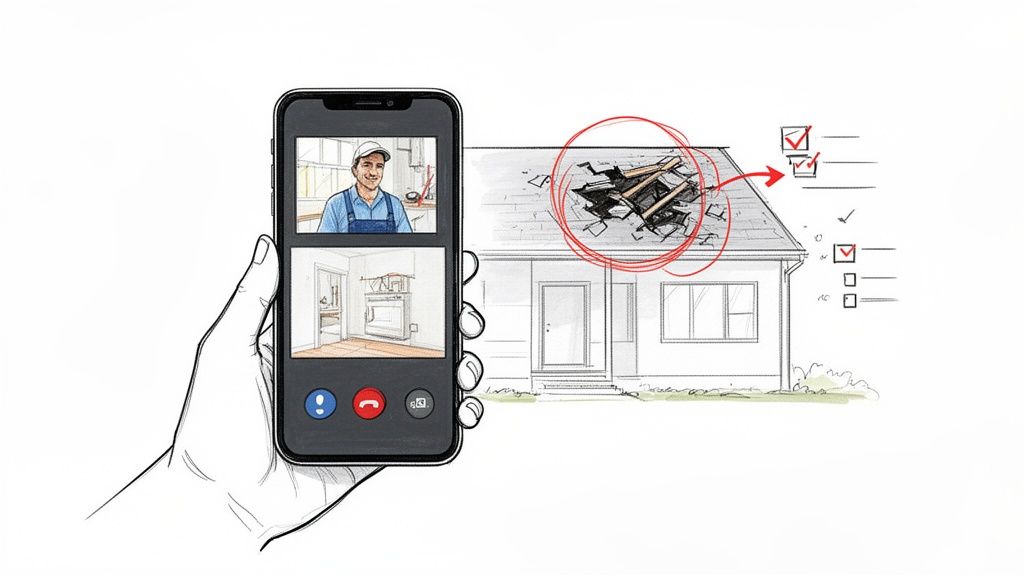
Think of a virtual inspection as the first responder of property claims. It's not meant to replace every in-person visit, but it's an incredibly powerful tool for triaging damage, especially after a major catastrophe like a hurricane or widespread hailstorm. The main goal is to get a quick, accurate read on the severity of the loss and get the right resources rolling.
This isn't just about convenience; it's about a smarter, more responsive claims strategy. By getting eyes on the damage faster and capturing better initial documentation, virtual inspections are changing the game for carriers, adjusters, and homeowners alike.
The Moving Parts of a Virtual Inspection
A good virtual inspection is far more than just a FaceTime call. It’s a structured process that combines technology with clear communication to build a bulletproof record of the property’s condition.
Here’s what’s involved:
- Live, Guided Video: An adjuster directs the person on-site—whether it's the homeowner or a contractor—telling them exactly what to show, from what angle, and in what light.
- High-Quality Photos & Videos: As the adjuster guides the call, the on-site person captures detailed images and video clips. This media becomes a permanent part of the claim file.
- On-Screen Markups: Many platforms let the adjuster draw directly on the video feed to circle specific damage, point out areas of concern, or add notes in real time. No more confusion about "the thing next to the other thing."
- Automatic Data Capture: The best systems automatically log crucial metadata like GPS coordinates and timestamps, locking in the when and where for every piece of evidence captured.
A virtual site inspection injects speed directly into the claims process. Instead of telling a distressed policyholder to wait for an appointment, you can empower them to get the ball rolling in minutes. It’s a huge win for customer experience.
More Than a Trend, It's the New Standard
The move to remote assessment isn't just a fad; it’s a fundamental shift, and the numbers prove it. The global virtual inspection market was valued at USD 17.78 billion in 2025 and is on track to hit USD 56.59 billion by 2033. That explosive growth is being fueled by huge gains in safety, new tech, and a growing demand for faster, more efficient ways to get work done.
For anyone in the claims world, those numbers tell a clear story: virtual assessments are no longer optional. They are a core part of modern property valuation and damage documentation.
By understanding how to transform property inspections with innovative solutions, carriers can deliver the speed and accuracy that today's market demands.
Choosing Between Virtual and In-Person Inspections
Let's get one thing straight: virtual vs. in-person isn't about which one is "better." It's about which tool is right for the job in front of you. This isn't a competition—it's a tactical choice that weighs speed, safety, and the level of detail a claim demands.
Picture this: a hailstorm rolls through a suburb, hitting hundreds of homes. With virtual inspections, a single desk adjuster can triage dozens of those roofs in a day. You can quickly see which ones are minor, get emergency repairs started on the severe ones, and manage homeowner expectations from the get-go.
Now, imagine a complex commercial fire. You’re seeing signs of potential structural failure. In that case, nothing beats having an experienced inspector on the ground, putting their hands on the structure, and using specialized tools to understand the building’s real condition. Some things just have to be seen up close.
The Power of a Hybrid Approach
Honestly, the smartest play is often not choosing one over the other, but using both. Think of the virtual inspection as your first-look—a quick, cost-effective recon mission.
If that initial look shows simple, clear-cut damage, you might be able to settle the claim right then and there. But if it uncovers something more serious, you now have the intel to send the right specialist for a targeted, boots-on-the-ground follow-up. This two-step process makes sure you're using your resources where they count the most.
A hybrid model puts technology to work for speed and scale right away, but saves your expert human resources for the claims that truly need them. It's the best of both worlds.
Key Decision-Making Factors
For desk adjusters and claims managers, making the right call comes down to a few key variables. Knowing how each inspection type stacks up is crucial for deploying your team effectively and keeping claims moving.
This table gives you a quick breakdown of the critical differences to help guide your decision.
Comparison of Virtual and In-Person Site Inspections
| Attribute | Virtual Site Inspection | In-Person Site Inspection |
|---|---|---|
| Speed | Immediate. Can be done within minutes of the first notice of loss, cutting out all travel and scheduling delays. | Delayed. Requires scheduling, travel time, and coordinating with the policyholder, which often takes days. |
| Cost | Low. Slashes Loss Adjustment Expenses (LAE) by getting rid of travel, fuel, and vehicle overhead. | High. Comes with costs for travel, an inspector's time on-site, and all the associated expenses. |
| Safety | High. The inspector stays remote, completely avoiding risky sites like steep roofs, fire-damaged buildings, or CAT zones. | Variable. Puts field staff in potentially hazardous situations, demanding strict safety protocols and gear. |
| Detail Level | Good to Excellent. Delivers high-res photos and video for most visible damage but offers no way to touch or feel the materials. | Comprehensive. Allows for a full sensory inspection, discovery of hidden damage, and the use of specialized tools. |
At the end of the day, the goal is to close claims accurately and without delay. While an on-site visit gives you an unmatched level of detail—and you can learn more about our process for onsite home inspections here—it isn't always necessary.
The key is knowing when to use the speed and safety of a virtual look and when to send in an expert. Master that choice, and you'll deliver faster, smarter, and more cost-effective results for everyone involved.
How a Virtual Site Inspection Works Step by Step
Let’s pull back the curtain on the virtual site inspection process. It’s far more than a simple video call; it’s a structured workflow we use to capture undeniable evidence and get claims moving faster. Understanding this journey shows how this tech goes from an abstract idea to a powerful, practical tool in an adjuster's hands.
Phase 1: Initiation and Setup
The whole thing kicks off the moment a claim is filed and flagged as a good fit for a remote look. This is often the case for claims with clear, visible damage—think storm damage—or any time speed is the top priority.
Sending the Invitation: The adjuster sends a secure link to the policyholder's phone or email. No complicated apps, no new accounts to create. The policyholder just taps the link on their smartphone or tablet to get started.
Guided Onboarding: The link opens a secure, browser-based video session. The platform gives a quick tutorial, showing the policyholder how to switch cameras, turn on the flash for better light, and follow the adjuster's lead. This ensures everyone is on the same page before the real work begins.
This first phase is all about simplicity. By knocking down technical hurdles, we empower policyholders to participate confidently. It turns a stressful moment into a proactive step toward a solution and sets the stage for a smooth, collaborative inspection.
Phase 2: The Live Guided Inspection
This is where the magic happens. The remote adjuster essentially becomes a virtual director, guiding the policyholder through a meticulous documentation process. Clear communication is the foundation here, making sure no detail gets missed.
The adjuster gives simple, direct commands like, “Please walk slowly toward the damaged section of the fence,” or “Can you hold the phone about a foot away from that shingle and turn on your flash?” This methodical approach guarantees the evidence we capture is both high-quality and relevant.
While the policyholder moves through the property, the adjuster uses digital tools in real-time:
- High-Resolution Capture: The adjuster can remotely trigger the phone’s camera, capturing crystal-clear, high-resolution photos and videos of specific damage. These images are instantly saved to the claim file, complete with metadata.
- Live Annotations: The adjuster can pause the live video and draw right on the screen—circling a missing shingle or highlighting a water stain. This visual markup removes any doubt and pinpoints the exact areas of concern.
- Evidence Collection: Every photo, video, and note is automatically organized and time-stamped. This creates a rock-solid, chronological record of the property’s condition at that exact moment.
The flowchart below shows how we decide which inspection method is the right tool for the job—a decision that kicks off this entire workflow.
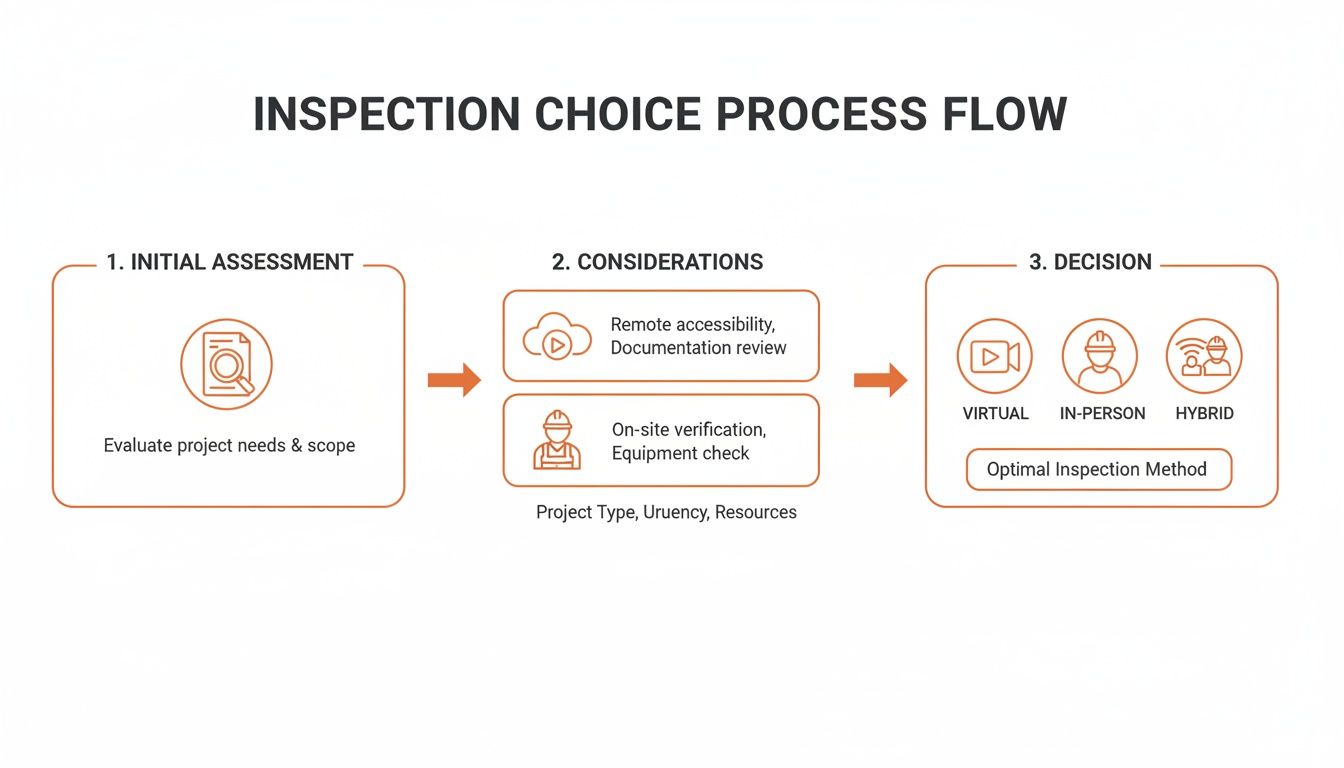
This visual really highlights how a virtual-first approach helps triage claims, saving the more intensive in-person or hybrid inspections for the really complex situations. That kind of strategic sorting is a huge advantage in a modern claims process.
Phase 3: Post-Inspection and Reporting
Once the live inspection wraps up, the job shifts from collecting data to analyzing it and taking action. This is where the real value of the technology shines, as all that evidence gets compiled into a single, actionable report.
The goal of a virtual inspection isn't just to see the damage; it's to create an indisputable digital record that can be used to make fast, fair, and accurate claim decisions.
The platform automatically gathers all the media—photos, videos, and annotated screenshots—into one clean file. This becomes the definitive source of truth for the claim. Because the data is so precise, adjusters can move forward with confidence. For anyone looking to build their own reports, having a solid framework is key. You can learn more about structuring these documents with a quality property inspection report template.
From here, the adjuster can write an accurate estimate, sign off on emergency repairs, or decide if a specialized follow-up visit is truly needed. What once took days of travel and phone tag can now be done in under an hour, pushing the claim from first notice to resolution at a pace that was once unthinkable.
Driving Efficiency and Accuracy in Claims Processing
While a step-by-step process shows you how a virtual inspection works, the real story is in the results. This isn't just about new tech; it's about fundamentally changing what's possible in claims processing. We're talking measurable gains in speed and precision.
It’s about moving beyond simply seeing damage to completely transforming how quickly and cost-effectively you can resolve a claim.
The most immediate benefit? A huge reduction in claim cycle times. By cutting out travel and scheduling headaches, adjusters can connect with a policyholder and document a loss in hours—sometimes even minutes—after the first call. That speed sends a positive ripple effect through the entire claims journey.
Boosting Adjuster Capacity and Slashing Costs
Virtual inspections completely change an adjuster's day-to-day. Instead of being held back by drive time and geography, a single desk adjuster can handle a much bigger caseload. This isn't a small tweak; it's a force multiplier for your team.
The numbers back this up. An analysis of remote visual inspection (RVI) workflows found that inspectors using this tech can conduct roughly three times more inspections per day than they could with traditional site visits. In one documented case, inspectors were averaging 20-25 remote inspections daily—a massive jump from the typical eight onsite jobs.
That surge in productivity adds up to over $30,000 in annual savings per inspector from efficiency gains and reduced vehicle costs alone. You can dive deeper into these metrics in this detailed whitepaper on remote inspections.
This newfound capacity directly shrinks your Loss Adjustment Expenses (LAE). The savings start stacking up immediately:
- Zero Travel Costs: Fuel, vehicle maintenance, and hotel stays for field adjusters simply vanish.
- Optimized Workload: Adjusters spend their time on what matters—assessing damage, not sitting in traffic.
- Reduced Admin Overhead: Faster data collection and automated reporting cut down on tedious data entry and file prep.
Accelerating Mitigation to Control Claim Severity
But speed isn’t just for closing files faster. It’s a powerful tool for controlling the total cost of the loss. A virtual site inspection delivers immediate, actionable proof that can get emergency mitigation services moving right away.
The faster you can see the damage, the faster you can act to prevent it from getting worse. A virtual inspection is the catalyst for a rapid response.
Picture this: a severe storm rips shingles off a roof. With a quick virtual inspection, an adjuster can confirm the damage and authorize an emergency tarping service in under an hour. That one quick action prevents water from pouring in, saving thousands in potential interior damage repairs.
This immediate documentation is crucial for effective mitigation in insurance claims, giving you the clear evidence needed to deploy preventative measures without delay. By getting ahead of secondary damage, you can dramatically control the final claim cost while showing the policyholder you’re on their side.
Ultimately, a virtual inspection proves that speed and accuracy aren't competing priorities. They are two sides of the same coin, both driven by smarter, more practical technology.
Improving the Policyholder Experience with Technology
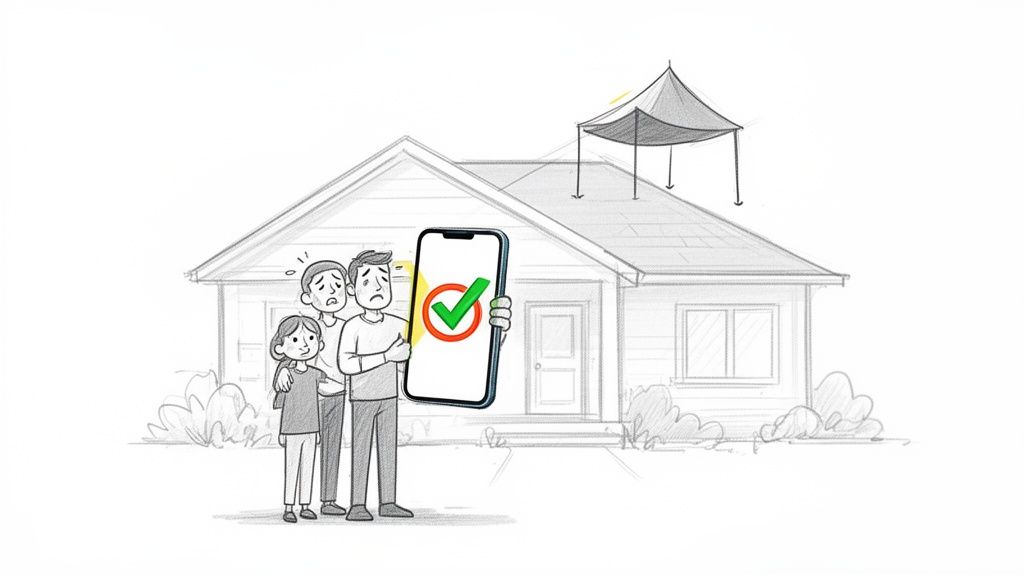
While a virtual site inspection offers clear operational wins, its biggest impact might just be on the person at the center of it all: the policyholder. After a loss, homeowners are often left feeling vulnerable and uncertain. The traditional claims process—with its scheduling delays and long waiting periods—only adds to that stress.
Technology flips that script entirely. A virtual inspection empowers the policyholder, giving them a sense of control and a way to take immediate, meaningful action. Instead of waiting days for an adjuster to arrive, they can get their claim moving within minutes of placing that first call.
Putting the Policyholder First
This isn't just about convenience; it’s about providing real reassurance during a crisis. Homeowners feel heard and involved, which is a powerful way to build trust and satisfaction. The process is simple and direct, cutting through the friction that often defines the first few days of a claim.
The feedback from users says it all. In a survey of over 1,400 people who completed a virtual inspection, an incredible 97% were satisfied with the experience. On top of that, 98% said the inspector communicated clearly and the process was easy to follow. When asked what they liked most, "ease of use" was a top answer, proving this technology genuinely simplifies a tough situation. You can see the full breakdown in this in-depth user satisfaction report.
A positive, efficient, and tech-forward claims experience is a critical differentiator. It shows policyholders you respect their time and are committed to helping them recover quickly.
This positive start is essential for anyone needing professional insurance claims assistance, as it sets a collaborative and supportive tone from the get-go.
A Real-World Example of Speed and Care
Picture this: a family wakes up after a nasty thunderstorm to find a huge tree branch has punched a hole through their roof. Water is dripping into the living room, and panic is setting in. They call their insurance company, bracing for a long, drawn-out process.
Instead, the claims handler offers an immediate virtual site inspection.
- Within 15 minutes: The homeowner is on a guided video call, showing the adjuster the hole in the roof and the water damage inside.
- Within 30 minutes: The adjuster has all the photos and videos they need, confirming the urgent need for mitigation services.
- Within an hour: An emergency tarping service is approved and on its way to the property. The leak is stopped before it can cause thousands more in secondary damage.
This isn’t some futuristic fantasy; it's happening right now. For that family, the experience wasn't just fast—it was a lifeline. The virtual inspection turned a moment of crisis into a moment of action and relief. It's a perfect example of how the right technology, when used thoughtfully, delivers not just efficiency but genuine peace of mind.
Of course. Here is the rewritten section, adopting the voice, style, and formatting of the provided examples.
Knowing When to Call in an Expert Partner
A virtual site inspection brings incredible speed to the claims process, but let's be honest—it’s not a magic bullet for every single claim. The key to using this technology effectively is knowing its limits. Recognizing where a virtual-only approach falls short is the first step to building a claim strategy that’s both fast and accurate.
Sometimes the problems are purely technical. A spotty internet connection at a rural property can turn a clear video call into a frustrating, pixelated mess. Poor lighting in a dark attic or basement will hide critical details. In other cases, a policyholder simply might not be able to safely get to a damaged area.
When a Virtual Look Is Not Enough
Beyond the technical glitches, there are certain things a camera just can’t do. The biggest limitation of any virtual inspection is the total lack of tactile feedback. You can see a roof, but you can’t feel for the subtle sponginess of water-logged decking underneath the shingles. You can see a foundation crack, but you can’t use specialized tools to measure its depth or know if it’s actively getting worse.
These limitations create a clear line in the sand for when a remote-only process isn't enough. Here are the most common times a virtual assessment alone just won't cut it:
- Suspected Structural Damage: If that video call shows sagging rooflines, major cracks in load-bearing walls, or compromised support beams, a hands-on structural evaluation is non-negotiable.
- Steep or Complex Roofs: Safety always comes first. Asking a homeowner to climb a steep, multi-story roof is never an option. These high-risk inspections demand trained professionals with the right safety gear.
- Widespread or Hidden Damage: For complex claims involving fire, widespread water intrusion, or potential mold, a virtual look can only scratch the surface. An expert needs to be on-site to trace the full path of the damage.
- Need for Specialized Tools: When the job calls for moisture meters, thermal imaging cameras, or other diagnostic equipment, a remote view simply isn't going to get you the data you need.
The Hybrid Model: The Critical Role of an Expert Partner
This is where the true power of a hybrid model comes in, blending the speed of technology with the irreplaceable value of hands-on expertise. Think of the virtual site inspection as your first line of defense—a rapid triage tool that separates simple claims from complex ones.
Technology gets you the fast, initial overview. An expert partner gets you the definitive, on-the-ground answer when the stakes are high.
When a virtual inspection flags a serious issue, it becomes the trigger to dispatch a specialized team. For example, your remote assessment might show several missing shingles on a steep two-story roof. The homeowner did a great job showing you the obvious damage, but you have a gut feeling there's more going on.
This is the perfect moment to call in a partner like Fox Claims. We take the intel from your virtual report and deploy a certified team to perform a targeted, hands-on assessment. Our inspectors show up with the safety equipment and training to get on that steep roof, find any hidden collateral damage, and deliver the comprehensive documentation you need to settle the claim right.
This hybrid workflow means you never have to choose between speed and accuracy. You use technology for what it's good for—speed—and human experts for what they're essential for—certainty.
Frequently Asked Questions About Virtual Inspections
Even with all the buzz, it's natural to have questions about switching to a virtual site inspection. Let's tackle some of the most common ones we hear from adjusters and property owners to clear things up and help you get comfortable with the process.
Is a Virtual Inspection as Thorough as an In-Person One?
This is the big one. And the honest answer is: it depends entirely on the claim.
For clear-cut, visible damage—think straightforward wind damage to siding or a fence knocked over in a storm—a virtual inspection is often more than enough. The guided video and high-resolution photos create a fantastic, detailed record of the loss.
But when you need to feel for soft spots on a roof deck, check a foundation for subtle cracks, or diagnose a tricky interior leak, nothing beats having an expert on-site. The key is knowing when to use each tool. Virtual inspections are perfect for that first look and for simpler claims. For everything else, you send in a pro.
What Technology Do I Need?
This is the best part: the tech is incredibly simple for the property owner. All they need is a smartphone or tablet with a decent camera and a stable internet connection—either Wi-Fi or their cellular data.
There are no special apps to download or complicated setups. The adjuster just sends a secure link, and the entire inspection happens right in the phone's web browser.
The whole point of these platforms is to make it easy. The tech is designed to be so intuitive that anyone can pick it up and follow along without a headache. It's really as simple as tapping a link.
What if I Have a Bad Internet Connection?
A spotty internet connection is a real concern, especially in rural areas or places hit hard by a storm where cell towers might be down. If the connection is too weak to get a clear video feed, the inspection just won't work.
In that situation, we have a couple of options. Some platforms have an offline mode that lets the policyholder take photos and videos from a checklist, then upload them once they have a better connection. If that’s not possible, the adjuster simply pivots and schedules an in-person visit. The virtual attempt wasn't a waste—it was a valuable first step that helped clarify the next move.
When a claim gets too complex or a virtual look just isn’t enough, you need a partner who can get you definitive, on-the-ground answers. Fox Claims Consultants specializes in delivering the hands-on expertise needed for steep roofs, structural assessments, and widespread storm damage. When you need certainty, we get boots on the ground fast. Learn more at https://foxclaimsconsultants.com.
Leave a Reply