
Let's be honest: some roofs just weren't made to be walked on. When an adjuster pulls up to a property with a roof pitch that looks more like a cliff face, their job comes to a screeching halt. Climbing it would be reckless, but ignoring it means an incomplete—and inaccurate—claim. This is exactly where steep roof assist comes in.
What Is Steep Roof Assist and Why It Matters
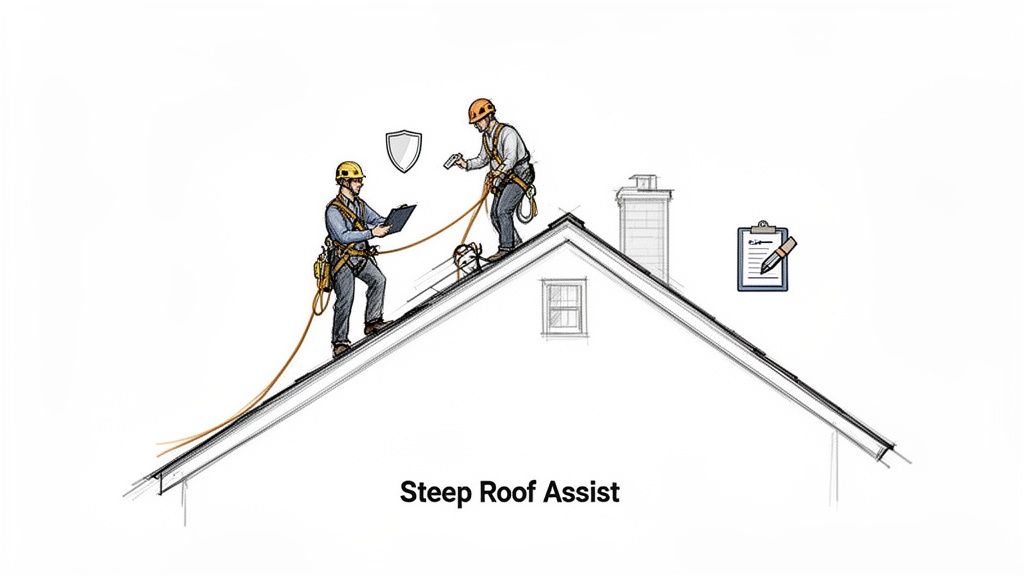
Think of it as calling in the special forces of roof inspection. When a roof is too steep, too high, or just plain too dangerous, a steep roof assist service deploys a certified team with specialized rope and harness systems. Their entire job is to get to places a typical adjuster can't.
These pros aren't just climbers; they're trained inspectors. They safely navigate extreme inclines, meticulously document every inch of the roof, and hand over a complete set of photos and data. The adjuster gets everything they need to do their job, all without ever leaving the safety of the ground.
Solving Problems for Every Stakeholder
A steep roof assist isn't just a safety precaution—it's a problem-solver for everyone involved in the claim. It eliminates major headaches for carriers, adjusters, and homeowners alike.
To understand its value, let's look at the challenges each stakeholder faces and how this service provides a direct solution.
Steep Roof Assist at a Glance
| Stakeholder | Challenge Without Assist | Benefit with Steep Roof Assist |
|---|---|---|
| Insurance Carriers | Major liability risk if an adjuster is injured on a policyholder's property. | Transfers high-risk work to insured specialists, mitigating liability and ensuring data accuracy. |
| Claims Adjusters | Inability to safely inspect roofs with a pitch of 8/12 or steeper, risking personal injury. | Allows them to get comprehensive photos and measurements without leaving the ground. |
| Homeowners | Risk of an incomplete or unfair assessment if the adjuster can't access the entire roof. | Guarantees a full, hands-on inspection, leading to a more accurate and equitable claim outcome. |
This service is the critical link that keeps the claims process moving forward safely and accurately.
A steep roof assist bridges the gap between safety and accuracy. It allows for a complete, hands-on inspection on roofs that would otherwise be deemed "un-walkable," ensuring no detail is missed and no one is put in harm's way.
This kind of support is non-negotiable in modern property claims. While some might suggest a drone, a camera in the sky can't tell you if a shingle is brittle or confirm the depth of a hail impact. That requires a hands-on touch.
The professionals performing these assists are often Haag Certified, bringing an expert eye to the inspection. It's about getting the job done right, the first time. You can see how this expertise is a game-changer by exploring what top-tier inspectors-on-demand bring to the field. Ultimately, it ensures the claim moves forward efficiently, fairly, and without putting anyone at risk.
The True Risks of Inspecting a Steep Roof
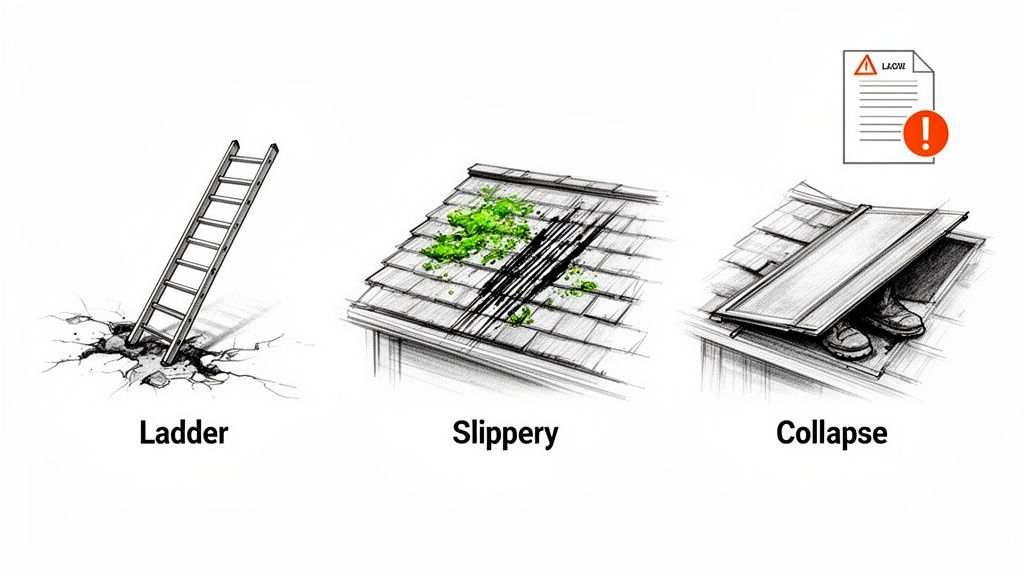
Everyone knows steep roofs are dangerous. The risk of falling is the first thing that comes to mind. But that’s just the obvious part. The real hazards are often the ones you don't see coming.
When you send an adjuster onto a roof with an 8/12 pitch or greater, you’re asking them to do more than just assess damage. You’re asking them to be a high-wire walker, often without the right training or safety gear. It’s a high-stakes gamble where a sudden gust of wind, a patch of morning dew, or a single loose shingle can lead to a catastrophe.
Hidden Dangers That Amplify Risk
It’s not just the incline. A steep roof is a minefield of variables that can turn a routine job into a life-or-death situation. We’ve seen firsthand how quickly things can go wrong, which is why specialized steep roof assist teams are not a luxury—they’re a necessity.
These are the hidden threats we see all the time:
- Surface Instability: Algae, moss, or even a thin layer of wet leaves can make a shingled roof feel like an ice rink. An adjuster can lose their footing before they even realize the hazard is there.
- Structural Weakness: After a major storm or fire, the roof decking underneath the shingles can be compromised. What looks solid might be a weak spot ready to give way under an adjuster's weight.
- Ladder Instability: A ladder that feels solid on a concrete driveway is a different story on soft ground or a sloped flower bed. The base can shift without warning as the adjuster climbs.
These aren't just hypotheticals. Roofing consistently ranks as one of America's deadliest jobs, with falls being a major reason why. The fatal injury rate can be as high as 57.5 per 100,000 workers. With storm claims topping $31 billion in a single year, the sheer volume of high-risk inspections is staggering. One misstep is all it takes.
The Liability Iceberg for Insurance Carriers
When an adjuster gets on a steep roof without the proper fall protection, the carrier is sitting on a powder keg of liability. A fall isn’t just a workers' comp claim. It’s the start of a legal and financial nightmare.
For an insurance carrier, an adjuster injury on a policyholder's property is a ticking time bomb of liability. It exposes the company to potential lawsuits, regulatory fines, and severe reputational damage.
Think of it like an iceberg. The immediate medical bills and lost work are just what you see on the surface. Lurking below is a much bigger and more dangerous mass of consequences.
- OSHA Violations: The Occupational Safety and Health Administration doesn't mess around with fall protection. An accident will trigger an investigation, and that often leads to hefty fines and mandated overhauls of your safety protocols.
- Third-Party Lawsuits: The homeowner can easily be pulled into a lawsuit, torching the policyholder relationship and creating a mess for everyone involved.
- Reputational Harm: Accidents become public record. The negative press can destroy the trust you’ve built with policyholders and agents, hurting your business long after the claim is closed.
Using a professional steep roof assist provider is one of the smartest risk management decisions a carrier can make. It transfers the physical risk—and the massive liability that comes with it—to a specialized, fully insured partner. You can learn more about how our expert teams provide support in our guide to professional ladder assist services. It’s a proactive move that keeps your people safe, ensures compliance, and protects your company from the devastating fallout of a preventable accident.
Why Specialized Roof Assessments Are No Longer Optional
The days of treating steep roof inspections as a niche service are over. For insurance carriers, having a plan for steep, complex roofs isn't just a preference anymore—it’s a core part of running an efficient claims operation. This isn't a random shift. It’s a direct response to how we build our homes, the age of those homes, and the simple fact that our weather is getting more intense.
For decades, American homebuilders have leaned into steeper rooflines. From classic A-frames to modern Tudors, these designs look great and shed water effectively. But the same pitch that adds curb appeal also creates a huge challenge for anyone trying to inspect them. They're built to be durable, but that durability makes them dangerous to get on without the right gear and training.
This is exactly why a professional steep roof assist has become so critical for getting a claim right the first time.
The Perfect Storm of Market Drivers
Three major trends are colliding, making safe and accurate roof assessments an absolute necessity in the modern claims world. Each one on its own is a challenge; together, they create a perfect storm that pushes carriers to find expert partners they can trust.
- Dominance of Steep-Slope Roofing: The simple truth is most residential homes are built with steep-slope designs.
- An Aging Housing Stock: Older homes are just more susceptible to damage. Their roofs need a careful, hands-on look, not a quick glance from the ground.
- Increasingly Severe Weather: Climate shifts are bringing more frequent and powerful storms, which means a higher volume of complex roof claims hitting your desk all at once.
These factors have created a new reality where skipping a tough roof inspection is no longer a viable option for any claims team that cares about accuracy.
The reality is that the average roof is getting older and the average storm is getting stronger. This combination means that the days of "eyeballing" damage from the ground or skipping a difficult roof are over.
This new reality demands a new approach. Steep-slope roofing is the American standard, and a recent industry report proves it. Three-fourths of roofing contractors work primarily with steep-slope asphalt shingles, and with 70% of residential contractors expecting sales to grow, the demand isn't slowing down. You can dig into the full 2026 State of the Roofing Industry Report to see just how much these trends are shaping the market.
From Optional to Operational Requirement
Think of a carrier's claims department as an air traffic control tower. In the past, a steep roof claim was like a rare, tricky flight that needed special handling. Today, a major hailstorm or hurricane is like a whole fleet of those tricky flights showing up at the same time, all demanding to land at once.
Trying to handle that surge with your existing team—field or desk adjusters who aren't trained or equipped for high-angle rope and harness work—creates an instant bottleneck. Claims stall, reports come back incomplete, and the safety risk for everyone involved goes through the roof.
This is why steep roof assist has gone from a "nice-to-have" specialty service to a fundamental operational tool. It’s like having a dedicated runway and ground crew ready to handle those high-priority flights. It allows the rest of your operation to keep running smoothly, ensuring every claim gets the attention and safety it deserves.
By bringing in a dedicated steep roof partner, carriers can:
- Scale Resources Instantly: Quickly get expert teams on the ground in storm-hit areas without the headache of hiring and training in-house rope-and-harness specialists.
- Maintain Consistency: Make sure every steep roof gets a thorough, hands-on inspection, no matter how complex or where it's located.
- Improve Cycle Times: Stop letting inaccessible roofs create delays. Move claims from first notice of loss to final settlement faster.
At the end of the day, using specialized assessment teams is a smart, strategic response to a changing world. For carriers focused on efficiency, accuracy, and safety, they are no longer optional. Our complete guide on insurance roof inspection services digs deeper into why this hands-on approach is now the industry standard.
The Steep Roof Assist Process from Start to Finish
So, what actually happens when you request a steep roof assist? It’s not some complicated, drawn-out affair. It’s a clean, systematic service we’ve refined for maximum efficiency and clarity, designed to get you the data you need without the risk.
Knowing the workflow helps both adjusters and homeowners understand exactly what to expect. Think of it as a well-rehearsed, five-step playbook. Each step builds on the last, giving the desk adjuster a complete package to confidently and accurately scope the loss.
Step 1: Initial Request and Information Gathering
It all starts the moment an adjuster flags a roof as too steep, high, or otherwise unsafe for a standard inspection. The adjuster simply reaches out to us with the essential details: the property address, the policyholder's contact information, and any known specifics about the damage or roof complexity.
This first exchange is critical—it’s like giving a pilot a flight plan. The more information provided upfront, the better. Details like the approximate roof pitch, building height, and type of suspected damage (hail, wind, etc.) allow our team to arrive fully prepared with the right equipment and a clear game plan.
Step 2: Scheduling and Policyholder Communication
With the request in hand, our coordinator reaches out directly to the policyholder to schedule a convenient time for the inspection. This is a crucial touchpoint, as our professionalism reflects directly back on the insurance carrier we’re serving.
Clear, professional communication is everything here. Our scheduler confirms the appointment and briefly explains what the homeowner can expect: a certified team will be arriving to safely inspect their roof using specialized rope and harness equipment. This proactive communication puts the homeowner at ease, sets clear expectations, and builds trust right from the start.
Step 3: On-Site Safety Setup and Inspection
On the day of the appointment, our certified inspection team arrives. Their first priority is always safety. Before a single shingle is touched, the team conducts a full site assessment and sets up their fall protection systems. This means securely anchoring their ropes and double-checking every piece of harness and safety gear. Only then does the work begin.
With all safety measures in place, the hands-on inspection starts. One or more technicians will get on the roof to perform a thorough evaluation. They don't just hunt for the obvious damage; they meticulously document every single slope, facet, and component of the roofing system. It's this comprehensive approach that separates a true steep roof assist from a simple drone flyover.
This level of specialized service is becoming more critical every day, driven by powerful market forces.
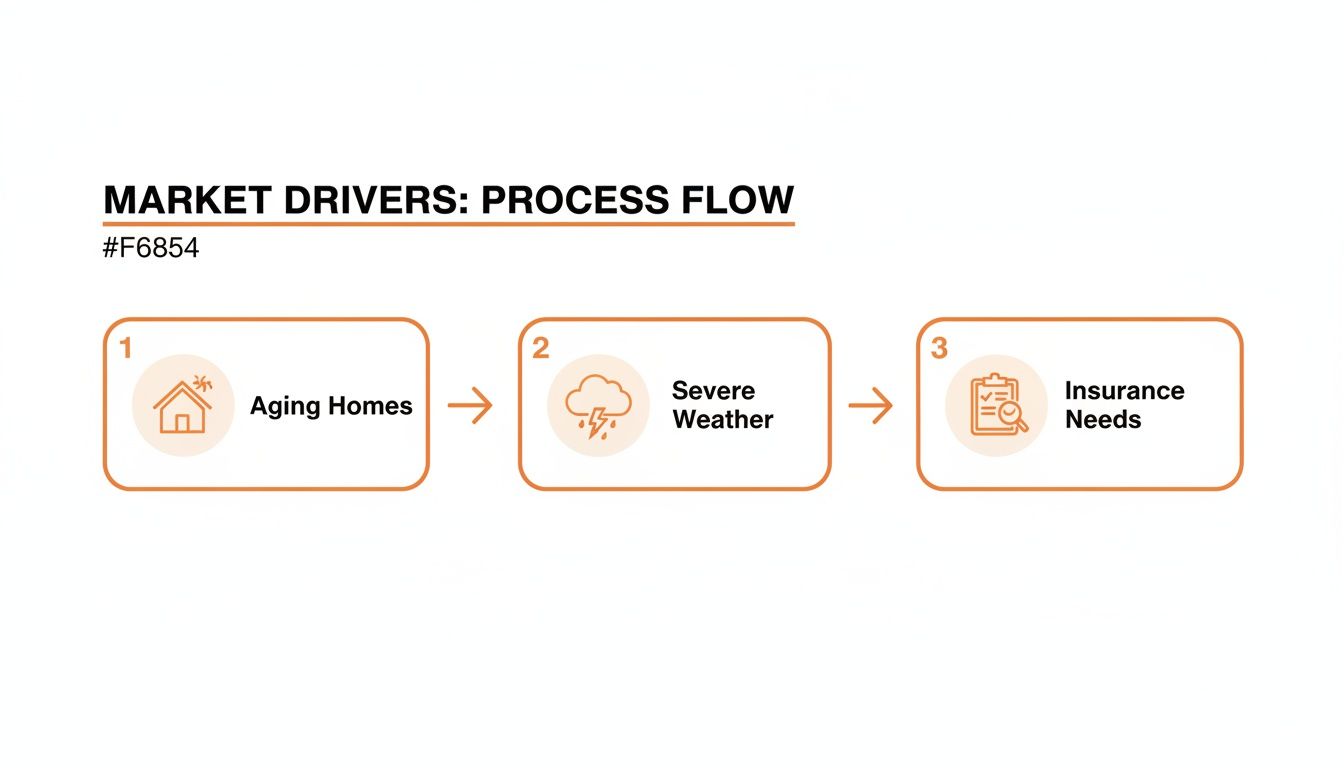
As homes get older and weather events become more severe, the demand for experts who can safely handle complex roof claims continues to rise.
Step 4: Comprehensive Photo Documentation
As our team inspects the roof, they’re capturing a structured, high-resolution photographic record of its condition. We don't just take a few random pictures; we build a complete visual file that tells the full story.
A photo without context is just a picture. A properly documented photo in a steep roof assist report is evidence. It tells a story of location, scale, and severity that is indisputable.
This meticulous documentation ensures the desk adjuster has irrefutable visual evidence to support their estimate. For every steep roof claim, certain photos are non-negotiable for building a clear and defensible report.
Essential Photo Documentation Standards for Steep Roof Claims
This table outlines the critical photo types required for a comprehensive and indisputable steep roof damage claim.
| Photo Category | Purpose and Description | Why It's Critical |
|---|---|---|
| Overview Photos | Images of each individual slope taken from a distance to establish a baseline view of the entire roof. | Provides context for the entire roofing system and shows the general layout and condition before zeroing in on damage. |
| Damage Photos | Close-ups of specific damage points (hail hits, lifted shingles, creases) with a measuring tool for scale. | Offers clear, measurable proof of the type and severity of damage, removing ambiguity from the assessment. |
| Collateral Photos | Images of damage to non-roof items like gutters, siding, window screens, and AC units. | Helps confirm the presence and timeline of a damaging event (like hail) by showing its impact on the entire property. |
| Context Photos | Shots showing the position of damage relative to fixed landmarks on the roof, like vents, pipes, or chimneys. | Pinpoints the exact location of the damage on the roof, making it easy for the adjuster to visualize and scope repairs. |
By adhering to these standards, we create a report that leaves no room for questions. Of course, if the inspection reveals immediate threats like broken skylights or gaping holes, our team is trained to respond. You can learn more about how we handle these situations in our guide to emergency roof tarping services.
Step 5: Final Report Delivery
The final step is getting the complete findings back to you. Within a tight 24-48 hour timeframe, the adjuster receives a full data package. This report contains all the organized photos, detailed annotations, and a clear summary of our findings.
It provides a virtual "boots-on-the-roof" perspective, giving the adjuster everything they need to scope the loss accurately and efficiently—all from the safety of their desk.
How Fox Claims Consultants Elevates Steep Roof Services
Knowing you need a steep roof assist is one thing. Finding a partner who actually delivers with speed, professionalism, and rock-solid reliability is another thing entirely.
In the high-stakes world of property claims, the gap between an average service and an exceptional one is huge. It shows up in cycle times, report accuracy, and ultimately, policyholder satisfaction.
At Fox Claims Consultants, we've poured more than 80 years of combined experience into our service, pairing an old-school work ethic with modern efficiency. We get it. When an adjuster calls us, they aren't just ordering an inspection; they're trusting us with their reputation and the safety of everyone involved.
Our job isn’t just to get on the roof. It’s to deliver a complete solution that makes the claims professional’s life easier, from the moment we’re dispatched until the final report lands on their desk.
Rapid Nationwide Deployment When It Matters Most
The hours after a major storm are pure chaos. A single hailstorm can flood a small area with thousands of claims, creating an instant, overwhelming demand for inspectors who can handle tricky structures. This is where we shine.
We are built for rapid response. Our nationwide network of certified inspectors lets us get boots on the ground faster than most. When a catastrophe hits, we don't see a logistical nightmare—we see an opportunity to help our clients bring order to the chaos.
Take a recent hurricane on the Gulf Coast. A national carrier was buried in claims on two- and three-story homes with steep, complex roofs. Their own teams were stretched thin and weren't equipped for the high-angle work. We deployed 15 certified rope-and-harness teams to the region within 48 hours, getting to work immediately to document damage and secure the properties.
After a storm, speed is safety. Getting a steep roof assist team on-site quickly isn't just about closing claims faster. It’s about getting emergency tarps down and providing the hard data needed to make good decisions before more damage occurs.
Our ability to scale up fast means carriers can handle the surge without cutting corners on quality or safety. We become a predictable, reliable extension of your own team exactly when you need it most.
A Commitment to Certification and Safety
Our teams aren't just physically capable; they are credentialed experts. A large number of our field inspectors hold elite certifications, including Haag Certified Inspector credentials. This means they assess damage with a forensic level of detail, identifying the cause and extent of loss with an authority that holds up under scrutiny.
This expertise is more important than ever. The roofing industry is on a massive growth path, projected to jump from $31.4 billion in 2026 to over $42 billion by 2030, mostly from renovations and storm repairs on steep-slope buildings. As volatile weather drives more inspections, our expert response is key to stabilizing properties and getting the documentation right.
And above all, our focus on safety protocols protects everyone: our team, the homeowner, and you. Every job starts with a thorough safety plan and the right fall protection to ensure we are fully OSHA-compliant.
End-to-End Solutions and Superior Communication
A Fox Claims steep roof assist is more than just a few pictures. We deliver actionable intelligence.
Our service is a complete package:
- Emergency Services: We stabilize the property right away with roof tarping and temporary repairs to stop further damage in its tracks.
- Detailed Inspections: Our certified teams perform meticulous hands-on assessments, leaving no shingle unturned.
- Precise Documentation: We create a complete visual record—overview shots, detailed damage photos with scale, and all the collateral evidence you need. For a look at what separates a good report from a great one, see our guide on the ideal property inspection report template.
- Xactimate-Compatible Reporting: We deliver clear, timely reports that plug directly into your workflow, giving you everything needed to scope the loss accurately.
Throughout it all, we make communication a priority. The adjuster always knows the inspection status, what we found, and when to expect the final report. This transparency kills the guesswork and empowers claims pros to move their files forward, which cuts down cycle times and builds trust with policyholders.
Your Steep Roof Assist Questions, Answered
When you're dealing with a steep or complex roof, questions are a good thing. For adjusters, carriers, and homeowners, knowing exactly how a service like steep roof assist works is the first step toward a safe and accurate claim resolution.
We get these questions all the time. Here are the direct, no-nonsense answers you need to feel confident about the process, from cost and timing to the qualifications that really matter.
How Much Does Steep Roof Assist Cost?
This is usually the first question we hear, and the answer is refreshingly simple. For most property claims, the cost of a steep roof assist is not a separate, out-of-pocket expense for anyone.
It’s almost always covered as part of the claim's Loss Adjustment Expense (LAE). Think of the LAE as the carrier's operational fund for investigating and settling a claim. It covers the necessary costs of getting the job done right, from the adjuster's time to expert consultations.
Because a steep roof assist is essential for safely getting the hands-on evidence needed to write an accurate estimate, it fits squarely into the LAE category. It’s a cost of doing business correctly, making it an incredibly effective way to guarantee three things:
- Adjuster Safety: It keeps your team off dangerous roofs, preventing costly and tragic accidents.
- Data Accuracy: It delivers the irrefutable evidence you can only get from a hands-on inspection, avoiding guesswork from a drone or the ground.
- Liability Mitigation: It transfers the high-risk work to a fully insured, specialized team.
By treating this as an LAE, carriers acknowledge it for what it is: a core tool for managing risk and ensuring claim accuracy.
How Fast Can a Team Be On-Site?
In claims, especially after a storm, speed is everything. A single day’s delay can let a small leak turn into major interior damage. That’s why rapid deployment is the cornerstone of our steep roof assist service.
We've built our entire operation around logistics and speed. For most standard requests in our service areas, we can have a certified team on-site within 24 to 48 hours.
This response time is even more critical in catastrophe (CAT) situations. When a hurricane or major hailstorm hits, we deploy multiple teams into the affected zone with the same urgency. Our national network means we get boots on the ground fast, helping carriers manage the surge of high-risk claims without falling behind.
In the aftermath of a storm, a rapid response is not just about customer service—it’s about loss control. Getting an expert team on-site quickly to assess damage and apply emergency measures like tarping can prevent thousands of dollars in additional interior damage.
Our commitment to speed keeps the claims process moving, which means a better, less stressful experience for the policyholder.
What Qualifications Should a Provider Have?
Not all assist services are the same. Trusting a high-risk inspection to an underqualified or uninsured team is a recipe for disaster. When vetting a partner, there are a few non-negotiable qualifications you need to look for.
It's like hiring any critical expert—you'd demand credentials and a proven track record. The same logic applies here.
Your checklist for any steep roof provider should include:
- Haag Certified Inspectors: This is the gold standard for damage assessment. A Haag Certified inspector's findings are based on forensic engineering principles and carry significant weight in the industry.
- Comprehensive Insurance: The provider absolutely must have strong General Liability and, most importantly, Workers' Compensation policies. This is what protects your company and the homeowner if an accident happens.
- Proven Safety Protocols: Ask to see their safety program. They need a defined process for everything from site assessments to equipment checks and fall protection that meets OSHA standards.
- A Strong Track Record: Look for a company with a history of working directly with insurance carriers. Their portfolio should show they can handle the pressure and precision required in storm response.
Choosing a provider who checks all these boxes means you’re getting a true professional who makes your job easier, not harder.
Can This Service Be Used for Non-Storm Damage?
Absolutely. While steep roof assist is a game-changer after a storm, its real purpose is to solve a physical access problem. The cause of the damage doesn't matter—if the roof is too steep, high, or complex to walk safely, an assist is the right call.
We see plenty of scenarios that have nothing to do with hail or wind.
Consider these common uses:
- Underwriting Assessments: An underwriter may need a hands-on inspection to document the condition of a steep roof and identify hazards before binding a new policy.
- Tree Damage Claims: After a large limb falls, an assist team can safely work around the debris to document the full scope of the structural impact.
- General Wear and Tear Evaluations: On older roofs, an expert is often needed to get up close to differentiate between long-term deterioration and damage from a specific, covered event.
- Real Estate Transactions: A home inspector might call for an assist to complete a thorough evaluation on a multi-story home before a sale can be finalized.
The rule is simple: if an adjuster, inspector, or contractor can't walk a roof safely, a steep roof assist is the responsible solution.
When safety and accuracy are on the line, you need a partner you can trust. Fox Claims Consultants LLC provides rapid, reliable, and professional steep roof assist services nationwide. Our certified teams are ready to help you handle your most challenging claims with confidence. Learn more about our solutions today.
Leave a Reply