
When it comes to insurance claims, a professional roof inspection is the single most important piece of the puzzle. It’s what separates new storm damage from old wear and tear, providing the hard evidence needed for a fair, fast, and accurate claim. For homeowners, carriers, and adjusters alike, it’s the key to bringing clarity to an increasingly chaotic process.
Why Roof Inspections Are More Critical Than Ever
The entire roofing insurance world is under pressure. It's not just your imagination—severe weather is hitting harder and more often, and it’s completely changing how roof claims get handled.
This isn’t a minor shift. We’re seeing a massive spike in both the number of claims and their cost. The latest data from Verisk shows that residential roof claims in the U.S. rocketed to $31 billion in 2026, a jump of nearly 30% since 2024. The main drivers? Wind and hail, which now make up over half of all residential property claims. You can explore more data on this trend and see the direct impact on the industry.
The data paints a clear picture of why the old way of handling roof claims just doesn't work anymore.
Key Statistics Driving Modern Roof Claims
| Statistic | Figure | Implication for Claims |
|---|---|---|
| Annual U.S. Roof Claim Costs | $31 Billion (2026) | Increased financial pressure on carriers demands greater accuracy to control loss adjustment expenses. |
| Growth Since 2024 | ~30% | Rapidly rising claim volume creates backlogs and extends cycle times without efficient inspection processes. |
| Wind & Hail Share of Claims | >50% | These perils often cause ambiguous damage, making expert differentiation between old and new issues essential. |
These numbers highlight a simple truth: accuracy is no longer optional. It's the only way to manage costs and keep the claims process moving.
The Impact on Carriers and Homeowners
For insurance carriers, this surge means longer cycle times and a much greater need to verify every single claim. The line between what a storm actually did versus pre-existing conditions has become the biggest source of conflict, leading to endless disputes and delays. Desk adjusters are stuck trying to make million-dollar decisions without clear, undeniable facts from the field.
Homeowners are feeling it, too. Premiums are on the rise, and the claims process feels more confusing than ever. After a storm rips through their neighborhood, the last thing a policyholder wants is a drawn-out fight over what’s covered. An incomplete or vague assessment can mean partial repairs, huge out-of-pocket costs, or even a flat-out denial.
An expert third-party assessment acts as a neutral arbiter, providing the accurate documentation needed to move claims forward. It bridges the gap between the homeowner's reality and the carrier's requirements.
The Solution Is in the Details
This is exactly why a professional roof inspection for insurance claims is no longer just a "nice-to-have." It’s the foundation of a fair outcome. A detailed, expert report cuts through the noise and delivers what everyone needs:
- Objective Evidence: Crystal-clear, high-resolution photos and meticulous notes that show the difference between new storm damage and old issues like blistering, granule loss, or weathering.
- An Accurate Scope: Precise measurements and damage identification that let an adjuster write an accurate scope of work right away, dramatically cutting down on supplements and revisions.
- Faster Decisions: When you give a desk adjuster all the information they need upfront, they can approve claims with confidence and speed.
In today's high-stakes environment, a quick look from the ground or a rushed, incomplete inspection is a recipe for disaster. Investing in a thorough, professional inspection is the only way to ensure everyone has the facts needed to settle the claim fairly and get life back to normal.
Laying the Groundwork for a Smooth Inspection
A roof inspection doesn't start when the ladder hits the siding. It starts long before that. What happens before an inspector ever sets foot on the property is just as critical as the on-roof assessment itself.
We’ve seen it time and again: solid prep work is the difference between a fast, undisputed claim and one that gets bogged down in delays and questions.
For homeowners, this is your chance to build a clear, undeniable story of the loss. Right after a storm passes, get outside and take pictures of any damage you can see from the ground. Look for fallen tree limbs, dented gutters, or shingles scattered across your yard. This creates a powerful timeline that points directly to the storm as the cause of loss.
Next, you'll want to pull together a few key documents. This isn’t just about finding your policy—it’s about creating a complete file on your roof's history.
Your Pre-Inspection Document Checklist
- Your Current Insurance Policy: Keep the declarations page handy. It has your policy number, confirms your coverage, and lists your deductible.
- Past Roofing Invoices: Any records from previous repairs or a full replacement are gold. They establish a timeline and document the roof's prior condition.
- Home Inspection Reports: If you bought your house in the last few years, this report is excellent proof of the roof’s condition before the storm.
- Your Own Photos: Those pictures you took right after the event? They are invaluable. If your phone adds a date stamp, even better.
Giving this information to your inspection partner provides crucial context. They can hit the ground running, focused on verifying the new storm damage instead of trying to piece together the past. A few minutes of prep here can save you weeks of headaches later.
Setting the Stage for Adjusters and Carriers
For insurance adjusters and carriers, preparation is all about efficiency. Your job is to arm the inspector with clear, direct information to eliminate any and all guesswork. A well-informed inspector is a fast and effective one.
Before dispatching an inspector, put together a complete information packet. It must include the claim number, the policyholder’s full contact info, and specifics about the loss—like "hail damage from the May 15th storm." If the homeowner mentioned a leak over the master bedroom, pass that detail on. The more information they have upfront, the more targeted the roof inspection for insurance claims will be.
Think of this as a pre-flight checklist. When homeowners and adjusters provide all the necessary information from the start, the inspector can function as a precise fact-finder, not a detective trying to solve a mystery.
Ultimately, this groundwork aligns expectations for everyone. The inspector arrives on-site with a clear mission and the background needed to do their job right. Just as a builder wouldn't pour a foundation without surveying the land first, a roof inspection shouldn’t begin without this essential prep work.
It transforms the entire process from a potential point of friction into a streamlined solution. To get even more granular, you can learn about the specific materials involved in roof repairs, like the different types of 1 1/4" Galvanized Straight Finish 5,000 Nails Per Box, to better understand what an inspector’s report might detail.
On-Site Damage Identification and Documentation
Once you’re safely on the roof, the real work begins. This is where a seasoned inspector’s eye for detail makes all the difference in a roof inspection for insurance claims. It’s not about just spotting a few missing shingles; it’s a forensic investigation, and every shingle, vent, and flashing tells part of the story.
A great inspector isn't just looking for the obvious. They’re trained to find the subtle clues of storm impact that often get missed—the kind of damage that leads to bigger headaches down the road. The process has to be methodical, starting with a full-system overview and then zeroing in on every slope, ridge, and valley. This is how you build a report that gives an adjuster the confidence to approve a claim.
Before the inspector even arrives, a few simple steps can set the entire process up for success.
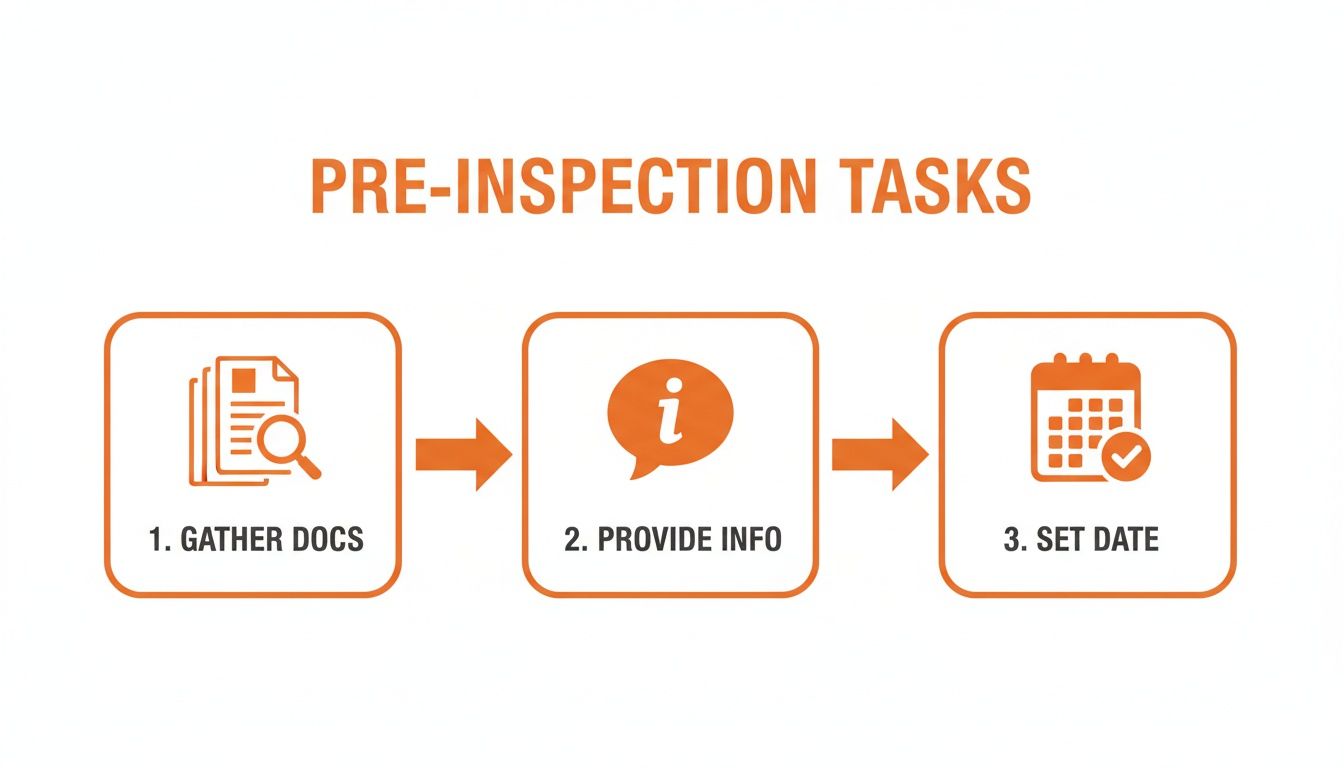
Getting these pre-inspection tasks handled—gathering paperwork, sharing key details, and setting a date—builds a clear foundation. It lets the inspector focus entirely on the roof itself, making the on-site work as efficient as possible.
Finding the Telltale Signs of Storm Damage
Different storms leave different fingerprints. An expert inspector knows exactly what to look for because identifying storm damage is about understanding the mechanics of how it happened, not just that it did.
- Hail Damage: This is probably the most argued-over damage type. We look for impacts that have physically bruised the shingle’s core mat, knocking granules loose and leaving a soft spot. You can literally feel the difference between a true hail hit and a simple blister from a manufacturing defect. The pattern of impacts also tells a story.
- Wind Damage: Wind does more than just rip shingles off. Its most common effect is lifting the shingles and breaking the sealant strip underneath. An inspector has to physically lift tabs to check for this broken seal, which is a dead giveaway for wind uplift. Those unsealed shingles will eventually crease, crack, and tear off.
- Tree and Debris Impact: A huge fallen limb is obvious. But the smaller branches and flying debris cause scrapes, gouges, and cracks that look very different from normal weathering. We often find wood fibers or other material embedded right in the shingle, which is undeniable evidence.
The core of a credible inspection report is its ability to differentiate. It must clearly separate covered storm damage—like hail impacts and wind-lifted shingles—from non-covered issues such as manufacturing defects, installation errors, or simple old age.
Getting this right has never been more critical. The data shows roof-related line items accounted for more than 25% of all residential claim value in 2026. And with over 34% of property claims now driven by wind or hail, having an expert who can accurately diagnose a roof is non-negotiable.
The Art of Photographic Documentation
In a claim report, a good photo isn't just a picture; it's evidence. The standards for photo documentation are high for a reason. It’s not enough to snap a photo of damage; each image must tell a clear, logical story.
A rock-solid photo report always follows a simple pattern: overview, mid-range, and close-up.
- Overview photos capture each full slope of the roof. These shots establish the context—where we are on the roof and the overall condition.
- Mid-range photos zoom in to show a specific area, like a group of hail hits on one slope or a row of lifted shingles along a rake edge.
- Close-up photos are the undeniable proof. They show individual damage points with a reference for scale—a ruler, a hail gauge, or even a coin—to prove the size of an impact or the severity of a crease.
Lighting is everything. A pro knows how to use the sun—or a powerful flashlight—to make subtle damage pop. Hitting a shingle with a bright light from the side can reveal granule loss from a hail strike that’s completely invisible in the midday sun. It's why we recommend specific high-lumen LED flashlights that our field teams rely on to capture these crucial details.
Differentiating Storm Damage from Wear and Tear
This is where most roof claims get contentious. Is it storm damage, or was the roof just old? An adjuster needs proof they are paying for a covered peril, not for a roof that was already at the end of its service life. A skilled inspector provides that proof by documenting both the storm damage and any signs of age.
This table is a great quick-reference guide for telling the two apart.
| Damage Type | Signs of Storm Impact (Covered) | Signs of Age/Wear (Often Not Covered) |
|---|---|---|
| Granule Loss | Concentrated "bald spots" or patterns of loss that match hailstone impacts or heavy water runoff from a specific storm event. | Uniform, widespread granule loss across the entire roof, especially on sun-exposed slopes. The shingles look faded. |
| Cracking | Sharp, fresh-looking cracks in shingles, often with visible tears in the fiberglass mat. Usually located near other impact signs. | Dry, brittle, spider-web-like cracks (called crazing) that appear randomly across many shingles. |
| Blistering | This is not storm damage. Blisters are trapped moisture from the manufacturing process and are a maintenance or defect issue. | Small, bubble-like bumps on the shingle surface. Over time, they "pop" and leave a small pockmark, but they don't have an impact mark. |
| Lifted Shingles | The sealant strip is clearly broken, allowing the shingle to be lifted easily. Often found in a distinct pattern on wind-facing slopes. | Shingles are stiff and brittle. The seal might be weak from age but isn't cleanly broken. There’s no clear wind pattern. |
By documenting these differences with sharp photos and clear notes, the inspector removes all the guesswork. The report doesn't just say "hail damage." It shows the size and location of the impacts and explains precisely why it isn’t blistering or normal wear. That data-first approach is what builds an undeniable claim file.
Navigating High-Risk Roofs Safely
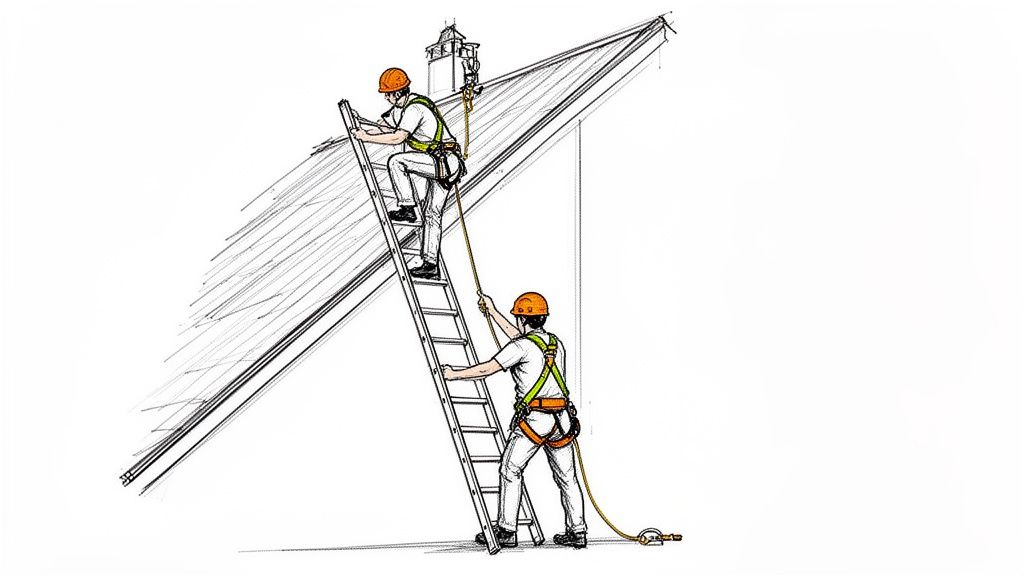
A low-slope, single-story home is one thing. A three-story house with a 12/12 pitch is a completely different ballgame. When a roof inspection for insurance claims takes you to a steep, tall, or complex roof, the game changes, and safety becomes the only thing that matters.
Trying to access these structures without the right training and gear isn't just a bad idea—it’s a massive liability. One slip can lead to serious injury, not to mention the risk of causing even more damage to the property. This is where you have to call in the experts.
For these properties, a standard approach just won't cut it. You need professionals who live and breathe high-risk access.
When to Call for a Ladder Assist
A "ladder assist" service is exactly what you’d think: a specialized team with the equipment and skill to safely get on and inspect difficult roofs. It’s the special forces of roof inspections. Most adjusters simply don’t carry the 40-foot ladders, ropes, and fall protection gear needed for every scenario.
The decision to bring in a ladder assist team isn't a gut feeling. It’s based on clear risk factors we see every day:
- Steep Pitch: Any roof with a pitch of 8/12 or greater is what we consider "non-walkable." It requires harnesses and ropes, period.
- Multiple Stories: Structures that are three stories or higher demand longer ladders and advanced stabilization. You can’t just lean a ladder and hope for the best.
- Complex Rooflines: Turrets, dormers, and sharp pitch changes create hazards that require skill and experience to navigate safely.
- Slippery Surfaces: Metal, tile, or slate roofs get incredibly slick, especially when wet. Walking them without the right gear is a recipe for disaster.
Ignoring these factors is a gamble you can't afford to take. A ladder assist ensures every inch of the roof gets a proper look without cutting corners or compromising safety. It’s how you build a complete, undeniable claim file.
Professional Safety Protocols in Action
Watching a professional team work a high-risk roof is like seeing a well-oiled machine. Every move is planned and backed by strict safety protocols. This isn’t about just tossing a rope over the ridge—it’s a systematic approach to neutralizing every potential hazard.
Safety isn't an afterthought; it's the foundation of a reliable high-risk roof inspection. Without it, you can't guarantee a thorough assessment, and you expose all parties to unnecessary risk. A professional team ensures the job is done right and everyone goes home safe.
The gear is highly specific. An inspector will be in a full-body harness, secured to a lifeline that’s anchored to the roof. On particularly steep sections, you’ll often see a two-person team—one inspecting while the other manages the safety line. Ladders are tied off and stabilized to prevent any possibility of shifting. You might even see specialized tools like a Wrench Tool 2-Piece Spanner Set for safely working around obstacles like solar panels.
The Value of Safe and Thorough Access
For homeowners, this commitment to safety delivers peace of mind. You know your property is being handled with care and that the inspection will be truly complete—no shingle left un-checked.
For carriers and adjusters, it means getting the reliable data you need without the liability. When a ladder assist team is on-site, the assessment is guaranteed to be comprehensive. Damage hidden on a steep upper slope won't be missed just because it was too dangerous to reach. This level of documentation prevents future supplements and provides the solid evidence needed to close the claim with confidence.
Your Defense Against Common Pitfalls and Fraud
After a major storm, your neighborhood can feel like the Wild West. Opportunistic contractors—often called "storm chasers"—flood the area, going door-to-door with high-pressure tactics and promises that are just too good to be true.
While many contractors are honest, these out-of-town outfits often leave a trail of shoddy work, inflated estimates, and outright fraud. Their game is to convince homeowners to sign a contract on the spot, then submit an exaggerated claim. This not only puts your settlement at risk but contributes to a much larger problem.
A professional, unbiased roof inspection for insurance claims is your single best defense against these pitfalls.
Exposing Storm Chaser Tactics
Recognizing the red flags is the first step. Storm chasers thrive on urgency and chaos, using a predictable playbook to take advantage of vulnerable homeowners.
We've seen it all. Their common tactics include:
- High-Pressure Sales: They'll insist you must sign a contract right now to "lock in a price" or "get on their schedule before it's full."
- Vague "Contingency" Agreements: These documents can be legally binding, forcing you to use their services if your claim is approved, no matter the quality or price.
- "Free Roof" Promises: No roof is free. This is a common line used to suggest they will absorb your deductible—a practice that is a form of insurance fraud.
- Creating Damage: In the most extreme cases, we've seen where unscrupulous individuals intentionally damage a roof just to create a claim where one didn't exist.
A detailed, third-party inspection report serves as your ultimate shield. It replaces high-pressure sales pitches with objective facts.
By providing irrefutable photo evidence, precise measurements, and a professional assessment, it clearly distinguishes legitimate storm damage from fraud or pre-existing conditions. This protects both the policyholder's right to a fair claim and the carrier's portfolio from abuse.
The Antidote to Fraud Is Documentation
Fraudulent roof claims are a growing menace. They worsen the crisis of skyrocketing legitimate claims and drive up costs for everyone. Property-related scams cost insurers billions each year, with storm chasers notoriously targeting homeowners with inflated estimates. These costs are ultimately passed on to all policyholders through higher premiums, as regional roof claims are hitting new highs.
An independent inspection report acts as an impartial truth-teller. It systematically documents the roof's condition, giving an adjuster the clear evidence needed to make a sound decision.
This process verifies legitimate damage while simultaneously debunking fraudulent claims by pointing out signs of manipulation or pre-existing wear. An inspector might even document their findings using a Body Camera With IR Night Vision to create an unbroken record of their assessment, leaving no room for dispute.
Ultimately, a strong inspection report brings order to the chaos for both homeowners and adjusters. It provides the clarity needed to ensure settlements are based on real damage, not on a convincing sales pitch from a contractor who will be gone by the next storm.
Turning Your Inspection Report into a Resolution
The inspection is done. The photos are taken. The damage is documented. Now what?
A professional report is more than a collection of pictures—it’s the tool that turns our on-site findings into swift, decisive action from the insurance carrier. It’s built to get results.
A great report tells the whole story of the roof's condition, starting with an executive summary. This gives a busy adjuster the bottom line upfront: the cause of loss and key findings. It saves them time and sets the stage for the detailed evidence that follows.
This level of detail empowers a desk adjuster to make a confident decision without ever leaving their chair. They don't have to guess about wind uplift or the density of hail hits. The evidence is all there, packaged in a logical, easy-to-follow format.
The Anatomy of a Decisive Report
A report that drives resolution isn't just a document; it's an undeniable case for a roof inspection for insurance claims. We build ours with a few non-negotiable components.
- Annotated Photos: We don't just send images; we mark them up so there’s zero room for interpretation. Arrows point to hail bruises, circles highlight lifted shingles, and clear notes explain exactly what the viewer is seeing.
- A Detailed Roof Diagram: We use professional diagrams, often built from satellite imagery, to show the exact dimensions of every slope, ridge, and valley. This becomes the blueprint for an accurate scope of repairs.
- A Clear Scope of Work: Based on the documented damage, the report outlines the necessary repairs or states the need for a full replacement. We give the adjuster a clear, evidence-based starting point for their estimate.
This isn't just about looking professional. This comprehensive approach dramatically reduces claim cycle times. When an adjuster has a complete, evidence-based package, the back-and-forth communication, supplemental requests, and re-inspections plummet.
The Role of Emergency Stabilization
In many cases, the claim process begins with immediate action to prevent further loss. Services like emergency tarping are not just a temporary fix; they are a critical first step.
Documenting that you took proactive steps to mitigate further water intrusion shows the insurance carrier you’re a responsible partner. It’s about protecting the property and preventing a small problem from becoming a much larger one. This proactive approach strengthens the entire claim.
A great inspection doesn't just identify problems; it guides the claim from the chaotic aftermath of a storm to a fair, documented, and swift resolution. Understanding what goes into quality roofing materials, like a IKOpro QUICK-DRY Bitumen Roofing Primer for flashing, highlights the level of detail that separates a basic look-over from a truly thorough report.
Common Questions We Hear in the Field
When you're dealing with a roof inspection for an insurance claim, a lot of questions come up. We get them from homeowners and adjusters all the time. Here are some straightforward answers to the most common ones, drawn from our experience on thousands of roofs.
How Long Does a Roof Inspection Really Take?
You should plan for a thorough inspection to take anywhere from 45 minutes to two hours. Of course, that time frame depends heavily on the roof itself. A simple, single-story ranch home might be done in under an hour, while a steep three-story Victorian with a few turrets is going to take a lot more time.
But speed isn't the goal—accuracy is. A professional inspector is there to meticulously document every slope, flashing, vent, and edge, often taking hundreds of photos. That level of detail is what builds a report that leaves no room for questions from the insurance carrier, which is what you want.
A rushed inspection is an incomplete inspection. We've seen it time and again: investing an extra 30 minutes on the roof can save you weeks of back-and-forth and supplemental requests down the line.
What if the Adjuster’s Assessment Is Different from My Inspection?
Discrepancies happen. It's a common part of the process. If your independent report shows more extensive damage than the adjuster’s initial assessment, the detailed photographic evidence becomes your most powerful tool. The key is to present objective data, not just a conflicting opinion.
An unbiased, data-driven report from a reputable third-party firm carries serious weight. You can submit this documentation to the carrier to justify a supplement or trigger a re-inspection. More often than not, the clear, annotated photos and precise measurements provide the concrete proof needed to get the claim amended for a fair and accurate settlement, without a long, drawn-out dispute.
Can I Choose My Own Roofing Contractor?
Absolutely. As the policyholder, you always have the right to choose your own roofing contractor. The insurance company's job is to determine the scope of covered damage and issue a settlement based on that assessment, minus your deductible. Their role is not to pick your roofer.
This is where a professional inspection report really empowers you. It helps ensure the scope of loss is accurate from the start. This gives you the appropriate funds needed to hire a qualified, reputable contractor who will do the job right, rather than being stuck with an incomplete initial estimate. It puts you in control.
When you need undeniable proof of roof conditions, especially on high-risk properties, Fox Claims Consultants LLC provides the expert documentation and safe access you need. Our nationwide team delivers fast, thorough reports that cut down cycle times and help you close claims with confidence. Get the clarity you need to move claims forward.
Leave a Reply