
The phone starts ringing before sunrise. A carrier wants boots on the ground in three counties. A desk adjuster needs roof photos before reserving authority. A homeowner wants to know whether the tarp can go on today or if more rain will get inside first.
That is when property inspection services stop being an abstract vendor category and become field operations, documentation control, and claim strategy all at once.
In storm work, the biggest problems are rarely theoretical. Access is bad. The roof is too steep for a standard walk. A tree impact has shifted the visible damage away from the true point of entry. Interior staining is getting worse by the hour. If the first inspection misses key details, everyone pays for it later in re-inspections, disputes, and preventable delays.
Bringing Order to Chaos After the Storm
The first days after a major weather event are noisy. Assignments pile up faster than many teams can triage them. Homeowners want answers immediately, adjusters need reliable field facts, and carriers need consistency across a large footprint.
In that environment, a rushed inspection creates more work than it solves.
Where claims stall first
A common pattern shows up on difficult structures. The roofline is high, the pitch is aggressive, access is limited, and the initial file comes back with incomplete photos or soft conclusions.
That is not a small issue. Industry reports indicate that 40% of steep roof claims face delays due to inspector access issues and incomplete documentation, and carriers report up to 25% higher adjustment costs from inadequate initial assessments (specialized guidance for steep and tall roof inspections).
When that happens, the claim often enters a loop:
- First visit falls short: Photos do not capture all elevations, accessories, or impact patterns.
- Desk review raises questions: The adjuster cannot confidently tie condition, cause, and extent together.
- Second inspection becomes necessary: More time passes while the property remains exposed.
- Customer frustration rises: The policyholder sees delay, not process.
What good inspection support does
Strong property inspection services bring order by narrowing uncertainty fast. They give the adjuster clear site conditions, safe access on hard roofs, organized image sets, and reporting that supports an actual decision.
That matters most when the assignment involves:
- Steep or tall roofs
- Tree strikes with structural and water intrusion concerns
- Emergency tarping or temporary stabilization
- Large storm volumes across multiple territories
Field truth beats file assumptions. If the first inspection captures the full loss clearly, the rest of the claim usually moves cleaner.
The difference is not just speed. It is control. A disciplined field process lets carriers separate cosmetic damage from functional damage, prioritize urgent loss mitigation, and reduce the number of files that bounce between desks, contractors, and reinspections.
What Are Property Inspection Services for Insurance Claims
A standard real estate inspection asks whether a buyer should understand the overall condition of a property before closing. An insurance inspection asks a different question. It asks what happened, where it happened, how far it spread, and what evidence supports that conclusion.
That distinction matters.
More forensic than transactional
In claims, property inspection services work more like a property forensics team than a checklist vendor. The inspector is not trying to produce a broad pass-or-fail opinion for a sale. The inspector is collecting objective field information that helps determine scope, cause indicators, urgency, and next steps.
A claims-focused inspection usually centers on a few practical tasks:
Document current conditions
Exterior elevations, roof surfaces, interior damage, detached structures, and any visible signs of storm or tree impact need to be captured in a way the file can use.
Identify access and safety limits
Some roofs can be walked. Some need ladder assist. Some should be documented with remote methods because the exposure is too high.
Support estimating and decision-making
The best reports do not drown the adjuster in generic observations. They organize findings so the scope can be reviewed, priced, and acted on.
How this differs from a home inspection
A pre-purchase home inspection often looks for maintenance concerns, aging systems, and condition issues that matter to a buyer. A claims inspection is narrower and more urgent. The field team needs to answer the questions tied to the reported loss.
That usually includes:
- Cause-related evidence: Storm-created openings, impact points, uplift indicators, or tree strike locations.
- Extent of damage: What is affected, what is not, and what needs immediate protection.
- Claim-ready documentation: Photo sets, measurements, notes, and reporting that fit carrier workflows.
The field side of this work often touches tools and materials many homeowners never think about until they need them. That can include moisture mapping, roof access equipment, temporary dry-in supplies, and replacement components identified during inspection support. Even something as specific as a replacement skimmer weir door fit for SP1070 SP1071 automatic systems reflects the broader reality that property losses often involve more than shingles and siding.
The role on the claim file
For carriers and adjusters, the inspection partner becomes the eyes and ears on site. For homeowners, that same partner often becomes the first source of clarity after a confusing loss.
The key is objectivity. The job is not to inflate damage or minimize it. The job is to document it correctly, safely, and in a format that lets the claim move.
A Breakdown of Key Inspection Types and Services
Not every assignment needs the same response. A wind claim on a low-slope outbuilding is one thing. A tree impact on a multi-story home with a steep main roof and active leaks is something else entirely.
That is why good property inspection services are built as a service menu, not a single field visit with a generic report.
What gets deployed and when
Residential inspections remain the core of the market. Residential property inspections held a 57.3% share in the building inspection services market in 2024, reflecting how central home-related work is to inspection demand (residential property inspections market share).
In claims, the practical question is simpler. What field service solves the problem in front of you?
| Service Type | Primary Goal | Best For | Key Deliverables |
|---|---|---|---|
| Full property inspection | Document full site condition and visible loss | Whole-property storm claims, disputed scope, mixed exterior and interior damage | Complete photo set, room-by-room notes, exterior elevations, condition summary |
| Roof damage assessment | Identify roof-related damage and affected components | Hail, wind, uplift, granule loss concerns, water entry tracing | Roof photos, slope-specific observations, accessory documentation, damage mapping |
| Tree damage inspection | Capture strike path and resulting structural or envelope issues | Fallen limbs, punctures, framing concerns, detached structure damage | Impact-area photos, affected elevations, interior tie-in notes, urgency flags |
| Ladder assist | Provide safe access support for elevated or difficult surfaces | Steep roofs, tall elevations, limited adjuster access | Access support, roof-level visuals, field notes from difficult areas |
| Emergency tarping and temporary repairs | Stabilize the property and limit further damage | Active leaks, exposed decking, storm-created openings | Before-and-after photos, mitigation notes, temporary protection documentation |
| Estimating support | Translate field findings into scope-ready documentation | Files needing pricing workflow support after inspection | Measurements, line-item support material, organized damage summary |
Trade-offs adjusters should think through
The wrong service usually fails in one of two ways. It is either too narrow for the file, or too broad for the immediate need.
A few examples:
- If access is the primary obstacle, order ladder assist early. Waiting for a standard visit to fail only adds another dispatch.
- If the structure is actively taking on water, stabilize first. Scope can follow. Secondary damage gets worse while people debate sequence.
- If there is a tree strike, inspect the full path of damage. The visible roof puncture may be only part of the loss.
Some assignments also benefit from field tools that support spot verification. An inspector checking temperature differentials around openings, wet materials, or mechanical concerns may use equipment similar to a MAX infrared thermometer that measures from -22 F to 1,202 F during broader site evaluation.
Order the service that matches the problem, not the label on the loss notice. “Roof claim” is often incomplete shorthand for a much broader field task.
What effective deliverables look like
The strongest deliverables are usable at desk level. They do not force the adjuster to guess what the inspector meant.
Look for reporting that includes:
- Organized photo labeling
- Clear separation of confirmed observations from pending questions
- Damage tied to specific elevations, slopes, and interior areas
- Mitigation status noted at time of inspection
That kind of structure prevents confusion later, especially when multiple stakeholders touch the file.
The Inspection Process From First Call to Final Report
A clean inspection process is visible in the file. You can see it in the scheduling notes, in the photo order, in the safety decisions, and in how quickly the report answers practical questions.
When the process is loose, the report feels loose too.
The five steps that matter
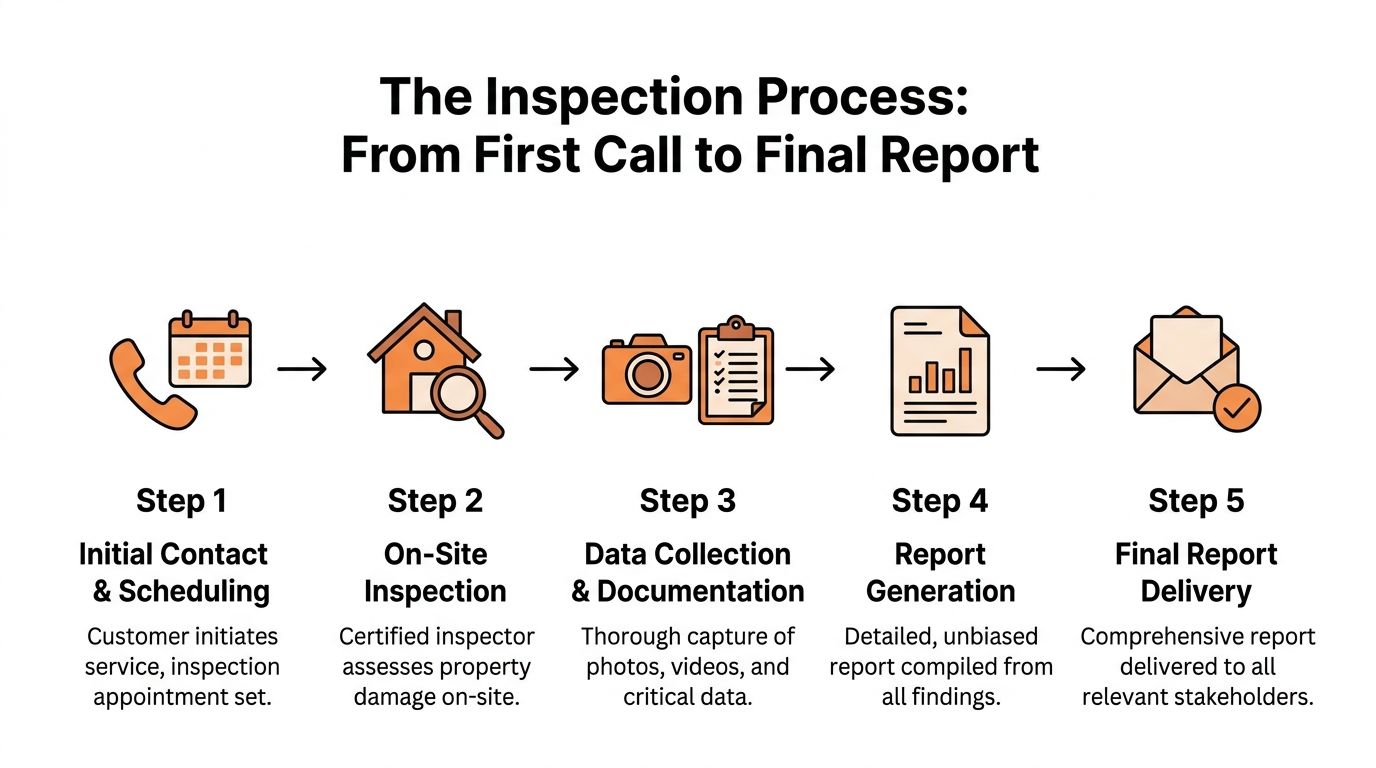
1. Assignment intake and triage
The first call should establish the loss type, occupancy status, access concerns, and whether emergency stabilization is needed before full inspection.
A steep roof, a large tree impact, or an active leak changes dispatch planning immediately. Those details should not wait until the inspector is in the driveway.
2. Scheduling and site prep
Good scheduling is not just picking a time slot. It includes confirming contact, clarifying who will be on site, identifying safety concerns, and setting expectations for what the inspector can and cannot do on arrival.
If there are specialized access concerns, that gets planned here, not improvised later.
3. On-site inspection and documentation
Field work needs a repeatable method. Start with exterior overview, then elevations, then roof access strategy, then interior tie-back to reported damage. Here, technology changes the game on hard roofs. Advanced technologies like drones reduce inspection time by up to 50% on steep roofs exceeding 8/12 pitch, while helping avoid safety risks that are 3 to 5 times higher than on flat surfaces. The same workflow can cut claim cycle times from 14 days to under 48 hours (drones and inspection cycle times).
That does not mean every roof should be inspected the same way. It means the access method should match the risk.
What a disciplined field capture includes
A reliable field package usually contains:
- Context shots: Whole elevations, roof planes, and site overview
- Detail images: Impacts, punctures, lifted materials, damaged accessories
- Interior correlation: Ceiling stains, wall damage, insulation wetting, attic indicators where accessible
- Mitigation record: Tarp placement, temporary repairs, and active leak status
Some teams also use portable diagnostic tools and meter-based verification during site work. In broader inspection operations, equipment categories can overlap with items like a combo meter LCD watt power volt amp analyzer for RC battery applications, which reflects how field technicians often rely on measurement-first workflows rather than visual guesswork alone.
Reporting that helps instead of delays
A final report should do three things well:
- State what was observed clearly
- Show the evidence in organized form
- Give the adjuster enough structure to move the file forward
The report should answer questions before the desk examiner has to ask them.
Weak reports bury the conclusion. Strong reports separate roof, exterior, interior, and mitigation into sections that support action.
The best inspection process is not the one with the most paperwork. It is the one that gets accurate field information into the file fast enough to matter.
How Inspections Empower Carriers Adjusters and Homeowners
A good inspection does more than document damage. It changes how each party experiences the claim.
For carriers, it improves consistency. For adjusters, it removes uncertainty. For homeowners, it replaces silence and guesswork with a clearer path forward.
For carriers and claim leadership
Carriers need inspection data that can scale across many files without becoming inconsistent from market to market. That is where structured reporting and analytics matter.
Data analytics platforms in property inspection services can improve underwriting accuracy by 20% to 30% by generating risk profiles from inspection data, which helps carriers identify vulnerabilities before they become larger losses (inspection data and underwriting accuracy).
In practical terms, that supports:
- Cleaner reserve decisions
- Better vendor oversight
- More consistency across catastrophe and daily claims
- Fewer surprises when a file escalates
Carriers also benefit when inspection partners communicate in a disciplined way. Constant updates, clear status notes, and photo-backed reporting reduce the dead space that usually drives internal follow-up.
For desk and field adjusters
Adjusters need usable evidence, not vague reassurance.
The right inspection partner helps by:
- Answering access problems on steep and tall roofs
- Capturing damage in a format that supports estimating
- Separating what is visible from what still needs further review
- Documenting temporary repairs so mitigation is part of the file, not a side conversation
That is also where one operational option like Fox Claims Consultants LLC fits into the market. The company provides steep and tall roof inspections, ladder assist, storm and tree damage assessments, emergency tarping, complete property inspections, and estimating support for claim workflows.
A short overview of field coordination can help frame what adjusters should expect from any inspection partner:
For homeowners under stress
Homeowners rarely care about inspection terminology. They care about two things. Is the house protected, and what happens next?
A professional inspection helps answer both.
Clarity is a service. A homeowner who understands the condition of the property and the next operational step is easier to help and less likely to feel abandoned by the process.
When the field report is thorough, the homeowner gets a smoother claim experience. There is less backtracking, fewer repeated visits, and better alignment between visible damage and the repair conversation that follows.
Choosing the Right Property Inspection Partner
The inspection field is growing. The global Property Inspection Services market was valued at $5.6 billion in 2024 and is projected to reach $10.4 billion by 2033 at a 7.1% CAGR, which makes vendor selection more important as more providers enter the space (global property inspection services market).
Growth is good for availability. It is not always good for consistency.
What to vet before assigning work
The right partner is not just the one with the lowest dispatch fee. In claims, cheap field work often becomes expensive file work.
Focus on five areas.
Specialized access capability
If your claims include steep roofs, tall structures, or tree-damaged properties, ask whether the provider can safely inspect those conditions without improvising. A generalist who struggles with access will create delay on the exact files that need speed.
Safety discipline
You want more than a statement that the team is “safety focused.” Ask how roof access decisions are made, when remote methods are used, and how emergency stabilization is handled when the site is still hazardous.
Reporting quality
Request sample deliverables. You are looking for organization, labeled photos, useful summaries, and observations that help resolve the claim.
A report can be detailed and still be hard to use. The best format is the one a desk adjuster can review quickly without losing the field story.
Communication standards matter as much as field skill
A provider may inspect well and still frustrate everyone if status updates are inconsistent.
Ask direct questions:
- Who confirms scheduling with the insured
- How are access problems escalated
- When do preliminary findings get communicated
- What does the final report package include
If a vendor cannot answer those questions clearly before assignment, they usually will not answer them well during a catastrophe surge either.
Pricing should match risk and complexity
Inspection pricing models vary. Some are straightforward per-assignment fees. Others are built around scope, travel, emergency response, or volume arrangements.
The best approach is not necessarily the simplest one. High-risk roofs, active leaks, and after-hours stabilization require more planning than a routine exterior condition check. Price should reflect the actual operational demand.
A fair inspection fee is cheaper than a failed first inspection. Re-dispatches, customer friction, and delayed scope review cost more than many teams expect.
A practical selection checklist
Use this when comparing providers:
- Can they handle steep and tall structures safely
- Do they offer emergency tarping or temporary repairs when needed
- Are their reports consistent across regions
- Can they scale during surge events
- Do they communicate like a claims partner, not just a field vendor
That checklist will tell you more about claim outcomes than a rate sheet alone.
Real-World Scenarios Case Studies in Action
The value of property inspection services shows up best when the file is messy.
Two common assignments make that obvious. One is the steep-roof hail claim that no one wants to reinspect. The other is the post-storm property that needs stabilization before the documentation is even complete.
Scenario one with a steep roof and disputed scope
A desk adjuster receives a hail file on a tall, multi-slope residence. The homeowner says the roof is clearly damaged. The first contractor says full replacement. The initial photos in the file are taken from the ground and do not show enough detail to support a firm decision.
That file needs more than another generic visit.
The practical move is to deploy a ladder assist plus roof-specific inspection with a clear photo plan. The inspector documents each accessible slope, captures accessories and soft metals, and ties roof observations to any interior staining that may support active leakage or prior moisture pathways.
What works in this scenario:
- Ordering access support at the same time as the inspection
- Requiring labeled images by slope and elevation
- Capturing both overview and close-up evidence
- Separating confirmed storm effects from unrelated wear
What does not work:
- Sending an unprepared generalist onto a difficult roof
- Accepting unlabeled photos
- Treating the second visit like a repeat of the first one
If the file later needs material or repair context, related site conditions can affect the discussion, including surfaces around entries, walks, or surrounding improvements where products like concrete sealer in a 5 gallon pail for driveways and walkways may become part of broader property restoration planning.
Scenario two with emergency tarping after severe weather
A homeowner reports roof damage after a major storm, followed by active interior leakage in multiple rooms. At first contact, the urgent issue is not final scope. The urgent issue is stopping more water from entering.
The strongest response sequence is simple. Dispatch emergency stabilization first, then complete the broader inspection with the temporary protection documented in place.
That approach changes the file in three useful ways:
- It limits additional interior damage
- It creates a clear record of pre-mitigation and post-mitigation condition
- It gives the adjuster a cleaner timeline for cause, protection, and repair planning
Here, many claims either settle into order or drift into argument. If the tarp goes on without documentation, later questions follow. If the inspection happens without acknowledging mitigation status, the file loses chronology. If no one captures the full damage path from roof opening to interior finish damage, the estimate becomes harder to defend.
Stabilize first when the property is exposed. Then document thoroughly enough that no one has to reconstruct the scene from memory.
In both scenarios, the inspection team earns its value by reducing ambiguity. That is the core product.
Frequently Asked Questions About Property Inspections
Is an insurance inspection the same as a real estate inspection
No. A real estate inspection looks broadly at property condition for a buyer or seller. An insurance inspection for a claim is narrower and more evidence-driven. It focuses on the reported loss, the visible damage, access conditions, and the documentation needed to support claim decisions.
When should an adjuster order ladder assist instead of a standard inspection
Order ladder assist when roof height, pitch, or site conditions make standard access unreliable or unsafe. If the structure is clearly difficult from the loss notice, dispatching the right access support early is usually better than waiting for a failed first visit.
Should the same company inspect the damage and perform repairs
Sometimes that can work, but carriers and adjusters should be careful about role clarity. Inspection work should stay objective and well documented. If repair services are also involved, the file should still preserve independent, photo-backed field observations.
How do you handle inspections on rural or underserved properties
These claims require more planning than suburban daily claims. Access routes, communications, weather windows, and local response capacity all matter.
That issue is especially visible on underserved properties. Only 60% of tribal properties received timely assessments after recent major storms due to access issues, which shows why proactive staffing and technology matter in hard-to-reach areas (timely assessments on tribal properties).
Practical steps that help include:
- Pre-confirming route and access conditions
- Using tech-enabled documentation when travel is difficult
- Setting realistic scheduling expectations with the policyholder
- Flagging emergency stabilization needs early
What should a final inspection report include
At minimum, the report should include labeled photos, observations tied to specific areas of the property, notes on access limitations, and documentation of any temporary repairs or mitigation completed at the site.
What creates the most avoidable delay
Poor first documentation. If the initial inspection misses key roof areas, fails to tie interior damage to exterior findings, or leaves mitigation undocumented, the file often slows down immediately.
If you need field support on difficult claims, Fox Claims Consultants LLC provides nationwide property inspection services focused on steep and tall roofs, storm and tree damage assessments, ladder assist, emergency tarping, complete inspections, and estimating support. For carriers, adjusters, and homeowners trying to move a complex loss forward, that kind of coordinated field documentation can bring speed and structure back to the claim.
Leave a Reply