
So you think a ladder assist job is just about hauling a ladder? Think again.
You’re not just the muscle; you’re the on-site access and safety specialist. You’re the reason a claims adjuster can safely inspect a steep, two-story, or complex roof they’d never be able to access on their own. This role isn't just helpful—it’s critical to getting property claims done right.
What Ladder Assist Jobs Really Involve
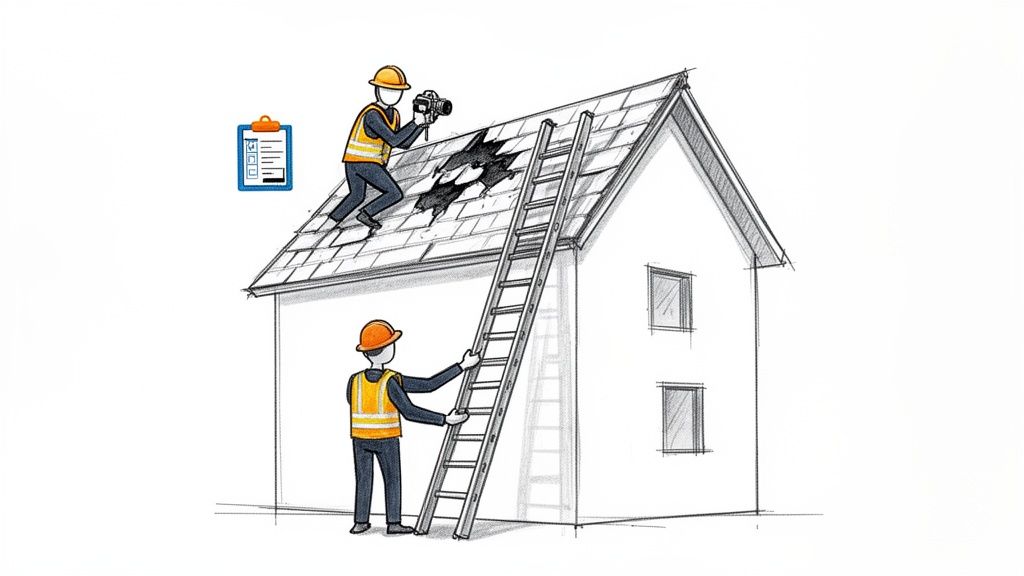
When an insurance carrier or independent adjusting (IA) firm is dealing with a tough property, a ladder assist pro is their essential partner. Your presence isn't a matter of convenience. It's a core part of their risk management and claims documentation process.
The job goes way beyond the physical work. You're the one responsible for making sure everyone on that roof is safe. That means you’re evaluating the structure, spotting hazards, and using specialized gear to give the adjuster a secure platform to do their job.
Your Impact on the Claims Process
Your work has a direct and immediate impact on how fast and accurate a property claim gets settled. By providing safe access, you empower adjusters to do their work without putting themselves at risk, which clears the way for a smoother workflow.
- Slash Claim Cycle Times: When an adjuster can't get on a roof, the claim grinds to a halt. You eliminate that bottleneck, keeping inspections on schedule and the whole process moving forward.
- Keep Adjusters Safe: Let’s be honest—most adjusters aren't trained or equipped for high-risk roof inspections. Your expertise prevents accidents, which is a massive priority for every carrier.
- Get Better Documentation: You're often the one taking the detailed photos and measurements, capturing undeniable proof of damage from the perfect vantage point. This kind of high-quality evidence is what fair and accurate settlements are built on.
Key Takeaway: As a ladder assist professional, you are not a subordinate helper. You are a specialized technician whose expertise in safety and access is essential for resolving complex property claims efficiently.
Why This Role Is More In-Demand Than Ever
The need for skilled ladder assist pros is booming. More severe weather events mean more damaged roofs that demand an expert eye. As claim volumes spike, carriers and IA firms are getting smarter about outsourcing high-risk tasks to specialists who know what they're doing.
This industry-wide shift toward safety and efficiency makes ladder assist jobs a solid and growing career path. By working with dedicated service providers, carriers can ensure compliance, protect their people, and get the accurate data they need to close claims. You can see how these partnerships work by checking out the core elements of professional ladder assist services.
Building Your Essential Skills and Certifications
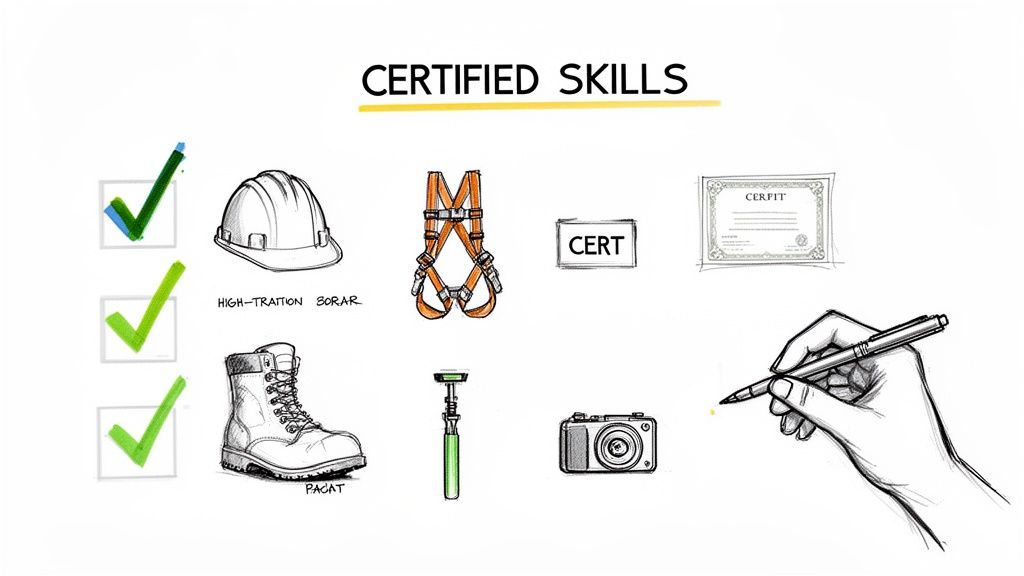
Want to make top dollar in ladder assist and roof inspection? It takes more than just owning a ladder and not being afraid of heights. To build a real career, you need a specific set of skills, certifications, and on-the-ground know-how.
Let's start with a reality check. You absolutely must be in good physical shape and completely comfortable working at height for long stretches. This isn't just climbing; it's carrying heavy equipment, navigating steep pitches, and staying sharp. You can't fake it when you're 40 feet in the air.
Beyond that, true pros are separated by their technical skill. It starts with safety—always. Mastering the three points of contact (two feet and one hand, or one foot and two hands on the ladder at all times) is non-negotiable. It’s the foundation of everything you do.
The Core Skills That Get You Hired
These are the skills that show you can do more than just get a desk adjuster to the roof. They prove you can be a valuable partner in the inspection itself.
- Roof Material ID: You have to know what you’re looking at, and fast. Is it architectural asphalt, standing seam metal, clay tile, or slate? Each one has its own unique characteristics and failure points.
- Basic Damage Assessment: Learn to spot the obvious signs of damage. You should be able to recognize the spatter marks of hail hits and know what creased, lifted, or missing shingles from wind look like.
- Mastery of Your PPE: Your Personal Protective Equipment is your lifeline. This means knowing how to properly fit and use your harness, ropes, and specialized footwear like Cougar Paws, which are essential for traction on steep-slope roofs.
The demand for professionals who can work safely at heights is huge. Back in 2017, the Bureau of Labor Statistics found that nearly 18.7% of all jobs required some form of climbing. That figure covers everyone from roofers to utility workers and shows just how critical this skill set is. It’s the core competency of all ladder assist jobs.
Must-Have Certifications That Matter
Experience on the roof is king, but certifications are what get you in the door for the best jobs. They’re proof to IA firms and carriers that you’re a serious professional who has invested in your training.
Your first priority should be the HAAG Certified Roof Inspector designation. It’s the gold standard in the industry for both residential and commercial roof assessments.
Next, get formal rope and harness safety training. This gives you documented proof that you’re competent and safe on steep, complex roof systems. These qualifications are what turn you from just a "guy with a ladder" into a certified access specialist.
For a deeper dive into staying safe on the job, especially during major weather events, check out our guide on adjuster safety during catastrophic events.
Gearing Up with the Right Tools and Technology
Your gear does more than just get you on the roof. It’s your business card, your safety net, and your key to getting the job done right.
Showing up to a site with professional equipment instantly tells adjusters and homeowners you’re a serious professional. This is a critical first impression for anyone building a career in ladder assist jobs. It’s the difference between being trusted or being second-guessed.
The foundation of your toolkit is, of course, a solid ladder. But not just any ladder will do. You’ll need at least one high-quality, ANSI-rated extension ladder, typically in the 28-foot to 32-foot range, to access most single and two-story homes. An articulating ladder is also a smart investment for its versatility on tricky rooflines.
Safety and Access Essentials
Beyond the ladder, your personal protective equipment (PPE) is non-negotiable. This isn’t about looking the part; it’s about making sure you go home safely after every single job.
- Rope and Harness System: For any roof with a pitch of 7/12 or steeper, this is your lifeline. A good system prevents a simple slip from turning into a life-altering fall. Don't climb without it.
- High-Traction Footwear: Standard work boots don't cut it on a steep slope. You need boots designed to grip asphalt, metal, and tile. Cougar Paws are the industry standard for a reason—their grip gives you the confidence to move safely.
- Daily Safety Gear: A properly fitted hard hat, durable gloves, and safety glasses are the basics. Wear them every day, on every job.
The Tech That Gets the Job Done
Your physical tools get you up top, but your tech is what ensures you capture accurate, undeniable evidence to support the claim. Modern inspections are all about high-quality digital documentation.
You’ll need a high-resolution digital camera or a modern smartphone that takes crystal-clear photos and videos. A tablet is also essential for completing reports from the field, which drastically speeds up the entire claims process for everyone involved.
Simple tools like a pitch gauge and a 100-foot tape measure are also daily must-haves for getting precise measurements. In some cases, a roof is too damaged for a simple inspection, and you'll need to document the need for temporary solutions. You can learn more by understanding what goes into professional emergency roof tarping services.
Real-World Advice: Investing in quality tools is an investment in your safety, reputation, and income. The cost of a good harness or the right boots is nothing compared to the cost of an injury or a lost client because you looked unprepared.
To help you get started, we've put together a list of the gear you'll need on day one versus the tools you can add as your business grows.
Ladder Assist Professional's Toolkit
Here’s a breakdown of the essential equipment you need to get started and the advanced tools you can invest in as you gain experience and take on more complex jobs.
| Equipment Category | Essential Day One Gear | Advanced/Specialized Tools |
|---|---|---|
| Ladders | 28-32 ft. ANSI-rated extension ladder | Articulating ladder, 40 ft. extension ladder |
| Safety Gear | Harness, ropes, Cougar Paws, hard hat, gloves | Advanced ascenders/descenders, specialized anchors |
| Technology | Smartphone/digital camera, tablet, pitch gauge | Thermal imaging camera, drone, laser measure |
Start with the essentials to build a solid foundation. As you advance, adding specialized tools will allow you to handle more complex inspections and increase your value in the field.
How to Find and Land High-Paying Ladder Assist Jobs
So you’ve got the skills and the gear. Now, how do you turn that into a steady stream of high-paying ladder assist jobs? It’s one thing to be good on a roof; it’s another to know where the work is and how to get it.
Your job hunt really starts with understanding the three main ways you can get hired in this field. Each path has its own pros and cons, and knowing which one fits you best is half the battle.
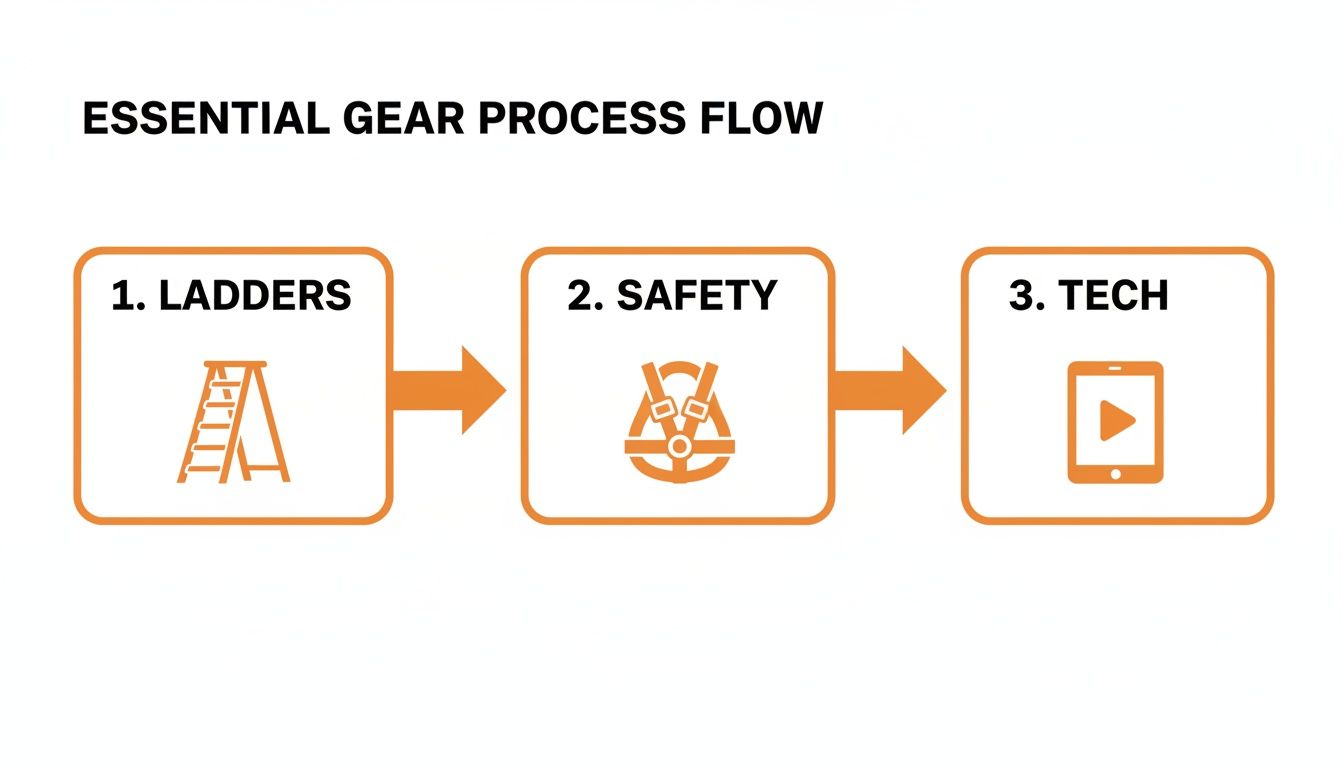
This process is straightforward: the right ladders get you up, the right safety gear keeps you there, and the right tech helps you get the job done efficiently. Everything works together.
Where to Look for Openings
Where you look for work really depends on what you want. Are you after the stability of a full-time gig or the flexibility of running your own show as a contractor? Most opportunities fall into one of three buckets:
- Insurance Carriers: Big carriers sometimes hire ladder assist pros directly. These are often W-2 positions with benefits and a consistent schedule, which is a great fit for some.
- Independent Adjusting (IA) Firms: These firms are the middlemen, working for multiple insurance companies. They keep a roster of trusted ladder assist techs they can deploy to claims as needed.
- Third-Party Vendors: Companies like ours specialize in providing top-tier ladder assist and inspection services to carriers and IA firms. Partnering with a dedicated vendor is one of the most reliable ways to get consistent work from multiple sources.
When you’re searching job boards, don't just type in "ladder assist." Broaden your search with terms like "field inspector," "roof inspector," and "ladder assist technician" to uncover more roles. You can see the kinds of opportunities we offer right now on our Fox Claims job openings page.
Crafting a Resume That Gets Noticed
Your resume has one job: to show a hiring manager you can solve their problems. If you're coming from a construction or roofing background, you need to translate your experience. Don't just list what you did. Frame it in a way that speaks directly to an adjuster's needs.
For instance, instead of a generic line like "Installed asphalt shingle roofs," try something that shows you understand the claims side of things:
Example Bullet Point:
Expertly navigated and assessed residential roof systems up to 12/12 pitch, ensuring 100% team safety compliance while documenting conditions for project estimates.
See the difference? This version screams safety, expertise on steep slopes, and documentation skills—the exact things we look for when hiring for ladder assist jobs. Your ability to prove your efficiency and expertise is what will help you advance. In fact, studies show productivity is a much better predictor of career growth than past wages. Proving you can get the job done right and fast is your ticket to moving up.
Acing the Interview
Get ready to talk about safety. A lot. Interviews in this field are less about your personality and more about your practical, real-world decision-making.
You'll almost certainly get a scenario-based question.
Sample Interview Question:
“Describe your safety protocol for inspecting a two-story, steep-slope roof on a windy day.”
A weak answer is vague. A strong answer is a checklist. It shows you have a process you follow every single time, without fail. Talk about checking weather conditions before you even set up, finding stable ground for the ladder, using tie-downs, and, of course, always using a proper rope and harness system.
When you answer with that level of specific detail, you’re not just answering a question. You’re proving you’re a low-risk, high-value professional they can trust in the field.
Your Paycheck and Your Path Forward
Let's get straight to it: the money. In the world of ladder assist and roof inspections, your pay isn't a simple, fixed number. It's a direct reflection of how you work, where you are, and the skills you bring to the roof.
The pay structure can look a few different ways. Many independent contractors get a per-inspection fee, which usually falls between $75 and $150 for a standard residential job. Others lock in a day rate, which can range from $300 to $500+, especially when things get busy during storm season. And yes, some IA firms and vendors offer full-time salaried spots, giving you stability but often with a lower ceiling than a hustling contractor.
What Drives Your Income Up
Your earning potential isn't static. It's something you can actively grow. Location is a huge piece of the puzzle—if you're in an area that gets hit with regular hail or wind, the work will find you. Your certifications, especially a HAAG credential, give you immediate credibility and the leverage to ask for better rates.
But the single biggest factor? Your willingness to travel for catastrophe (CAT) work. When a major hurricane or hailstorm makes landfall, the demand for skilled, reliable inspectors explodes. Those who can deploy to a disaster zone are compensated very well for their efforts.
A dependable, certified ladder assist pro who is ready to travel for CAT deployments can absolutely build a six-figure income. The work is tough, but the financial rewards are there for the taking.
From the Roof to the Corner Office
A ladder assist role isn't just a job—it's your foot in the door of the entire property claims industry. Think of it as a paid apprenticeship. The skills, experience, and reputation you build on the roof are your ticket to bigger and better roles.
We see it all the time. Good techs follow a clear path to bigger opportunities.
- Become an Independent Claims Adjuster: After a couple of years, you'll know more about roofs than most desk adjusters. The natural next move is getting your own adjuster's license so you can run the entire claim yourself.
- Specialize as a Large-Loss Consultant: Once you have deep expertise in spotting and scoping damage, you can focus on high-value commercial or complex residential losses where top-tier skills demand premium pay.
- Move into Management or Ownership: Master the trade, then lead the team. You can step into a management role at a firm or even launch your own company, hiring and training the next wave of techs.
Your career climb is directly tied to your performance. Delivering solid, reliable work—like the kind you'd capture with a great property inspection report template—is what builds the trust that opens doors. That reliability becomes even more critical during economic shifts, when employers double down on their most productive people. It's a well-documented trend; you can see it in research on the job ladder and economic cycles. In this business, consistency and quality are your best currency for getting ahead.
Common Questions About a Ladder Assist Career
Once you start seriously thinking about a career in ladder assist, you get past the high-level ideas and dig into the real questions. What’s the job really like day-to-day? How hard is it to break in?
We’ve pulled together the most common questions we hear from aspiring techs. Here are the straight, honest answers you need to move forward.
This isn’t your typical nine-to-five. It’s a physically demanding, mentally engaging career that rewards expertise, reliability, and an unwavering commitment to safety.
How Physically Demanding Is This Job?
Let's be direct: this is one of the most physically demanding roles in the claims industry. You're not just climbing ladders—you're carrying them, setting them up on soft or uneven ground, and working in all kinds of weather.
A standard day can easily involve:
- Lifting and maneuvering a 28-foot extension ladder that weighs 50-70 pounds.
- Spending long stretches working at heights of 20-40 feet.
- Navigating steep, complex roof pitches that demand excellent physical conditioning.
You need a solid foundation of fitness, great balance, and absolutely no fear of heights. This isn't a job where you can fake it. Your physical ability is tied directly to your safety and your effectiveness on the job.
Can I Do This With No Roofing Experience?
While a background in roofing or construction is a huge advantage, it's not always a deal-breaker. Many of the best ladder assist techs we've worked with came from other fields entirely.
What they all have in common are a few key traits: they’re mechanically inclined, they learn fast, and they have a deep-seated respect for safety protocols.
If you’re coming in without direct experience, your attitude is what counts. You have to be ready to soak up a ton of information about different roofing systems, how to identify damage, and how to use your gear properly. Starting with a company that offers strong on-the-job training is the best way to bridge that gap.
Key Takeaway: Many firms would rather hire for attitude and train for skill. If you're dependable, safety-focused, and have a strong work ethic, you can build a great career, even without a construction background.
Do I Need to Own My Own Business?
No, you don't need to start your own company, especially when you’re just getting into the field. The vast majority of professionals get their start by working for established firms.
You generally have two paths:
- Employee (W-2): This route offers stability, benefits, and a consistent paycheck. The company typically provides the truck, tools, and a steady flow of assignments.
- Independent Contractor (1099): This gives you more flexibility and higher earning potential, but you’re on the hook for your own truck, tools, insurance, and finding your own work.
Most techs begin by working for a reputable vendor or IA firm. This is the proven way to gain priceless experience, build a professional network, and learn the business inside and out before even thinking about going out on your own.
At Fox Claims Consultants LLC, we partner with skilled field professionals who can deliver reliable, safe, and efficient inspection services nationwide. If you have what it takes to handle high-risk structures and are committed to quality, we want to hear from you.
Explore our partnership opportunities and see how you can grow with us.
Leave a Reply