
A tree has come through the roof. Shingles are in the yard. Water is already finding its way into insulation, drywall, and electrical runs. The homeowner wants answers now. The desk adjuster needs usable documentation. The field adjuster needs a clear scope. The contractor wants authorization before committing labor and materials.
That’s usually where the friction starts.
Most claim delays don’t begin with bad intent. They begin with incomplete information, mismatched expectations, and handoffs that happen too late. One party is trying to stabilize damage. Another is trying to verify coverage. Another is trying to price repairs accurately. If those steps aren’t aligned in the first few days, the file gets heavier, the repair gets slower, and everyone spends more time arguing about what should have been obvious from the start.
Insurance repair contractors sit right in the middle of that tension. They aren’t just builders. In a good claim, they become part estimator, part coordinator, part documentation partner, and part production manager. In a bad claim, they get pulled into scope disputes, permit delays, supplement battles, and payment problems they didn’t create but still have to manage.
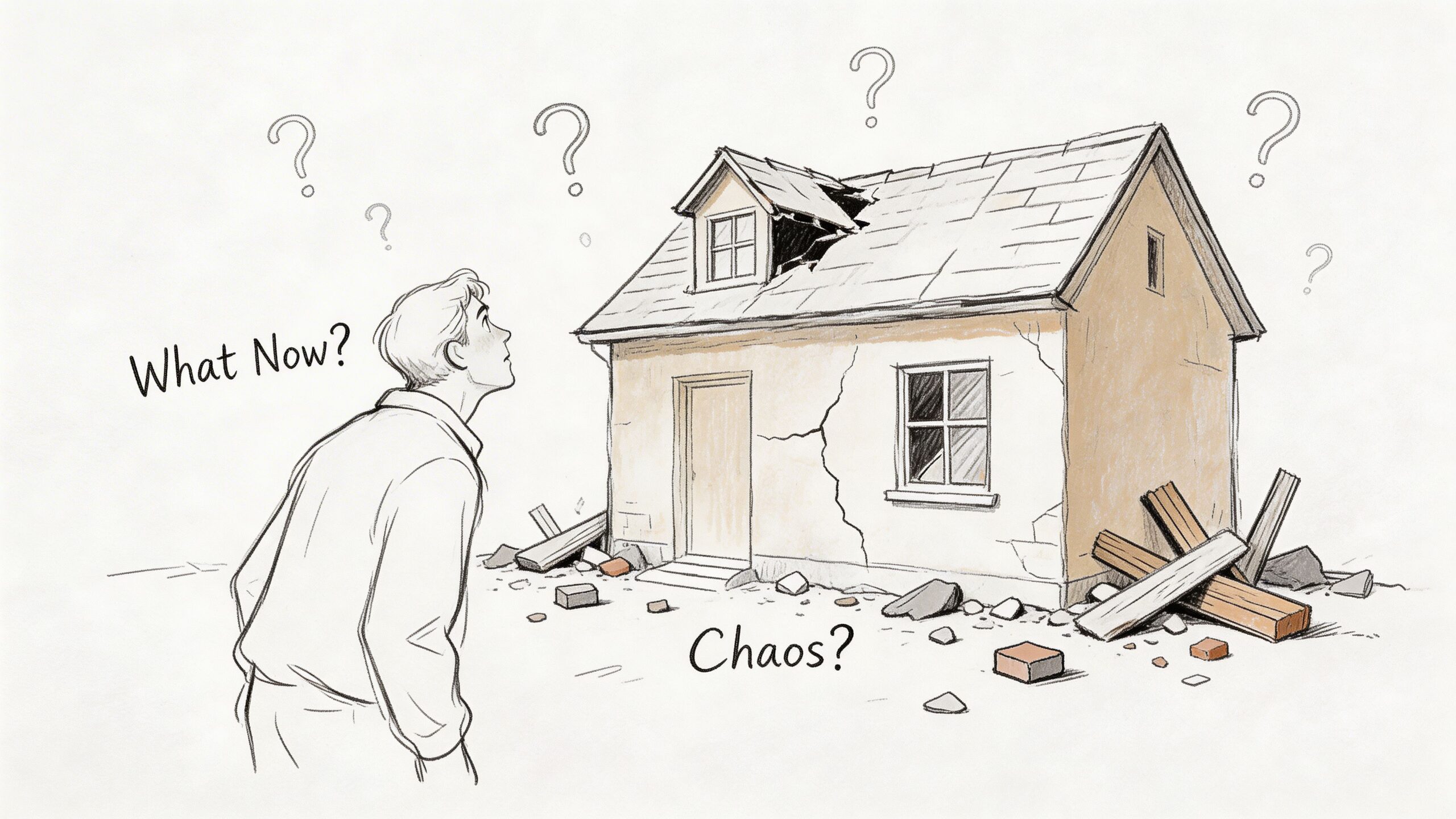
The Aftermath Navigating Your First Steps After Damage
The first hours after a loss feel messy because they are messy.
A homeowner sees visible damage and wants the property made safe. The insurer needs enough verified detail to move responsibly. The adjuster needs conditions documented before anything changes. The contractor needs to know whether the job is temporary mitigation, full restoration, or both.
What matters immediately
In the first day or two, the right question isn’t “Who can rebuild this cheapest?” It’s “Who can document the condition accurately, prevent further loss, and keep the claim from drifting off course?”
That early window is where strong claims operations separate from chaotic ones.
- Stabilize first: Stop active water intrusion, secure openings, and prevent avoidable secondary damage.
- Document before conditions change: Photos, measurements, material notes, roof access details, and hazard observations all matter.
- Clarify roles early: The contractor repairs. The adjuster evaluates the loss. The insurer applies coverage. Confusion between those roles creates conflict fast.
- Use safe access methods: High, steep, and storm-damaged structures need proper field protocols and equipment such as a Forester Safety Helmet With Mesh Face Shield forestry hard hat when work conditions call for impact and debris protection.
The file usually goes sideways before the first estimate is written. It happens when the site changes faster than the documentation.
The scale of the market shows why this process now carries more operational weight than it used to. The global contractors insurance market reached USD 48.52 billion in 2025 and is projected to grow to USD 52.56 billion in 2026, with about 40% of contractors relying on broad coverage to protect operations, according to 360iResearch’s contractors insurance market analysis.
The choices that shape the rest of the claim
A rushed inspection creates missing line items. Missing line items create supplements. Supplements delay approval. Delays affect scheduling, permits, and payment. By the time everyone realizes the original problem was poor field capture, the claim has already become harder than it needed to be.
That’s why the earliest decisions carry outsized weight. The first contractor on site, the first inspection set, and the first scope discussion often determine whether the claim moves cleanly or spends weeks stuck in avoidable rework.
Defining the Insurance Repair Contractor Role
An insurance repair contractor is best understood as the project manager of the physical recovery.
That description matters because people often confuse this role with either a retail remodeling contractor or an insurance adjuster. They overlap in the same claim, but they do different jobs.
What this contractor does
The insurance repair contractor takes documented damage and turns it into repair execution. That includes site stabilization, scope review, estimating support, trade coordination, scheduling, permit follow-up, production oversight, and final completion work.
In practice, that means the contractor has to operate in two worlds at once.
One world is construction. Materials, labor, sequencing, code issues, subcontractors, drying, demolition, rebuild.
The other world is claims. Scope validation, estimate review, supplements, insurer communication, photo evidence, and payment controls.
What they are not
A general retail contractor may be excellent at renovations and still struggle in an insurance file. Insurance work requires cleaner documentation, faster response, tighter line-item discipline, and patience for review cycles that don’t exist in private-pay remodeling.
An adjuster has a different job entirely. The adjuster inspects, evaluates, and values the claimed damage within the policy framework. The adjuster doesn’t swing the hammer, pull the permit, or manage the framing crew.
Here’s the clean distinction:
| Role | Primary function | What they do not do |
|---|---|---|
| Insurance repair contractor | Restores the property and manages physical repair execution | Determine coverage under the policy |
| Insurance adjuster | Evaluates the loss and supports claim valuation | Perform the repair work |
| Retail general contractor | Builds or renovates for direct-paying customers | Usually doesn’t specialize in insurer documentation and claim workflow |
Why insurance repair contractors create either clarity or friction
A strong contractor understands that estimate format, field notes, and repair sequencing all have downstream effects.
For example, if the contractor documents roof damage but misses interior moisture migration, the estimate may understate demolition, insulation replacement, and finish work. If the contractor starts discussing policy outcomes instead of construction scope, the homeowner can end up with false expectations. If the contractor knows the work but can’t communicate it in a claims-ready way, approval slows down.
Practical rule: Hire for claims fluency, not just building skill.
The best insurance repair contractors do three things consistently:
- They separate scope from coverage. They can explain what needs repair without pretending to interpret the policy.
- They write and support repair logic clearly. That includes why a task is needed, not just what it costs.
- They manage production with claim realities in mind. They know the work may pause for approval, permit, or supplement review.
The biggest misunderstanding
Many homeowners think the contractor’s job begins when rebuilding starts. In insurance work, it begins much earlier. It starts when someone has to convert field conditions into a repair path the carrier, adjuster, and property owner can all understand.
That early coordination role is why insurance repair contractors matter so much in storm, fire, and tree-impact claims. They don’t just fix damage. They influence whether the claim becomes organized or adversarial.
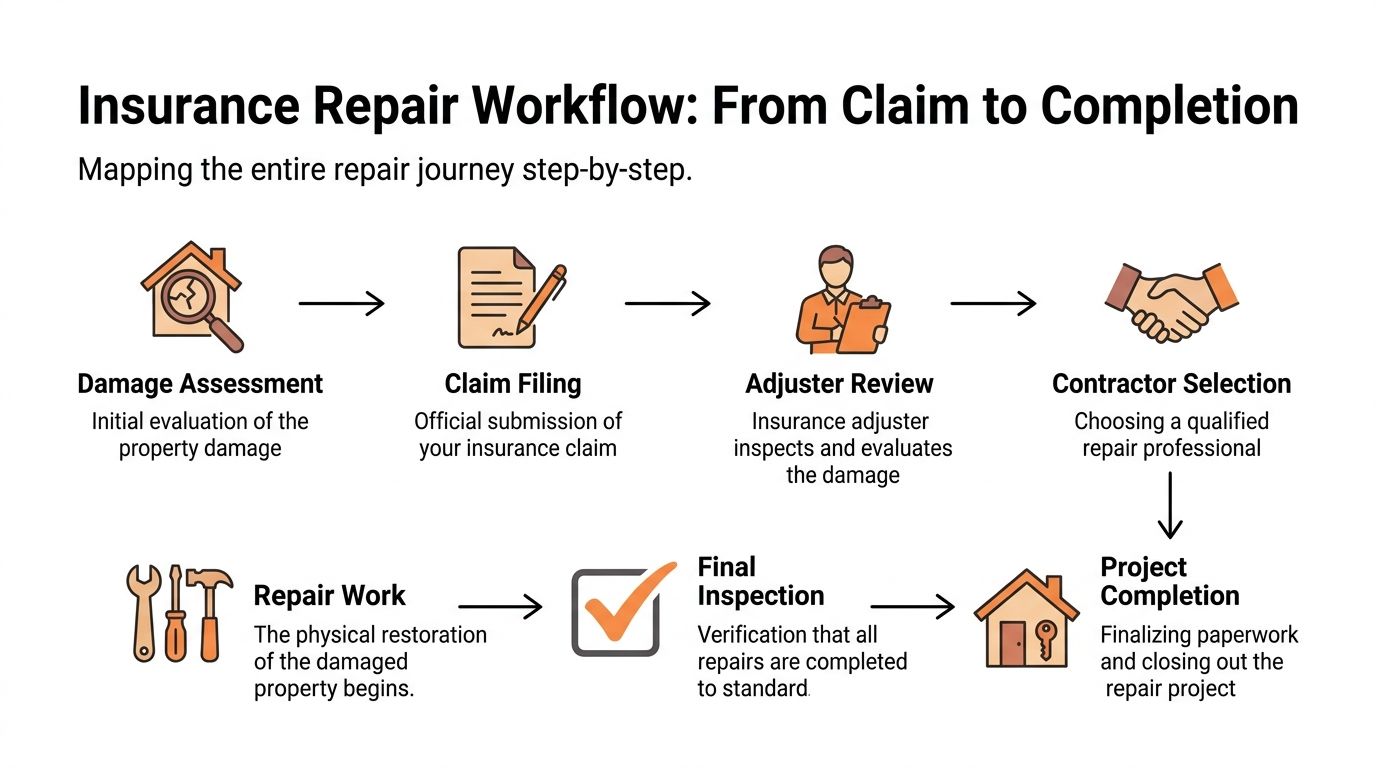
Mapping the Insurance Repair Workflow From Claim to Completion
Most insurance repair problems aren’t caused by one catastrophic mistake. They come from small failures at each handoff.
A missing photo at intake. An incomplete roof measurement. A vague line item. A permit assumption nobody confirmed. A supplement filed after work moved too far ahead. The workflow matters because every later stage depends on the quality of the earlier one.
The workflow in the field
Damage assessment
Someone has to inspect the property safely and thoroughly. On a simple loss, that may be straightforward. On a steep roof, tree strike, or high structure, access itself becomes part of the claim challenge.Claim filing
The loss gets reported, and the insurer opens the file. This sounds administrative, but the timing and quality of early reporting affect the entire chain.Adjuster review
The adjuster evaluates visible damage and compares it against the claim facts, policy, and supporting documentation.Contractor selection
The property owner or carrier-backed program identifies the contractor who will handle repairs.Estimate preparation and alignment
Here, many delays either get prevented or created.Authorization and permit path
Work can’t just charge ahead because the site is damaged. The contractor often needs approvals, permit clarity, and trade coordination first.Repair execution
Demolition, drying where needed, rebuild, code-driven updates, finish restoration, and inspections.Final inspection and closeout
The job gets reviewed for completion, punch items, paperwork, and payment release conditions.
Why estimate standardization matters
Estimate friction is one of the biggest avoidable slowdowns in insurance restoration. That’s why software standardization matters so much in this space.
About 80% of insurance repair contractors and property insurance companies use Xactimate, and that common format reduces pricing and scope disputes that often stall estimate approval, according to Contractor Accelerator’s discussion of working with insurance companies and Xactimate.
When the adjuster and contractor are reading from the same estimating language, fewer hours get lost translating one estimate style into another. That doesn’t eliminate disagreement, but it reduces avoidable disagreement.
Where workflow breaks down
Inspection gaps
If the initial inspection misses elevations, attic conditions, moisture pathways, detached structures, or code-triggered items, the estimate starts incomplete.
That doesn’t just affect pricing. It affects sequencing.
A contractor can’t confidently schedule framing, electrical, roofing, insulation, and interior trades when the true scope is still moving around.
Documentation that doesn’t travel well
Photos without context don’t help much. Neither do notes that only make sense to the person who wrote them.
Useful documentation usually includes:
- Clear overview photos: Front, rear, sides, and relationship shots
- Close-range damage images: Enough detail to support line items
- Measurements and diagrams: Roof, rooms, elevations, openings
- Material identification: Roofing type, siding profile, finish categories
- Safety and access notes: Height, pitch, debris load, instability, electrical concerns
For hard-to-access conditions, field teams often rely on portable lighting and safe visibility tools such as an Inspection Lamp 2 Pin Auxiliary Socket Plug CAB185 Classic or similar inspection equipment to capture conditions accurately in darker or obstructed areas.
A claim file moves faster when someone who never visited the property can still understand the damage from the record alone.
Review loops and supplement churn
A poor estimate rarely dies quickly. It usually gets revised in stages.
The adjuster asks for clarification. The contractor revises. Hidden damage appears during tear-off or demolition. Another supplement follows. Then another trade issue surfaces. Each round may be justified, but repeated re-estimation creates lag, scheduling conflict, and homeowner frustration.
What works in practice
The cleanest claims usually share the same operating habits:
| Workflow stage | What works | What fails |
|---|---|---|
| Initial inspection | Complete field capture before conditions change | Partial inspection with assumptions |
| Estimate prep | Standardized estimating language and clear scope notes | Narrative-only estimates with vague pricing |
| Adjuster review | Organized photo sets and line-item support | Mixed files, missing labels, scattered uploads |
| Repair launch | Authorization, permit review, and sequencing discipline | Starting too much work before approvals are stable |
| Closeout | Final walkthrough, documented completion, clean invoice package | Rushed billing with unresolved punch items |
Insurance repair contractors who understand this workflow don’t just build better. They reduce claim drag. That’s the difference between a file that advances and a file that keeps circling the same issues.
How to Vet and Select a Qualified Contractor
The wrong contractor rarely looks wrong on day one.
They often sound confident. They promise speed. They say they “handle insurance all the time.” Then the certificate of insurance is outdated, the contract is thin, the estimate is sloppy, and the job starts leaning on verbal assurances instead of verifiable controls.
Selection needs to be disciplined because the failure cost shows up late.
Start with insurance and licensing, not the sales pitch
The first screen is basic but essential. Verify licensing where required. Verify general liability coverage. Verify workers’ compensation where applicable. Verify whether the contractor is properly insured for the type of work being performed, especially on high-risk jobs.
That verification can’t be treated as one-and-done. ServiceChannel’s review of contractor insurance management notes that frequent lapses in contractor insurance compliance are a real exposure, and some industry audits in 2025 showed lapse rates as high as 15% to 20%, particularly dangerous on steep roofs and emergency service work.
A contractor who was compliant last month may not be compliant today.
Contractor Vetting Checklist
| Verification Item | What to Ask For | Why It Matters |
|---|---|---|
| License status | Current license number and jurisdiction | Confirms legal operating status where required |
| General liability insurance | Current certificate with effective dates | Protects against third-party property or bodily injury exposure |
| Workers’ compensation coverage | Policy proof for field labor | Reduces risk when workers are injured on site |
| Claims experience | Examples of insurance repair projects and estimating process | Insurance restoration is different from retail remodeling |
| Local presence | Physical address, service area, references | Improves accountability and follow-through |
| Documentation process | Sample photo reports, scope notes, estimate format | Strong files reduce disputes and rework |
| Subcontractor controls | Who performs roofing, electrical, drywall, mitigation | Clarifies responsibility and quality oversight |
| Contract clarity | Work authorization, payment terms, supplement process | Prevents confusion once repairs begin |
The quality test many overlook
Ask how they handle disagreement.
Not in theory. In an actual claim.
If the adjuster questions scope, does the contractor provide organized support or start making threats? If hidden damage appears, do they document it immediately and explain causation clearly? If the permit office requires upgrades, do they communicate the impact early?
You learn more from that answer than from the sales brochure.
Cheap usually means unstable
The industry is dealing with a hard truth. Some contractors are being squeezed so tightly on insurance jobs that pricing pressure becomes an operational problem. That pressure can push weaker firms toward shortcuts, cash strain, weak supervision, or unfinished work.
That’s why low bid alone is a bad selection method in insurance restoration.
Look for operational stability instead:
- They communicate in writing.
- They can explain estimate logic.
- They verify insurance proactively.
- They understand supplements without turning every file into a fight.
- They have enough production depth to finish what they start.
A contractor using professional tools, organized reporting, and even basic field gear such as a Husky Professional Torx Screwdriver Set Precision Star Drivers in a well-equipped setup won’t prove quality by itself, but attention to tool readiness often tracks with overall job discipline.
Questions worth asking before award
How do you document the initial condition?
If the answer is vague, expect scope problems later.
Who writes your estimate and who supports supplements?
A contractor that outsources all claims communication without field coordination often creates disconnect between what was seen and what gets priced.
How do you track policy-related limits versus actual repair needs?
They shouldn’t interpret coverage, but they should know how to distinguish repair necessity from insurance decision-making.
Good vetting isn’t about catching fraud alone. It’s about avoiding preventable project failure.
Insurance repair contractors need to be qualified builders, but that’s only half the test. The other half is whether they can function inside a claim without becoming another source of instability.
Understanding Repair Timelines and Project Costs
The question everyone asks first is “How long will this take?”
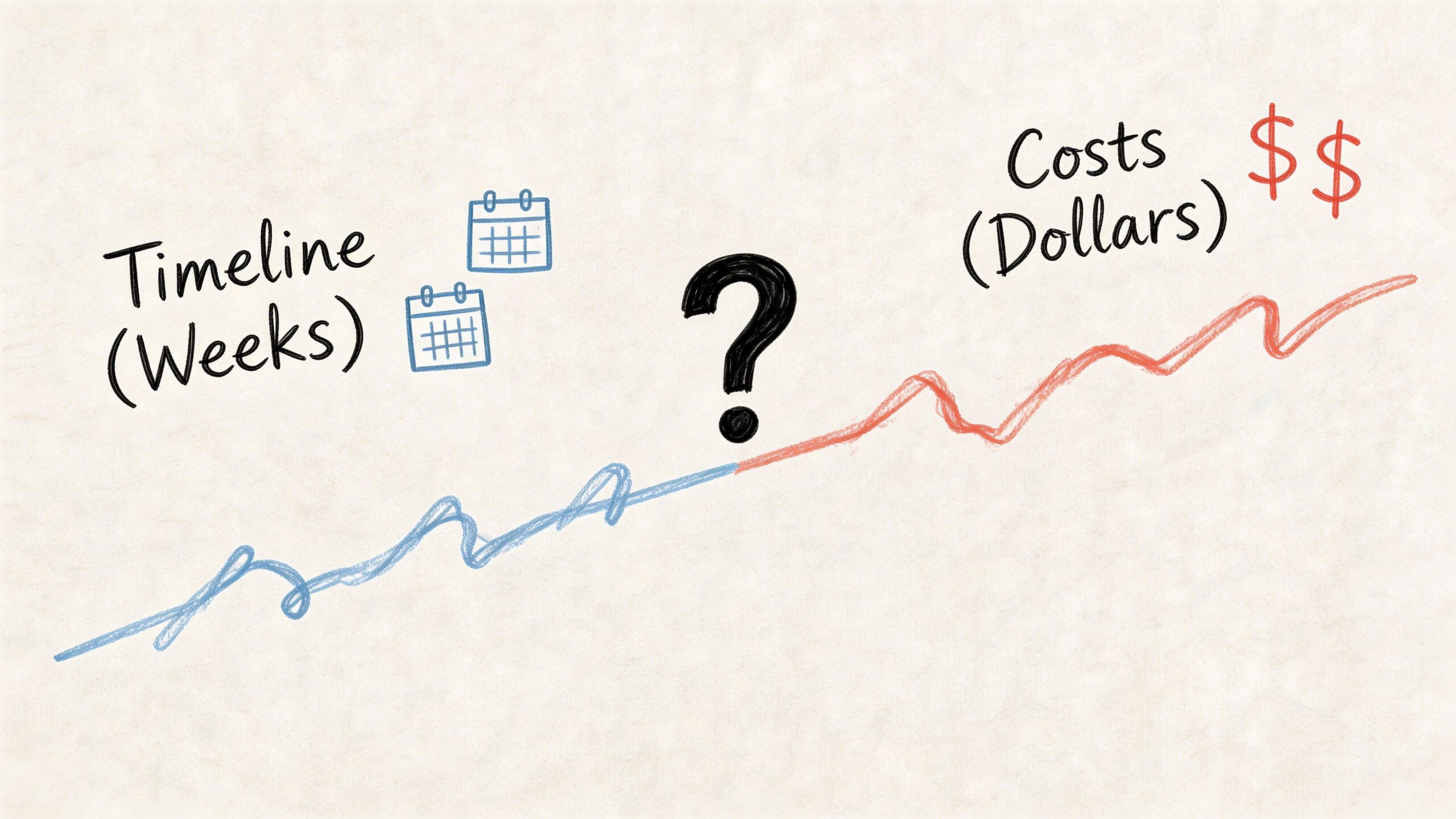
The honest answer is that insurance repair has two clocks. One clock governs scope and approval. The other governs permits and physical reconstruction. Those clocks don’t move at the same speed.
The two phases that drive the schedule
For major losses, the scope and estimate phase often takes 1 to 2 weeks, while the permit and repair phase can run 6 to 18 months. Permit timing alone can range from 3 days to more than 6 weeks in busier urban areas, according to Matterport’s overview of insurance restoration timelines.
That split matters because many owners assume approval means crews will begin full reconstruction immediately. Often they won’t.
The property may still need permit clearance, engineering input, municipal review, trade scheduling, material coordination, or code-driven redesign before major work can start.
Why the timeline stretches
Permits and code
The damaged structure usually can’t just be rebuilt exactly as it was. Local code may require the repaired system to meet current standards. That affects electrical, framing, roofing assemblies, guardrails, ventilation, and other components.
Code compliance adds legitimate scope, but it also adds review time.
Hidden damage
Tear-off and demolition reveal things inspections can’t always fully confirm from the surface. Wet decking, concealed structural impact, damaged underlayment, compromised insulation, or electrical issues can trigger supplement discussions.
That doesn’t always mean someone missed something. It means damaged buildings often disclose the rest of the story in phases.
Material and trade sequencing
Even when all parties agree on scope, the work still has to be sequenced properly. Roofing before interior dry-in. Framing before insulation. Electrical before close-in. Finishes after substrate conditions are right.
Trying to compress that sequence usually creates rework.
The cost terms people should understand
A few terms control most cost confusion in insurance repair.
- Scope of work: The list of tasks required to restore the damaged property.
- Supplement: Additional requested payment for work or damage identified after the original estimate.
- Recoverable depreciation: The portion sometimes held back until qualifying repairs are completed and documented, depending on the policy.
- Actual cash value and replacement cost: These affect payment structure, not the physical repair logic itself.
What keeps costs from drifting
A disciplined file doesn’t eliminate change, but it contains it.
| Cost driver | What helps control it |
|---|---|
| Incomplete initial scope | Thorough documentation before demolition and dry-in |
| Permit surprises | Early municipal review and code awareness |
| Hidden damage disputes | Immediate photo capture and supplement support |
| Repair sequencing errors | Clear trade scheduling and site supervision |
| Site exposure while waiting | Temporary stabilization and weather protection |
For temporary sealing or containment work, even simple materials such as Seam Sealer 10.5oz Tube for automotive metal work illustrate the broader point. Small stabilization measures taken early can protect the structure and keep secondary damage from expanding while approvals and permits catch up.
The fastest claim isn’t the one with the most aggressive schedule. It’s the one with the fewest preventable resets.
The practical takeaway is simple. Don’t promise a clean finish date before the scope is stable, the permit path is understood, and the repair sequence is realistic. That’s not caution for its own sake. It’s how experienced teams avoid disappointing everyone involved.
Red Flags and Common Pitfalls to Avoid
Most red flags are symptoms of a deeper problem.
A contractor demands full payment upfront. Another offers to “absorb” the deductible. Another wants a signature before a meaningful scope discussion. Another submits a thin contract and gets evasive when asked about insurance or subcontractors. Those behaviors aren’t random. They usually point to weak cash flow, weak controls, or weak ethics.
The warning signs that matter most
Pressure before clarity
If a contractor pushes hard for commitment before documenting conditions, reviewing the damage path, and explaining the process, slow down.
Urgency is real after a storm. Manufactured urgency is different.
Vague paperwork
A loose contract often hides loose operations. If the scope, change-order process, payment terms, and responsibility lines aren’t clear, conflict is almost guaranteed once the job gets moving.
Deductible games
A promise to waive, rebate, or cover the deductible should set off alarms immediately. Beyond the legal and ethical issues, it often signals a business model built around padding scope elsewhere or cutting quality to recover margin.
Communication that disappears under scrutiny
Some contractors are responsive while they’re selling and erratic once documentation questions begin. That pattern matters because insurance repair is documentation-heavy by nature.
Why these behaviors are showing up more often
The restoration sector is under pressure. C&R Magazine’s reporting on the “quiet crisis” in property claims describes systemic underpayment and profit erosion that can push quality firms out of the market and leave homeowners and insurers dealing with unstable contractors who cut corners or fail mid-project.
That broader pressure doesn’t excuse bad conduct. It explains why file instability often shows up in recognizable ways.
When contractors can’t sustain the work economically, the symptoms tend to look like this:
- Front-loaded money demands
- Overpromising on schedule
- Resistance to documentation
- Thin staffing and poor supervision
- Change-order chaos once demolition starts
A practical pattern to watch
A financially stressed contractor often tries to convert uncertainty into immediate cash. That’s why upfront pressure, vague terms, and aggressive promises tend to travel together.
Even small signs can be telling. A field team relying on improvised fixes instead of proper materials, where a straightforward item like a Red Yellow Or Clear Lens Repair Tape Kit Fix Broken Car stands in for actual repair discipline in unrelated site conditions, often reflects a larger habit of patching over process instead of managing it correctly.
What to do when you spot a red flag
Don’t escalate emotionally. Tighten the process.
Ask for current insurance verification. Ask for a complete written scope. Ask who will perform each trade. Ask how supplements are documented. Ask when permit review begins. Ask who owns temporary protection responsibility.
If the answers stay blurry, move on.
The biggest contractor risk in insurance restoration isn’t always incompetence. It’s instability that doesn’t become visible until the job is halfway open.
That’s the trap. By the time the red flag becomes obvious to everyone, the property may already be torn apart, exposed, and dependent on a contractor who can’t carry the job to completion.
Building a Collaborative and Efficient Repair Process
Claims move best when nobody tries to win the file alone.
The adjuster needs accurate field evidence. The contractor needs a supportable scope. The carrier needs reliable documentation before releasing money. The property owner needs a repair path that is understandable and realistic. Those interests can align, but only when the claim is built on objective information instead of assumptions and reactive argument.
The operating model that holds up
A collaborative insurance repair process usually has four traits:
- Early stabilization
- Clean documentation
- Role clarity
- Fast communication when scope changes
That sounds simple. It isn’t automatic.
The stabilizing force is often the party that documents the property well enough for everyone else to work from the same facts. On steep roofs, storm losses, tree impacts, and other high-risk conditions, that field documentation becomes the single source of truth for the rest of the file.
Where claims operations improve
When the field record is complete, disputes shrink earlier. Estimates become easier to align. Repair sequencing becomes easier to plan. Supplement requests become easier to justify. Payment review becomes less speculative.
That doesn’t mean every claim will be smooth. It means the file is less likely to fail for avoidable reasons.
The insurer-contractor relationship gets blamed for plenty of problems, and sometimes fairly. But the strongest repair outcomes usually come from shared discipline, not forced agreement. Good inspection, good reporting, and good handoffs make that possible.
Frequently Asked Questions About Insurance Repairs
Can I choose my own contractor?
Usually, yes. Many property owners can choose their own contractor rather than using a preferred vendor. The key is choosing someone who understands insurance repair work, not just construction. The best choice is the contractor who can document well, communicate clearly, and finish the job.
Should the contractor and adjuster agree on everything before work starts?
Not always. Emergency stabilization may need to happen quickly to prevent further loss. Full repair scope, however, should be as clear as possible before major reconstruction begins. Starting broad rebuild work with unresolved estimate issues often creates supplement fights later.
What if hidden damage is found after demolition?
That’s common in insurance repair. The right response is immediate documentation, prompt notice, and a clean supplement package tied back to the loss. Hidden damage shouldn’t be handled through verbal updates alone.
Is the cheapest contractor the best financial choice?
Usually not. A lower number on the front end can lead to weak documentation, delays, missed scope, poor supervision, or contractor failure. In insurance work, stability and process control matter as much as price.
Why do insurance repair contractors ask so many questions?
Because the work sits at the intersection of claim handling and construction. They need to know what was damaged, what has been approved, what requires permit review, what must be documented before demolition, and who is authorizing each stage.
What should I keep in writing?
Keep the contract, insurance certificates, scope of work, change orders, estimate revisions, supplement submissions, material selections, and communication about timing. Memory is unreliable in a long claim. Written records keep disputes smaller.
When do repair delays become a real concern?
Delays become serious when nobody can explain the reason for the delay, the next action, and who owns that action. A permit queue is one thing. Silence is another. Good files have visible next steps, even when the work itself must wait.
When a loss puts pressure on everyone at once, the fastest way to steady the claim is to start with reliable field facts. Fox Claims Consultants LLC provides national property inspection support for steep and tall roof inspections, storm and tree damage assessments, ladder assist, emergency tarping, temporary repairs, and detailed reporting that helps carriers, adjusters, contractors, and property owners move from uncertainty to action. If you need a safety-focused inspection partner that documents conditions clearly and responds when timing matters, Fox Claims is built for that job.
Leave a Reply