
A desk adjuster gets the loss notice. The roof is steep. The storm path was messy. The first photos are blurry, taken from the ground, and the policyholder wants answers now. Meanwhile, the file sits because nobody wants to approve scope, reserve, or next steps on weak field evidence.
That is where an insurance claim expert stops being a vague title and becomes an operational necessity.
On ordinary claims, a standard inspection process can work fine. On high-risk roofs, tree impact losses, emergency tarping situations, and surge events after severe weather, ordinary processes break down fast. The problem usually isn't effort. It's mismatch. The claim needs specialized eyes in the field, but the file is being handled with generalist assumptions.
The High-Stakes Claim and the Bottleneck It Creates
A steep roof claim comes in after a storm. The intake photos are taken from the driveway, the shingles are still wet, and the policyholder wants an answer before the next rain hits. The file stalls almost immediately because nobody has enough field evidence to set scope with confidence.

That stall creates more than inconvenience. It creates a chain reaction across the claim. Reserves stay soft, estimates get revised, policyholder calls increase, and supervisors get pulled into disputes that started with one simple problem. The field inspection did not produce usable evidence fast enough.
High-stakes property losses create bottlenecks because the claim cannot move any faster than the quality of the site findings. On a routine loss, that gap may be manageable. On a steep-slope roof, tree strike, or mixed-cause storm claim, it becomes expensive.
Why these files clog up so quickly
These claims tend to jam for the same operational reasons:
- Site access is risky: Steep pitches, slick surfaces, unstable debris, and multi-story elevations limit who can inspect safely and what they can document.
- The damage pattern is messy: Wind, impact, prior repairs, age-related wear, and failed maintenance can all appear in one loss.
- Temporary protection may be time-sensitive: Tarping or stabilization decisions often need to happen before the file is fully scoped.
- Initial documentation is weak: Ground-level photos and secondhand descriptions rarely support accurate measurements, causation analysis, or reserve decisions.
I see the same trade-off repeatedly. Teams try to save a field assignment fee at the front end, then spend more on reinspections, estimate drift, complaints, and cycle-time creep.
Practical rule: If the inspection conditions would make a general field resource cautious about access or documentation, assign a specialized expert early.
The actual cost of waiting
Delay often looks cheaper than it is. A file can sit for several days while the desk waits for clearer photos, a better contractor note, or internal approval to send someone more qualified. During that time, conditions change on the roof, mitigation gets harder to document, and the policyholder loses confidence in the process.
Speed matters because early field clarity affects everything downstream. It shortens review time, supports cleaner estimates, and reduces the odds of sending a second person to answer questions the first inspection should have settled. That is the ROI case for specialized claim expertise. It is not just about technical skill on a roof. It is about preventing a weak first inspection from turning into a long, expensive claim file.
Even in related field-response work, visibility, access control, and site safety are treated as operational basics, as seen in this example of reflective evacuation warden equipment used for clear field identification.
An insurance claim expert adds value here by removing uncertainty early, while the claim is still controllable. That is what keeps a difficult loss from turning into a desk bottleneck.
Defining the True Role of an Insurance Claim Expert
Many people use the term loosely. That causes problems because not every "expert" plays the same role in a claim.
The cleanest way to think about it is medical. A primary care doctor handles routine issues. A specialist steps in when the case involves higher risk, narrower expertise, or consequences that justify deeper evaluation. Property claims work the same way. A desk adjuster can manage a large share of files well, but a steep roof, tree strike, or contested storm loss often needs a specialist in the field.
What the expert actually does
An insurance claim expert in the property context serves as the carrier's or adjuster's eyes, ears, and hands on site. The mission is not to make the coverage decision. The mission is to produce field evidence that helps the right person make that decision correctly.
That usually includes:
- Physical inspection of hard-to-access areas: Roof surfaces, elevations, flashing, penetrations, gutters, soft metals, detached structures, and surrounding conditions.
- Photo and measurement capture: Clear visual documentation that supports estimating and later file review.
- Cause-oriented observations: Not legal conclusions, but disciplined observations about what is present, where it is present, and what patterns matter.
- Mitigation support: Tarping, temporary protection, and documentation of emergency conditions when immediate action is needed.
- Reporting discipline: Organized, timely notes that adjusters can use without guessing what happened in the field.
A good expert reduces interpretation drift. A weak one adds it.
What the expert is not
This role is often confused with a public adjuster. They are not the same.
A public adjuster represents the policyholder's interests. A field inspection partner supports the carrier, desk adjuster, independent adjuster, or administrator by gathering accurate site information. Those functions can both exist in the same claim ecosystem, but they should not be mixed up.
A useful comparison looks like this:
| Role | Primary client | Main function |
|---|---|---|
| Desk adjuster | Carrier or TPA | File ownership, coverage handling, communication, decision workflow |
| Public adjuster | Policyholder | Advocates for the insured's claim presentation |
| Field inspection expert | Carrier, IA, TPA, or claims handler | On-site documentation, access, measurements, condition reporting |
Why specialization matters
A general field resource may be perfectly capable on straightforward losses. The problem comes when teams assume general competence transfers automatically to high-risk inspections. It doesn't. A slick steep roof after a storm is not just "another roof." A tree-on-structure loss is not just "more severe damage." The field methods, safety decisions, and documentation standards all change.
The expert's value isn't mystery. It's disciplined observation under conditions where ordinary inspection methods stop working.
Technology plays a role too. Photos, video, and remote review all help. But remote tools only work when someone gathers the right evidence in the first place. Even products built around visibility and monitoring, like IR night vision security camera systems, illustrate the same principle. Better decisions depend on better capture.
When teams define the role correctly, they stop treating the insurance claim expert as a luxury vendor and start using them as a precision tool in claim handling.
Knowing When to Deploy a Specialized Field Expert
The best time to assign a specialist is early, before the file hardens around weak assumptions. Most delays happen because the need was visible at intake but nobody acted on it until after the first failed inspection, the disputed estimate, or the angry callback.
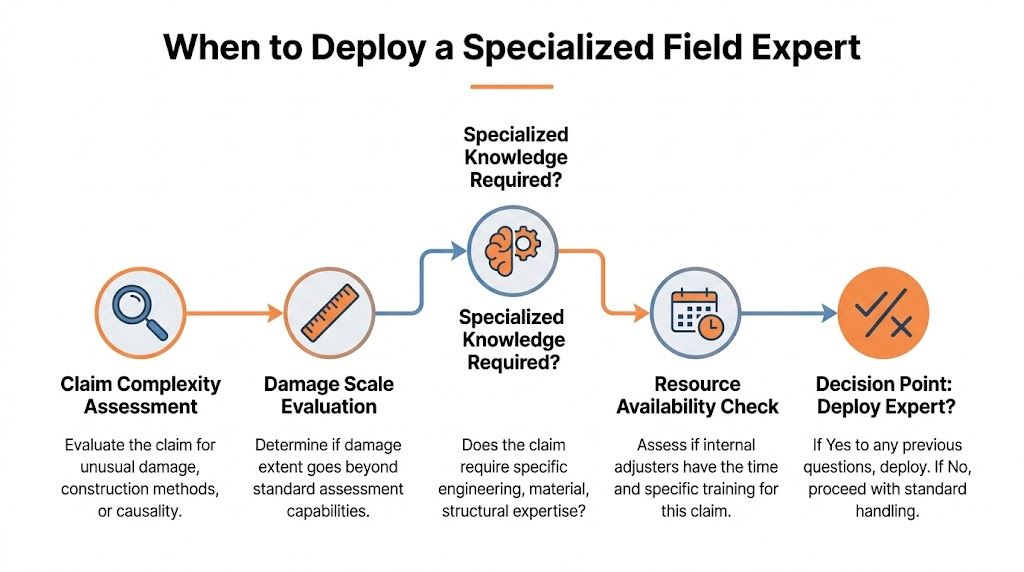
The field triggers that should change your handling path
Some claims announce themselves immediately. Others look routine until one detail changes the entire inspection plan. These are common triggers for specialized deployment:
- Steep-slope roof conditions: If the roof pitch, height, or surface condition creates real fall risk, send a specialist.
- Multi-story access problems: Upper elevations, limited ladder placement, and architectural complexity raise both safety and documentation difficulty.
- Tree impact or structural loading concerns: Tree-on-roof losses need careful observation of entry points, displaced materials, and temporary stabilization needs.
- Widespread storm damage indicators: Creased shingles, collateral indicators, detached components, and multiple slopes with varying exposure often require more experienced field review.
- Emergency mitigation need: If water intrusion, exposed decking, or active weather creates ongoing damage risk, a fast field response matters.
- Catastrophe surge support: When internal teams are overloaded, specialists keep inspection quality from collapsing under volume.
A simple rule works well here. If the claim requires unusual access, unusual safety controls, or unusual interpretation, don't handle it like a standard ladder-and-photos assignment.
Pairing field expertise with intake intelligence
Modern triage gets practical when Predictive severity modeling at first notice of loss can reduce claim cycle time by up to 40% by enabling straight-through processing and routing complex files to specialized resources quickly, according to VantagePoint's guide on insurance analytics and FNOL severity modeling.
That matters because analytics only create value if operations follow through. If a model flags a loss as high complexity but the claim still sits in a generic queue, nothing improves. The operational win comes from combining machine triage with human specialization.
A deployment framework that works in practice
Use this screen at assignment:
Can a standard adjuster access all damaged areas safely?
If the answer is no, assign a specialist.Will the initial inspection need measurements and photo evidence precise enough to support estimating without repeat visits?
If yes, assign a specialist.Is there a strong chance of mixed causation or disputed scope?
If yes, assign a specialist.Will delay increase physical damage or customer friction?
If yes, assign fast-response field support.
Claims teams get the biggest lift when they use specialists at the front of the file, not after the file has already gone sideways.
That same front-end thinking applies in emergency readiness more broadly. Teams that keep field resources and practical site tools close at hand, including large emergency fire blankets and other response equipment, usually manage unstable situations with less confusion.
The point isn't to over-deploy experts. It's to deploy them at the claims where delay, risk, and ambiguity are likely to cost more than early specialization.
The Non-Negotiable Qualifications for a Claims Expert
Experience matters. It just isn't enough by itself.
The industry has a real blind spot here. A common gap is the lack of guidance for carriers on selecting qualified field inspectors for complex claims, especially for high-risk structures where specific certifications and experience are critical but often overlooked, as discussed in Merlin Law Group's analysis of experts in claims disputes.
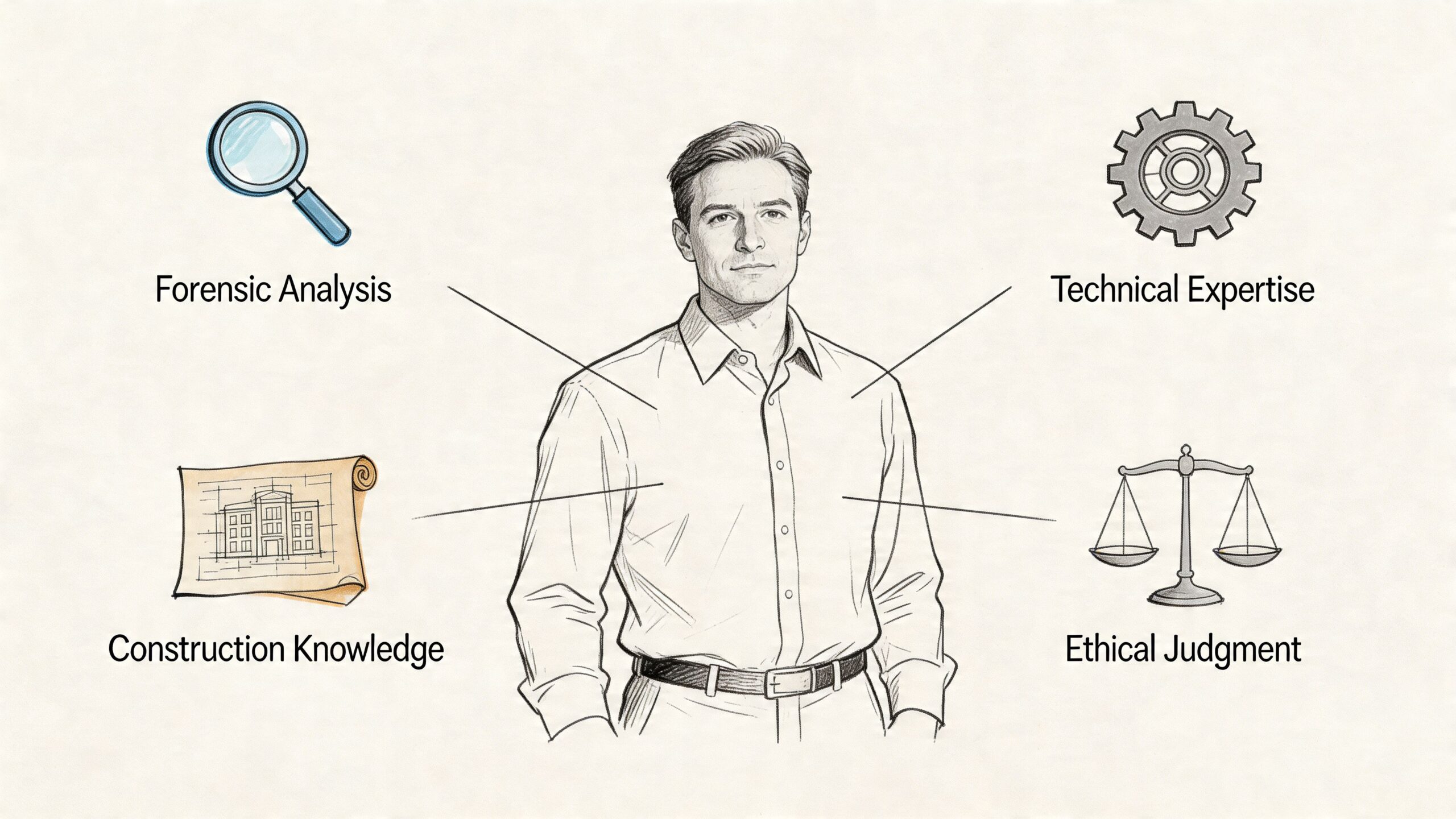
A carrier doesn't need a vendor with vague confidence. It needs people whose training, methods, and safety decisions can stand up inside a difficult file.
Credentials that affect real claim outcomes
For complex property inspections, ask about qualifications that connect directly to the loss type.
- Roof-specific training and certification: If the assignment involves steep-slope or commercial roofing, the inspector should have formal roof inspection training, not just general adjusting background.
- Water and fire restoration knowledge: On losses with interior damage, drying issues, soot spread, or mitigation questions, restoration-focused credentials matter.
- Working-at-height and site safety training: Anyone climbing steep or tall structures should have documented safety training and a defined field protocol.
- Construction literacy: The inspector should understand how roofing systems, flashing details, underlayment, ventilation, and repair histories affect observations.
- Report discipline: A technically skilled field person who writes vague reports still creates file risk.
The qualification test is practical. Can this person gather evidence safely, explain what they observed clearly, and produce documentation another professional can rely on later?
What to ask beyond the résumé
A claims leader should press on methods, not just titles.
Ask questions like these:
- What kinds of roofs do your inspectors handle most often?
- How do you document inaccessible or high-risk areas?
- What is your protocol when conditions aren't safe to climb?
- How do you distinguish field observation from causation opinion?
- What quality review happens before the report is submitted?
Those questions reveal whether the firm has a real operating standard or just a list of names.
Field note: The most dangerous phrase in vendor selection is "our people have seen a lot." Seeing a lot is useful. Following a repeatable inspection method is what makes the file defensible.
Safety is part of expertise
A claims expert is not qualified if they put themselves, the property, or the file at needless risk. Safety isn't separate from quality. It's part of quality. An inspector who shouldn't be on a roof often misses details, rushes capture, or creates inconsistent evidence because the method was wrong from the start.
Visible field identification and emergency role clarity matter too, especially during active mitigation and catastrophe environments. Even something as simple as emergency response team identification patches reflects a broader truth. Organized field work produces better outcomes than improvised field work.
This short video is a useful visual reminder that claims expertise is a blend of technical judgment, documentation discipline, and field readiness.
The standard to hold
For ordinary losses, broad competence may be enough. For steep roofs, major storm claims, tree impact, or emergency stabilization, carriers should require proof of specialized capability. If a vendor can't explain training, safety procedure, and QA in concrete terms, keep looking.
Your Checklist for Evaluating an Expert Partner Firm
Choosing an inspection partner is not the same as hiring a body to climb a roof. You're selecting a firm that will influence cycle time, estimate confidence, customer communication, and file defensibility. That means the vetting process should look more like operational due diligence than vendor shopping.
What strong partner firms have in place
Start with the systems behind the fieldwork.
- Scheduling discipline: They should have a clear intake path, triage rules, and appointment coordination process.
- Communication protocol: You should know who updates the file, when status changes are reported, and how urgent issues are escalated.
- Safety program: Ask for documented field safety procedures, not a verbal assurance that they "take safety seriously."
- Quality assurance review: Reports should be reviewed for completeness, labeling, clarity, and photo relevance before delivery.
- Scalability plan: A partner that performs well on ten files but stalls during weather surge is not a dependable extension of your claim operation.
- Defined scope boundaries: Good firms know where field observation ends and where engineering, legal interpretation, or coverage determination begins.
If a firm can't explain its workflow plainly, expect confusion after assignment.
Look for evidence of operational maturity
A mature partner behaves predictably under pressure. That shows up in small but meaningful ways:
- Appointment confirmations happen without repeated follow-up.
- Field teams note site hazards early.
- Reports arrive in a format adjusters can use immediately.
- Photo sets are organized by elevation, slope, room, or damage area.
- Disputed findings trigger a review process, not defensiveness.
One option in this space is Fox Claims Consultants LLC, which operates as a national property inspection partner for steep and tall roof inspections, storm and tree damage assessments, ladder assist, emergency services, and estimating support. The useful takeaway for buyers isn't branding. It's fit. Firms built around high-risk structures tend to understand access, mitigation, and reporting demands better than general inspection vendors.
Key questions to ask a potential inspection partner
| Category | Question to Ask |
|---|---|
| Coverage area | How do you staff assignments across the regions we serve? |
| Claim types | Which losses do you handle directly, and which do you decline or refer out? |
| Safety | What is your written protocol for steep, wet, tall, or otherwise hazardous roofs? |
| Reporting | What does a finished report include, and how are photos labeled and organized? |
| Turnaround | How do you communicate status changes from assignment to report delivery? |
| Emergency response | How do you handle tarping, temporary repairs, or same-day stabilization requests? |
| QA process | Who reviews reports before submission, and what errors are checked? |
| Disputes | What happens if our adjuster disagrees with the field findings? |
| Surge events | How do you scale during catastrophe volume without lowering inspection quality? |
| Technology | How are assignments received, tracked, and delivered back into the claim workflow? |
A firm becomes valuable when your adjusters stop chasing updates and start trusting the package that arrives.
Red flags worth taking seriously
Some warning signs show up before the first assignment is finished.
- Vague answers about training: If the firm talks around credentials, they probably don't have a standard.
- No clear escalation path: Urgent field issues shouldn't depend on whoever happens to answer the phone.
- Messy sample reports: Poor structure in a sample usually becomes worse under real claim volume.
- Overpromising on every loss type: Serious partners know their limits and say so.
- No discussion of documentation standards: If they don't care how findings are presented, you'll feel it later.
Strong monitoring habits also matter when you're auditing field performance over time. Even in other operational contexts, teams rely on centralized visibility tools like multi-channel CCTV recording systems because consistent review beats guesswork. The same logic applies here. Track partner performance with structure, not anecdote.
A good expert partner should make your process calmer, clearer, and easier to manage. If the vetting conversation already feels chaotic, the claims won't feel better.
Calculating the ROI of Specialized Claim Expertise
The wrong way to price specialized field support is to ask only, "What does the inspection cost?" The better question is, "What does this inspection prevent, accelerate, or clarify?"
That shift matters because the return from an insurance claim expert usually appears in several places at once. Adjusters spend less time chasing field detail. Estimators work from stronger documentation. Emergency mitigation happens sooner. Reinspection risk drops. Policyholders get clearer answers.
Where the return actually shows up
A specialized inspection partner can create value in four practical ways.
First, cycle time improves when the first field visit answers key questions. Claims stall when the report lacks usable photos, complete measurements, or clear damage mapping. A strong inspection package reduces that back-and-forth.
Second, accuracy improves. The file gets better documentation on difficult surfaces, mixed damage conditions, and mitigation needs. That doesn't guarantee agreement, but it gives the adjuster a stronger basis for decisions.
Third, loss mitigation improves when emergency services and field documentation happen together. If the roof is open or water is still entering, fast action matters. Waiting for a later visit often means the claim grows more complicated.
Fourth, internal capacity improves. Desk teams can focus on handling and decision-making instead of coordinating repeat site visits and untangling field ambiguity.
Pricing models are simpler than people assume
Most firms structure work around one of these approaches:
- Per-file fee: Common for standard inspection assignments with defined deliverables.
- Service-based pricing: Separate charges for inspection, emergency tarping, temporary repairs, ladder assist, estimating, or reinspection.
- Daily or surge-based deployment: More common during catastrophe response or complex multi-site events.
None of those models is better by default. What matters is whether scope, deliverables, and response expectations are clear before work begins.
A practical way to judge ROI
Use this framework on a sample set of files:
| ROI area | What to examine |
|---|---|
| Inspection efficiency | Did the first visit produce enough evidence to move the file forward without a repeat trip? |
| File handling time | Did the adjuster spend less time requesting clarifications and organizing missing details? |
| Mitigation outcome | Did early field action help stabilize the property and preserve evidence? |
| Dispute resistance | Did the documentation package support a clear explanation of scope and observations? |
| Surge resilience | Did the partner absorb volume without disrupting core internal operations? |
What works and what doesn't
What works is assigning specialists to files where access, safety, or complexity justify them. What doesn't work is using a specialized vendor as a cleanup crew after a weak initial inspection has already confused the file.
What works is clear reporting standards. What doesn't work is paying for a field visit and still forcing the adjuster to reconstruct the loss from scattered photos.
What works is integrating emergency response with documentation. What doesn't work is treating mitigation and inspection as unrelated activities when both affect the same claim narrative.
The best ROI usually comes from avoiding the second trip, the second argument, and the second week of delay.
A final point gets overlooked. Not every return fits neatly into an invoice comparison. When a specialist helps an adjuster make a timely, well-supported decision on a hard claim, the organization saves stress, preserves credibility, and reduces avoidable friction with the insured. Those benefits are real even when they aren't reduced to a single spreadsheet line.
Bring Order to Chaos with Fox Claims Consultants
A severe storm hits on Friday night. By Monday morning, the file count is rising, insureds want answers, and the hardest losses are the ones no one can inspect safely from the ground. That is where claims operations start to slip. Cycle time grows, documentation quality drops, and adjusters spend more time chasing missing details than making decisions.
Specialized field expertise fixes that bottleneck by giving the claim a usable starting point. The goal is not to add another vendor to the file. The goal is to get accurate access, clear documentation, and timely field reporting before delay turns a difficult claim into a disputed one.
For carriers, staff adjusters, independents, and administrators, the practical standard is straightforward. Deploy a specialist when roof pitch, height, storm conditions, access limits, tree impact, or active exposure make a routine inspection inefficient or unsafe. Then measure the result in practical terms: fewer return trips, cleaner reports, faster scope review, and better control of mitigation.
What a strong partner should give you
A strong field partner should help you:
- Reduce early uncertainty: Clear photos, measurements, and site observations give the adjuster a workable file from day one.
- Protect people and property: Safe access methods and prompt temporary protection reduce added damage and avoid preventable field risk.
- Shorten handling time: Organized reporting cuts down on clarification requests, duplicate visits, and internal back-and-forth.
- Hold quality during surge events: High volume should not force weaker inspections or inconsistent documentation.
- Keep the claim moving: Status updates, clear next steps, and consistent communication prevent the file from stalling between parties.
The core value shows up in the files that usually go sideways.
If your claims include steep roofs, multi-story elevations, storm damage, tree strikes, ladder assist work, emergency tarping, or rapid property documentation, specialized field support is part of sound claim handling. Used at the right point, it improves speed without sacrificing accuracy.
Fox Claims Consultants LLC supports that need with field services built around access, safety, documentation, and response time. If you need a field partner for steep roof inspections, storm and tree damage assessments, ladder assist, emergency tarping, or rapid property documentation, contact Fox Claims Consultants LLC to discuss your claim volume, response needs, and reporting requirements.
Leave a Reply