
A claim goes sideways fast when the file arrives before the facts do. The photos are blurry, the roofline is too steep for a routine visit, the homeowner is stressed, a contractor is already offering opinions, and the adjuster still doesn’t have a clean answer to a basic question. What is damaged, how urgent is it, and what needs to happen next?
That’s the moment an independent field inspector stops being a line item and becomes the person who restores control. In property claims, especially after wind, hail, tree impact, or heavy water intrusion, the file usually doesn’t stall because nobody cares. It stalls because nobody on the file has reliable field evidence yet.
A strong inspector changes that. They don’t just collect photos. They convert uncertainty into usable facts, separate visible damage from assumed damage, document conditions in a way carriers can act on, and identify where loss mitigation has to happen before the claim gets worse. When that’s done well, cycle time shortens, dispute points narrow, and everyone from the desk adjuster to the policyholder gets a clearer path forward.
When Chaos Hits a Claim You Need a Specialist
A steep roof claim after a storm often starts the same way. A policyholder reports interior staining. A contractor says the whole roof is compromised. The first photos show a few lifted shingles, some debris, and a ceiling spot that could be fresh or old. Nobody has a complete view, and nobody wants to send the wrong person onto a dangerous slope.
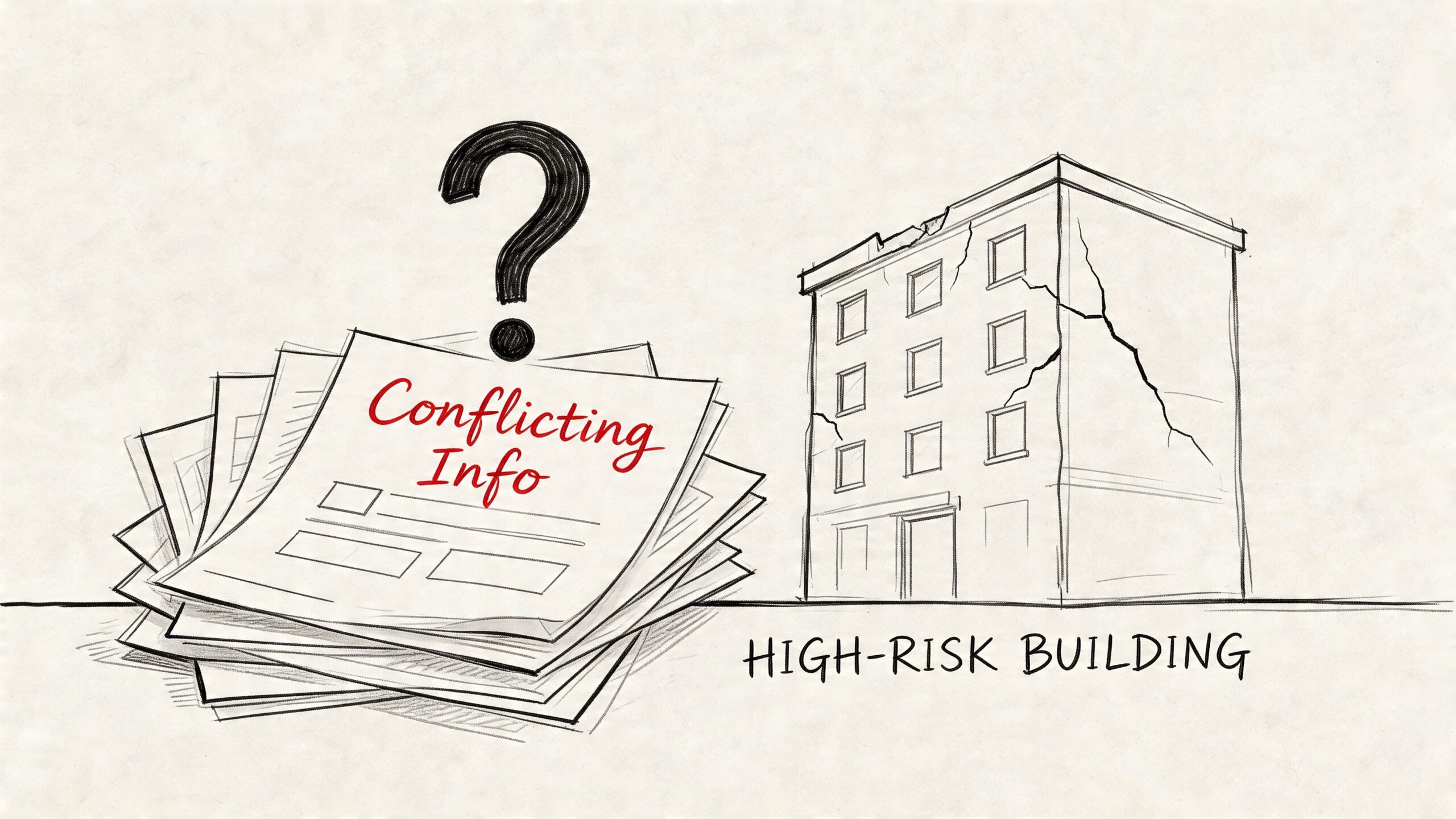
That’s where the claim either regains momentum or drifts. If the site sits too long, conditions can change. Temporary water intrusion can spread. Repair conversations get ahead of documentation. The file fills with opinions instead of evidence, and each new email adds more noise.
An independent field inspector brings a different kind of order. The value isn’t just access to the structure. It’s disciplined field work under pressure. The inspector arrives knowing the assignment is bigger than a checklist. They need to assess safety, secure accurate visuals, verify conditions, note active exposure, and give the desk side enough defensible information to make the next decision without guessing.
What the specialist changes immediately
The best inspectors reduce confusion in a few practical ways:
- They establish the scene: Wide photos, access notes, elevation views, roof conditions, and visible hazards create a clean baseline.
- They identify urgency: If active water entry, compromised coverings, or unsafe conditions are present, the report flags mitigation needs early.
- They filter noise: They document what’s observable and relevant, not every opinion offered on site.
- They keep the file moving: A structured inspection gives carriers, independent adjusters, and homeowners something solid to work from.
A claim doesn’t calm down when more people talk. It calms down when one qualified person documents the right facts.
On high-risk structures, that matters even more. Ladder assist, steep-slope access, storm damage documentation, and emergency stabilization all require field judgment. The same mindset that supports a safe response in other risk-heavy environments, including specialized backboard rescue equipment and head immobilizer support, applies here. Preparation, controlled access, and disciplined documentation are what keep a hard job from becoming a bigger problem.
What Is an Independent Field Inspector
An independent field inspector is the property claim professional who goes to the loss location, documents conditions objectively, and delivers field evidence that other decision-makers can use. Think of the role as a forensic specialist for buildings. The inspector is not there to negotiate coverage, sell repairs, or manage the entire claim. The inspector is there to establish what’s present, what’s damaged, what’s accessible, what’s urgent, and what the file needs next.
That distinction matters because claims get messy when roles blur. A staff adjuster may own the broader claim handling process. A contractor may know how to repair the building but also has an interest in the scope of work. The independent field inspector serves a different function. The assignment is to gather facts in the field with enough precision and neutrality that the file can move forward.
Where the inspector fits in the claims chain
A useful way to separate the roles is this:
| Role | Primary job | Main risk if overextended |
|---|---|---|
| Staff or desk adjuster | Manages claim decisions, communication, and file handling | Making field calls without solid site evidence |
| Contractor | Repairs damage and proposes restoration scope | Mixing diagnosis with sales incentives |
| Independent field inspector | Documents site conditions and damage facts objectively | Being treated like a casual photo runner instead of a technical resource |
When carriers use the role correctly, the inspector becomes the bridge between the damaged property and the claim file. That bridge is especially important on steep roofs, storm losses, and remote assignments where access, speed, and documentation quality make or break the claim.
Why the workforce profile matters
This isn’t a fringe occupation. In the United States, there are over 15,674 field inspectors currently employed, with 77.6% being men and an average age of 50, which points to a mature and experienced workforce used in nationwide emergency response settings, according to field inspector demographics compiled by Zippia.
That profile tells you something practical. Many inspectors in the field today learned the job through years of exposure to difficult properties, severe weather losses, access issues, and high-pressure reporting demands. Experience doesn’t guarantee quality, but it does matter in this work. A seasoned inspector usually recognizes the difference between surface staining and active moisture pathways, between cosmetic disturbance and functional damage, and between a safe access plan and a bad decision.
What an inspector is not
The role gets misunderstood in two directions.
First, some clients expect the inspector to be a full claim handler. That creates friction because the inspector’s strength is factual field reporting, not file ownership.
Second, some vendors reduce the role to “someone who takes pictures.” That mindset creates poor outcomes. A weak inspector can flood a file with unlabeled photos, vague notes, and missing context. A strong one builds a report that answers the questions the claim team needs answered.
Practical rule: If the inspection doesn’t help someone make a faster, cleaner claim decision, it wasn’t thorough enough.
That’s why the independent field inspector should be viewed as an objective field partner. The role supports clarity, not clutter.
A Day in the Life On-Site Inspection Duties
A professional inspection starts before boots hit the property. The inspector reviews the assignment, confirms the loss location, checks any prior notes, and plans the site visit around safety, access, and the likely damage path. On a storm claim, that often means preparing for roof access limits, wet surfaces, debris fields, interior water mapping, and conversations with occupants who may already be frustrated by delays.
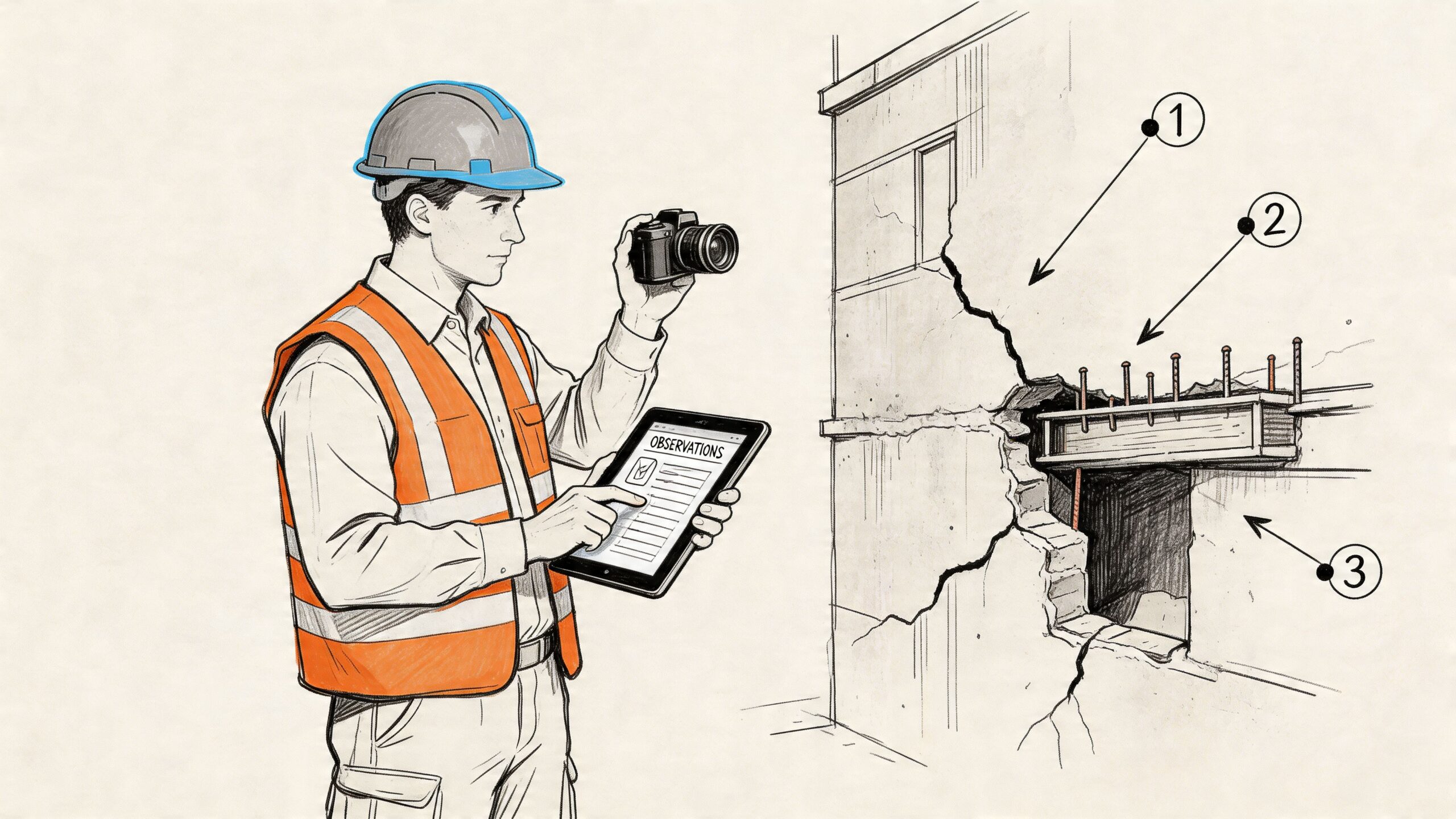
Once on site, the inspector doesn’t wander. The work is methodical. Good inspection discipline is what turns a field visit into a usable claim document.
Arrival and site control
The first job is orientation. The inspector identifies hazards, confirms the structure matches the assignment, notes weather and access limitations, and determines whether all elevations and interior areas can be reviewed safely. On a steep or tall roof, this is also where judgment matters most. If access conditions are unsafe, the inspector documents why and adjusts the inspection method rather than forcing a climb.
Then comes scene-setting documentation. Wide exterior photos establish the property context. Elevation photos show each side of the structure. Site photos capture fencing, vegetation, outbuildings, tree strikes, detached materials, and any temporary repairs already in place.
A disciplined inspector also pays attention to sequence. The report should let a reviewer reconstruct the site visit in logical order. If a desk adjuster has to guess where a photo was taken, the inspection lost value.
Damage scoping and evidence capture
After the site baseline is established, the inspector begins detailed scoping. On roofing claims, that means documenting slope conditions, coverings, penetrations, valleys, ridges, soft metal, gutters, vents, flashing, and collateral indicators. On interior claims, it means following the moisture path, not just photographing the obvious stain.
The tools matter here. Top inspectors use moisture meters, which detect subsurface water with up to ±3% accuracy, and laser measuring devices that reduce estimation errors from 15-20% with manual methods to under 5%. Proficient use of this technology is correlated with 30-50% faster carrier approvals because the file contains quantitative evidence instead of loose impressions, as described in ZipRecruiter’s overview of independent field inspector tools and hiring expectations.
That’s not a minor upgrade. It changes how quickly the file becomes actionable.
A moisture meter can confirm whether staining is tied to active intrusion or older, dried conditions. A laser measurer gives the report dimensional credibility, especially when roof sections are difficult to pace off accurately. Inspection management platforms such as InspectAll or HomeGauge help organize photos, notes, and measurements so the final report reads like one inspection, not five disconnected observations.
What strong photo documentation looks like
The difference between weak and strong field work often shows up in the photo set. Strong inspectors usually collect:
- Establishing shots: Front, rear, and each elevation to orient the file reviewer.
- Mid-range context photos: Damage areas shown in relation to nearby building features.
- Tight detail photos: Close-ups of punctures, fractures, lifted components, creasing, impact marks, or moisture indicators.
- Scale-based images: Photos that include a measuring reference when size matters.
- Mitigation condition photos: Tarping, temporary seals, exposed openings, and active leak points.
Short field demonstrations can help teams understand the rhythm of that process:
Interviews and field judgment
An on-site inspection also includes listening. Homeowners, occupants, maintenance staff, or contractors may provide timeline details, prior repair history, or loss observations that help frame the inspection. But experienced inspectors don’t let interviews replace physical evidence. They use conversations to guide where to look next, then document what they can verify.
This is also where a firm like Fox Claims Consultants LLC may fit as one operational option for carriers needing steep-roof access, ladder assist, emergency response, and field reporting tied to claim movement rather than casual site visits. On any inspection model, the principle is the same. The field partner has to produce evidence that stands up when reviewed later.
Even support gear matters on the margins. Teams that manage high-risk field operations tend to think in systems, from access planning to replacement essentials such as ZOLL emergency medical pads used in response environments, because a preventable field problem can derail the assignment.
What doesn’t work
A rushed inspection usually has the same warning signs:
- Unlabeled photos
- No moisture verification
- No explanation of inaccessible areas
- No distinction between observed damage and reported damage
- Narratives that are too vague to support next steps
The inspector’s report should answer questions before the adjuster has to ask them.
That’s the benchmark. If the report creates more follow-up than it resolves, the inspection wasn’t strategic. It was just activity.
Decoding Inspector Certifications and Safety Protocols
A field inspector can have good instincts and still be the wrong choice for a difficult assignment. On steep roofs, storm-damaged structures, and unstable access conditions, credentials and safety protocols aren’t paperwork. They are part of claim risk control.
Carriers sometimes focus so hard on turnaround time that they overlook qualification depth. That’s a mistake. Fast reporting only helps if the person collecting the data knows what they’re looking at and can reach the area safely without creating a new liability problem.
Certifications that mean something in the field
Not every credential carries the same practical value. The useful question is simple. Does this certification tell you the inspector can evaluate a specific loss type or perform a specific access task competently?
A few categories matter more than others:
- Storm damage credentials: These indicate focused training in hail, wind, and roofing damage recognition.
- Water and restoration training: Useful when interior moisture mapping and cause-path analysis matter.
- Fall protection and rope access training: Relevant for steep, high, or otherwise difficult structures.
- Equipment-specific training: Important when the work depends on harnesses, ladders, moisture meters, and other field tools being used correctly.
The right mix depends on the assignment. A low-slope commercial roof with ponding concerns isn’t the same job as a storm-struck residence with tree impact and interior leakage on multiple levels.
Safety is part of report quality
Unsafe field work doesn’t just endanger the inspector. It degrades the inspection itself. People who feel rushed, unsupported, or physically exposed make worse observations. They skip angles, shorten time on slope, avoid key elevations, or force access they shouldn’t attempt.
A professional inspection partner should have documented safety habits that show up in daily operations:
| Safety area | What competent practice looks like |
|---|---|
| Pre-site planning | Hazard review, access plan, weather check, assignment suitability |
| On-site decision-making | Clear stop-work authority when conditions become unsafe |
| Protective equipment | Proper use of ladders, anchors, harnesses, footwear, and helmets when required |
| Communication | Reliable check-in process for solo field assignments |
| Documentation | Clear notes on inaccessible areas and why they were not entered |
That last point matters. Some inspectors think documenting an access limitation makes them look weak. It does the opposite. It shows judgment. A report that states an area was unsafe to access, explains why, and documents available evidence from alternate viewpoints is more credible than a reckless climb followed by incomplete notes.
A carrier doesn’t need a fearless inspector. It needs a disciplined one.
Why this protects the client too
Every high-risk inspection carries liability around site conditions, worker safety, and decision quality. When the inspection partner has a real safety program, the client gets protection in several ways. The inspection is more likely to be completed consistently. The report is more likely to explain limitations transparently. The assignment is less likely to trigger preventable injuries or disputes about how the field work was performed.
That operational mindset shows up in the details. Organizations that take field risk seriously usually maintain a broader safety culture, including awareness tools such as carbon monoxide and propane leak detection equipment for hazardous environments where atmospheric conditions matter.
The practical takeaway is simple. If a firm can’t explain its certifications, safety standards, and stop-work rules in plain language, don’t send it onto a difficult property.
Strategic Triggers for Hiring an Inspection Partner
Some claims should go straight to an inspection partner without debate. Waiting too long often costs more in delay, confusion, and avoidable loss than the field deployment ever would.
The right time to engage an independent field inspector is usually when the claim needs one of three things. Safe access, neutral documentation, or fast loss stabilization. If the file needs all three, the decision is even easier.
The claims that should trigger immediate deployment
CAT events are the clearest example. When storms hit a region hard, internal teams get buried quickly. Desk adjusters can manage communication and file triage, but they can’t create field certainty from a distance. A dedicated inspection partner gives the carrier a way to scale evidence collection without sacrificing structure.
High-risk access is another obvious trigger. Steep roofs, tall elevations, unstable surfaces, tree strikes, and properties with partial collapse indicators all require a specialist mindset. These are not ideal assignments for casual vendor networks or “someone nearby with a ladder.”
Then there are claims where the first issue isn’t scope. It’s mitigation. If the roof opening is active, interior contents are exposed, or weather is still moving through the area, the claim needs field action that limits further damage while preserving documentation.
Common situations where hiring early works better
The following situations usually justify early deployment:
- Storm surge in claim volume: Internal resources are tied up and field evidence is lagging behind incoming files.
- Steep or tall roofs: Access difficulty raises both safety risk and documentation risk.
- Conflicting accounts: The homeowner, contractor, and initial photos don’t line up.
- Need for ladder assist: The adjuster needs reliable access support and objective roof documentation.
- Emergency protection needs: Tarping or temporary repairs may be necessary before conditions worsen.
A lot of claim teams treat inspection support as a backup plan. In practice, it works better as an early control measure.
Why this is a management decision, not just a field decision
Hiring an inspection partner isn’t just about who climbs the roof. It’s about controlling the file before it spreads. Every day without good field information leaves room for avoidable friction. More calls. More opinion-based scope arguments. More reserve uncertainty. More frustrated policyholders.
There’s also a vendor network angle. Claims teams that handle broad territories need partners with real geographic flexibility and field consistency. Even something as ordinary as logistics and vehicle readiness matters when scaling response across regions, which is why operationally minded teams pay attention to assets tied to mobility and field durability, including practical components like a front bumper reinforcement for fleet vehicles.
Deploy the inspector when the claim needs clarity, not when the file has already hardened into a dispute.
That’s the strategic shift. The independent field inspector isn’t just there to document damage after everyone else has stalled. The inspector is the move that prevents stall in the first place.
Choosing the Right Independent Inspector Firm
Plenty of firms can say they perform inspections. Fewer can show that their reports reduce claim friction. When you evaluate an independent field inspector firm, the question isn’t whether they can visit a property. The question is whether they can deliver field intelligence that is safe, objective, consistent, and easy to use.
Start with the report, not the sales pitch
Ask for a real sample report with identifying details removed. A capable firm should be comfortable showing how it documents an assignment.
Look for a report that does these things well:
- Builds a logical record: The reviewer should understand the site layout, access points, and damage sequence without guessing.
- Separates observation from allegation: Reported conditions and observed conditions should never be blurred together.
- Explains limitations clearly: If an area was unsafe or inaccessible, the narrative should say so plainly.
- Uses photos as evidence, not decoration: Images should support findings, not overwhelm the reader.
- Supports next steps: A good report tells the claim team what was found and what should happen next from an operational standpoint.
If the report feels like a photo dump with a thin summary, move on.
Evaluate communication under real claim pressure
The second screen is communication discipline. Most claim problems blamed on “inspection delays” are communication failures. The field visit happened. The client just didn’t know status, limitations, or expected delivery timing.
A dependable inspection firm should be able to answer:
| Evaluation question | What you want to hear |
|---|---|
| How do you confirm assignment acceptance? | Prompt acknowledgment with scheduling or access notes |
| How do you report field issues? | Immediate escalation for no-contact, unsafe access, or active mitigation needs |
| What does a finished package include? | Standardized narrative, labeled photos, measurements, and site observations |
| How do you handle re-inspections? | Clear process, documented reason, and continuity from the first visit |
Communication style matters too. The best firms don’t bury the lead. If active leaking is present, they say so. If the slope was unsafe, they say so. If the contractor’s claim doesn’t match field conditions, they document it without drifting into argument.
Understand the labor and compliance risk
Many buyers get careless when comparing inspection vendors only on speed and price, ignoring how the labor model behind the network could create downstream legal exposure.
A January 2024 DOL Final Rule makes it harder to classify inspectors as independent contractors, exposing firms to backpay lawsuits for misclassification. At the same time, top-paying cities offer about 28% above the national average hourly wage of $25.18, which raises the financial stakes for carriers building and maintaining a vendor network, as noted in this overview of inspector classification and market pay context.
That has two practical implications.
First, a firm that relies on loosely managed gig labor may introduce compliance risk the client never intended to absorb. Second, unusually low pricing can be a warning sign rather than a bargain. If the economics don’t support trained, safe, responsive field work, the service model may be unstable.
Use compensation reality as a screening tool
Compensation benchmarks won’t tell you everything, but they do help set realistic expectations. Independent field inspectors in the United States earn a national average hourly wage of $25.18, with a median annual salary of about $50,500. The range runs from $19.23 at the 25th percentile to $28.85 at the 75th percentile, with higher-end extremes up to $44.95 per hour, according to ZipRecruiter salary data for independent field inspectors.
You don’t need to mirror those numbers directly in a vendor agreement. But you should understand what they imply. Skilled inspectors with technical tools, safe access capabilities, and disciplined reporting don’t operate on a bargain-basement model for long. If a vendor underprices aggressively, ask how they maintain training, communication standards, and field readiness.
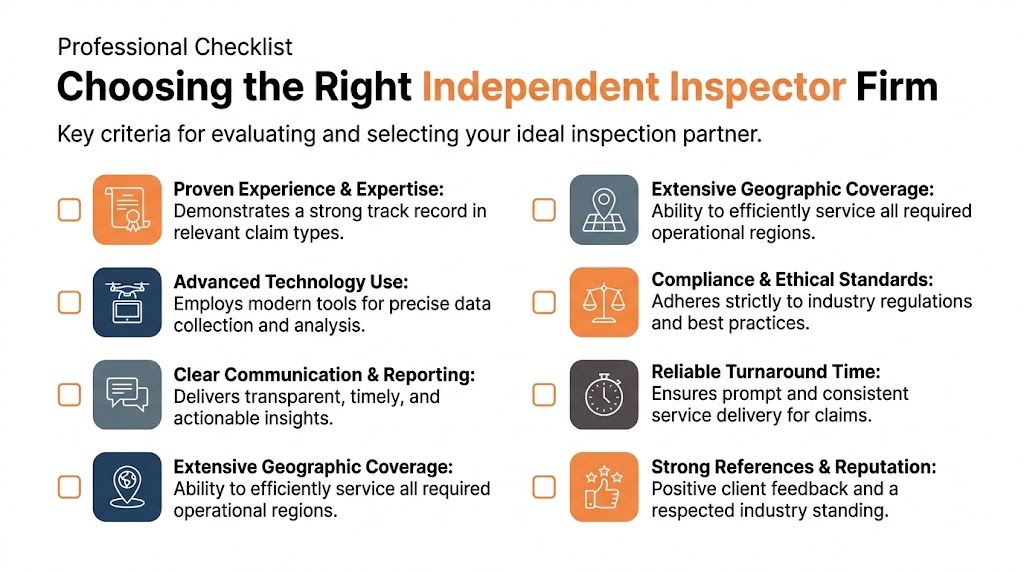
Seven filters that usually expose weak vendors
Use these criteria during selection:
- Proven assignment fit: Ask for examples of similar claim types, especially steep roof, storm, or emergency response work.
- Technology use: Confirm they use moisture meters, laser measurement, and organized inspection management software where appropriate.
- Safety documentation: Require a clear explanation of field safety protocols and stop-work authority.
- Geographic coverage: Make sure their coverage map matches your actual claim footprint.
- Quality control: Ask who reviews reports before delivery and how inconsistencies are handled.
- Escalation habits: Find out how they flag urgent mitigation issues from the field.
- Labor model transparency: Ask who performs the work, how they’re managed, and how compliance is handled.
Low price is only a win if the report closes questions. If it creates supplements, re-inspections, and disputes, it was expensive.
The best fit is usually boring in the right ways
A strong inspector firm won’t rely on flashy language. It will show repeatable process. Assignment intake is clean. Site updates are timely. Reports are readable. Urgent conditions are escalated fast. Re-inspections don’t start from scratch because the first file was organized correctly.
That kind of reliability is what claims teams need. Not drama. Not mystery. Not “we’ll see what we find.” They need a field partner whose work product lowers friction across the life of the claim.
The Inspector as a Strategic Claims Asset
The biggest mistake in this space is treating the independent field inspector like a basic commodity. That mindset misses what the role entails when it’s handled well.
A top-tier inspector creates order where claims usually lose it. They secure field facts early, document conditions in a way decision-makers can trust, identify active exposure before more damage develops, and give the file a clean evidentiary backbone. That work supports faster decisions, tighter scope control, cleaner communication, and fewer avoidable disputes.

Claims teams feel that impact immediately. The desk adjuster gets a usable report instead of a pile of loose images. The carrier gets a clearer basis for next-step decisions. The policyholder gets movement and communication instead of silence. The contractor gets a documented condition set to respond to, even when disagreements remain.
Why the role deserves a strategic seat
The inspector’s value shows up in three areas:
- Speed: Good field evidence reduces waiting, rework, and unnecessary back-and-forth.
- Accuracy: Measurements, moisture verification, and disciplined visuals narrow the room for bad assumptions.
- Risk mitigation: Early documentation and mitigation awareness help prevent a manageable loss from becoming a larger one.
That’s why the role should be built into claim strategy, not bolted on after the file starts slipping. The right inspection partner isn’t there just to observe damage. They help stabilize the claim itself.
There’s a practical discipline to that kind of work. It resembles any technical field service where the job depends on proper support, controlled handling, and the right tools being ready when needed, even down to specialized shop equipment like a tool for holding mountain bike forks and shocks during service. The principle is the same. Precision work breaks down when support systems are loose.
The best independent field inspector doesn’t add activity to a claim. They remove uncertainty from it.
When a property loss turns chaotic, that’s the difference that matters. Not more emails. Not more opinions. Better field truth, delivered fast enough to matter.
If you need a field partner that can support steep and tall roof inspections, storm and tree damage assessments, ladder assist, emergency tarping, and detailed property documentation, Fox Claims Consultants LLC provides nationwide property inspection support designed to help carriers, adjusters, and property owners move claims forward with clearer field evidence and faster next steps.
Leave a Reply