
After a hailstorm blows through, you’re left with the aftermath. The most common signs of hail damage on a roof are pretty easy to spot once you know what you’re looking for: dark, "bald" spots on shingles from granule loss, dents on metal surfaces, and even visible cracks.
Think of this first look from the ground as a quick triage—a way to figure out if you need to call in the professionals.
Your First Look at Post-Storm Roof Damage
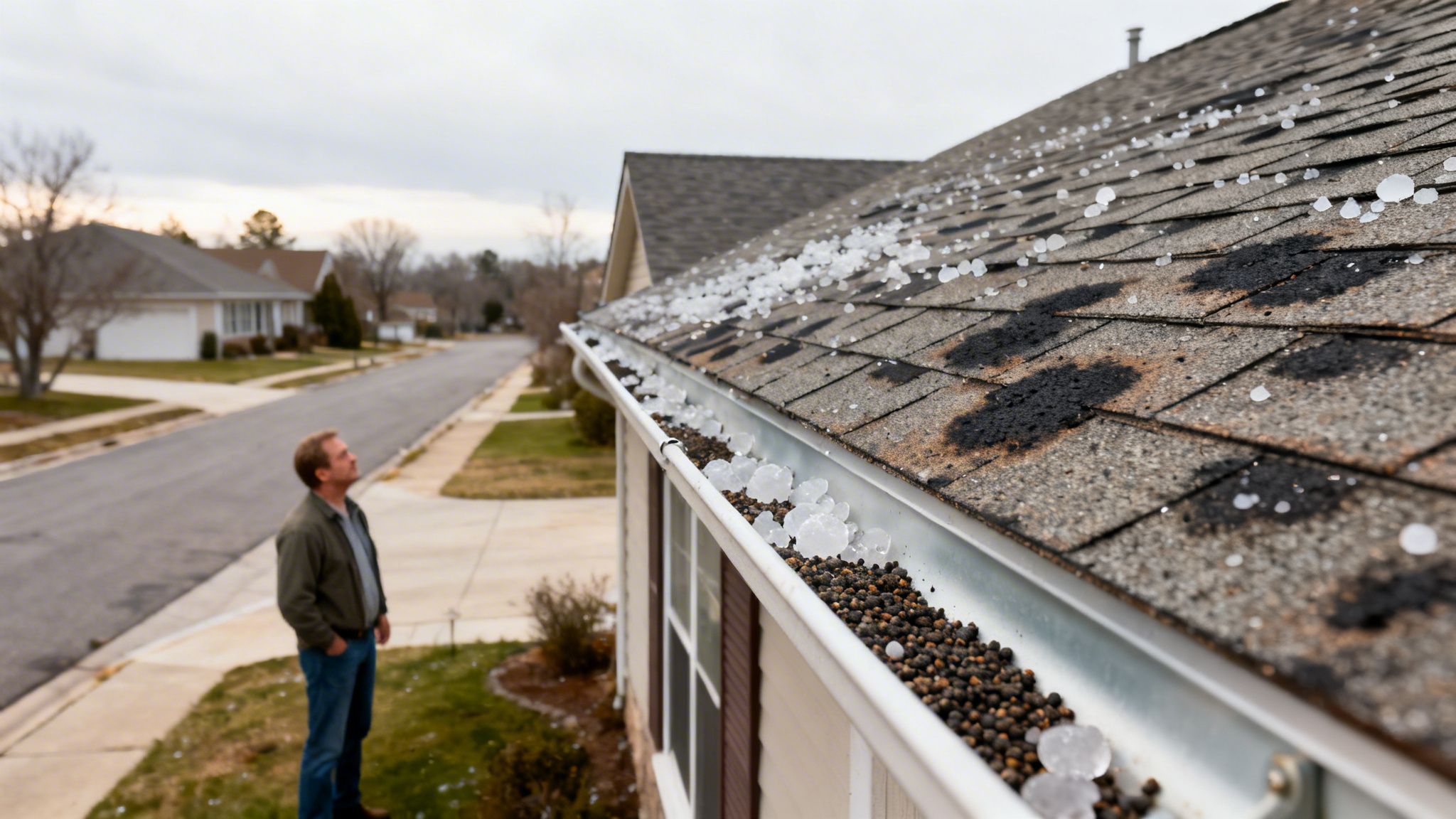
When the sky clears, your eyes might be drawn to the obvious mess, like fallen branches or debris in the yard. But the real, silent threat to your home could be right above your head. A quick post-storm roof check is the most critical first step you can take to protect your property.
You don't have to be a roofer to see the red flags. You just need to know where to look.
This initial check is all about identifying the most obvious problems to gauge the storm's severity and decide what to do next. You can—and should—do this safely from the ground, maybe with a pair of binoculars. It’s the best way to determine if a full, professional inspection is really needed.
The Big Three Initial Indicators
When our pros arrive on-site, they’re looking for three things right off the bat. These are the most immediate signs that hail has compromised your roof’s ability to protect your home. If you spot even one of them, it's time for a closer look.
To help you know what to look for, here's a quick summary of the top three signs and what they really mean for your roof.
Quick Guide to Initial Hail Damage Signs
| Sign of Damage | What It Looks Like | Why It Matters |
|---|---|---|
| Granule Loss | Dark, circular "bald spots" on shingles; a pile of sand-like granules in your gutters. | Those granules are like sunscreen for your roof. Without them, the shingle is exposed to UV rays, which will make it brittle and accelerate its failure. |
| Denting | Small, round dents on soft metal surfaces like your vents, flashing, and gutters. | If soft metals are dented, your shingles almost certainly took a beating, too. This is the clearest sign your roof was hit by hail with enough force to cause real damage. |
| Cracking or Bruising | Visible cracks on shingles or tiles; soft, spongy "bruises" on asphalt shingles that give when you press on them. | A crack or bruise means the underlying mat of the shingle is fractured. This is a direct pathway for water to get in, leading to leaks and structural problems. |
Seeing these signs is the first step. The next is knowing what they mean and taking the right action to prevent small issues from turning into major headaches.
A sagging roofline, persistent leaks, or water stains on your ceiling are not just signs—they are emergencies. If you notice any of these, call for a professional assessment immediately. The damage is likely far more serious than what you can see from the outside.
It’s also important to be able to tell the difference between storm damage and normal wear and tear. Hail damage usually shows up in a random, scattered pattern, while age-related problems tend to be more uniform across the whole roof.
Understanding what you're seeing is the key to protecting your investment. If you’re ever unsure, getting a professional evaluation is the only way to get the clarity you need. You can learn more about how a professional insurance roof inspection service documents these specific issues to build a clear and accurate claim.
Understanding Granule Loss on Asphalt Shingles
Think of the tiny granules on your asphalt shingles as a permanent, heavy-duty sunscreen. Their main job isn’t about color; it’s to shield the asphalt underneath from the sun’s relentless UV radiation. When a hailstorm hits, this is the roof’s first line of defense.
That’s why one of the most common—and often underestimated—signs of hail damage is granule loss. Hailstones hammer the shingle surface, knocking these crucial granules loose and leaving behind what roofers call "bald spots."
These bald spots show up as dark or shiny patches where the underlying black asphalt is now exposed. Without its protective coating, the shingle is in trouble. It's like getting a severe sunburn—the initial damage might look cosmetic, but it signals a deeper problem that only gets worse.
Why Granule Loss Is a Serious Problem
Exposed asphalt is a major issue. UV rays start to break it down almost immediately, causing the shingle to become dry, brittle, and inflexible. This accelerated aging process drastically shortens your roof's lifespan and makes it far more likely to crack and leak during the next storm.
What starts as a few innocent-looking bald spots can quickly cascade into widespread roof failure. Once that protective barrier is gone, the integrity of the entire shingle is compromised.
Key Takeaway: Granule loss isn't just cosmetic. It's direct physical proof of forceful impact and the first step toward a shingle's premature failure from UV exposure.
And the proof isn't just on the roof. Check your gutters and downspouts. If you find a large accumulation of black, sand-like particles after a storm, that’s a clear sign your roof has sustained significant impact damage.
The Link Between Hail and Premature Aging
Hail damage often starts with this subtle loss of granules. The impacts batter the protective layer off, exposing the asphalt to UV rays and kicking deterioration into high gear. This sign is critical because, if ignored, it’s a direct path to leaks.
These events are happening more and more. According to NOAA data, hail events have surged, with thousands of reports annually hitting states like Texas and Illinois. Texas, the epicenter of this activity, averages hundreds of storms yearly and consistently leads the nation in hail loss claims. You can explore more data on hail storm trends to see the impact on properties across the U.S.
Spotting and documenting granule loss is a vital part of any insurance claim. It provides concrete proof that the storm was strong enough to cause legitimate damage. Without this evidence, it's tough to distinguish between storm damage and normal wear and tear.
When you're inspecting the roof, look for:
- Dark, circular spots on shingles where granules have been knocked off.
- Piles of black "sand" collected in the gutters or at the bottom of downspouts.
- A shiny appearance on the shingle where the raw asphalt is exposed to the sun.
Recognizing these indicators is the first step in addressing a serious threat to the roof’s health. It’s a foundational piece of the puzzle when you’re assessing the true extent of hail's impact.
How to Find Dents and Bruises on Different Roofs
If granule loss is the quiet clue a hailstorm leaves behind, then dents and bruises are the obvious fingerprints at the scene. These impact marks are one of the most undeniable signs of hail damage, but they look different depending on the roof. The material itself dictates exactly how it will show this kind of trauma.
Think about it this way: dropping a golf ball on a concrete patio might only leave a tiny chip. But drop that same golf ball on a car hood, and you've got a noticeable dent. Roofs are no different, and knowing what to look for on each surface is the key to an accurate assessment.
Identifying Bruises on Asphalt Shingles
When it comes to asphalt shingles—the most common material on the market—hail damage isn’t always a visible dent. Instead, it often creates a “bruise”. This is a soft, spongy spot where the hailstone has actually fractured the shingle's inner fiberglass mat. A bruise is a critical distinction because it’s a structural failure, not just a cosmetic scuff.
You can't always spot these bruises from the ground. The real test is done by touch.
- How to Check: When you’re safely on the roof, press gently on a spot where you suspect an impact. A healthy shingle will feel firm under your finger. A bruised area will feel soft and give way, almost like pressing on a ripe avocado.
- What It Looks Like: A bruise might show up as a dark spot, sometimes with a circular pattern of missing granules, but sometimes without any significant granule loss at all. That underlying softness is the true giveaway.
- Why It Matters: A bruised shingle has lost its integrity. It’s now a weak point that will eventually crack, letting water seep through to the roof deck below.
This is where the damage cycle really begins.
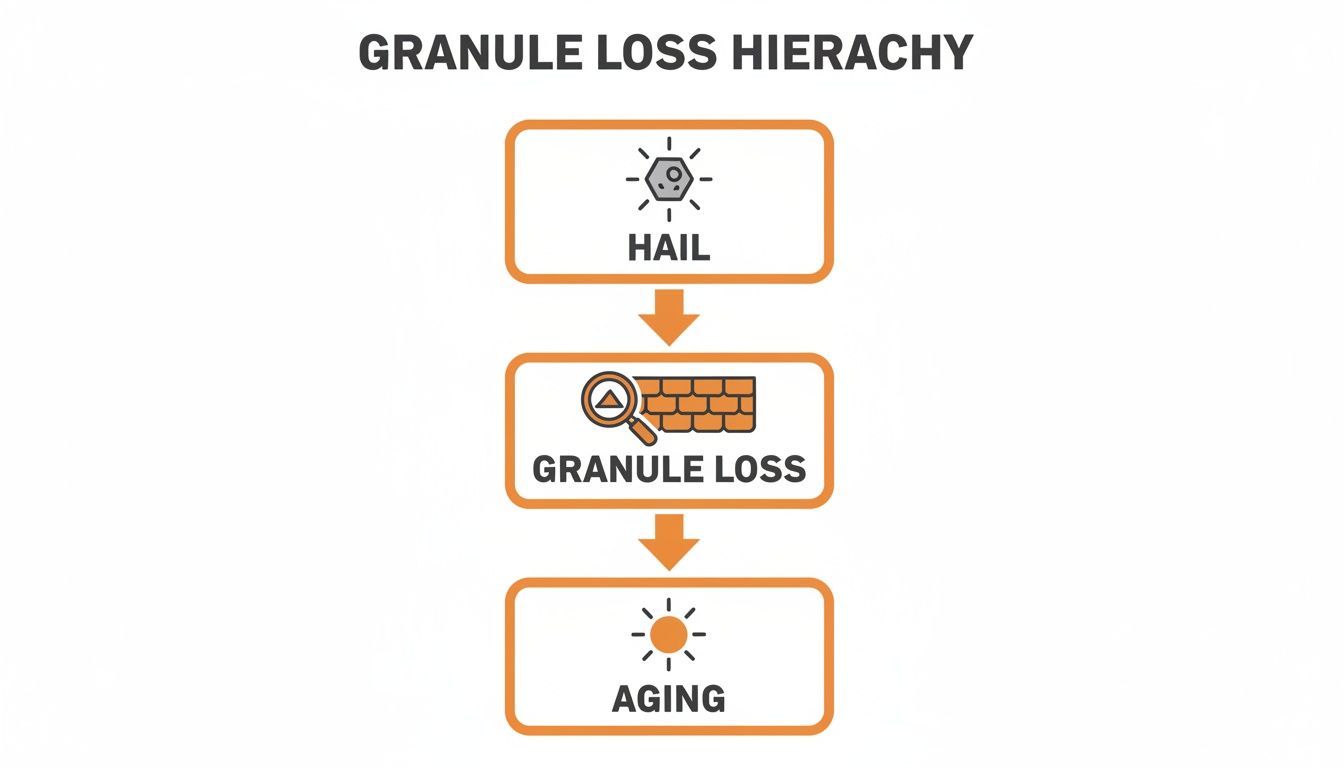
As the diagram shows, hail causes granule loss, which exposes the asphalt to UV rays and dramatically speeds up the aging process.
Finding Dents on Metal Roofs
Unlike the subtle bruising on asphalt, hail damage on a metal roof is usually obvious. Hailstones leave behind distinct, circular dents on everything from the panels and flashing to the vents and gutters. These aren't just an eyesore; they represent a major breach in the roof's defenses.
When a metal roof is dented, the impact often cracks or chips the protective coating. This exposes the raw metal underneath to moisture, creating a direct pathway for rust and corrosion to begin.
Even small dents can snowball into huge problems. Each dent creates a small basin where water can pool, which accelerates the breakdown of the panel’s finish and leads straight to premature failure.
Spotting Chips and Fractures on Tile and Wood
Harder roofing materials like clay, slate, and wood shakes don't dent. They react to hail with more dramatic, brittle fractures—they chip, crack, or completely shatter.
- Tile Roofs (Clay or Slate): Look for fresh, sharp-edged chips, crescent-shaped cracks, or tiles that are broken clean through. The damage pattern will be random, which is how you can tell it’s from hail and not just old age.
- Wood Shakes: Hail often causes splits right along the wood grain. These new cracks will be lighter in color than the weathered wood surrounding them, making them easy to spot as a recent break.
The size of the hail is directly tied to how bad the damage is. These dents, bruises, and fractures are the clearest signs your roof has been compromised. Baseball-sized hail (2 3/4 inches) almost always demands a full roof replacement, while anything larger causes catastrophic failure. Wind and hail account for a massive percentage of property damage claims in the U.S., especially in states like Texas and Colorado. You can learn more about recent hail damage statistics to see the full financial picture.
Of course. Here is the rewritten section, adopting the expert, human-written voice and style from your examples.
Spotting Cracks and Fractures on Shingles and Tiles
If dents and granule loss are serious problems, then cracks and fractures are the gaping wounds of a hailstorm. They aren't subtle hints of damage; they are undeniable breaches in your roof's primary line of defense. When hail hits hard enough to shatter or split your roofing, it has created a direct path for water into your home.
It’s crucial to know the difference between a fresh, hail-induced fracture and the hairline cracks that come with normal aging. Think of it this way: an old piece of wood left in the sun might have tiny splits all over it from years of weathering. But if you hit that same wood with a hammer, you’ll see a sharp, fresh break right at the point of impact.
That’s exactly what we look for on a roof. Hail damage has a signature appearance that sets it apart from simple wear and tear.
How Fractures Appear on Different Roof Materials
The way a material breaks comes down to its composition. Brittle materials shatter, while more flexible ones will split. Knowing what to look for helps you identify the specific signs of hail damage on your roof.
Asphalt Shingles: A hard enough impact won't just bruise the shingle; it will fracture the entire piece. The underlying fiberglass mat tears, leaving a clean crack that runs straight through the shingle. You’ll typically see these cracks randomly scattered where the hail hit, not in a uniform pattern.
Wood Shakes: Wood splits along its natural grain. A forceful hailstone will cause a split that follows this grain, and the newly exposed wood will look much lighter and fresher than the weathered surface around it, making it easy to spot.
Slate and Clay Tiles: These materials are tough, but they're also brittle. They don’t dent—they shatter. Hail will chip the edges, punch out crescent-shaped "half-moon" fractures, or simply break the tile into pieces. A single, large hailstone can easily destroy a solid tile.
A cracked shingle is a major red flag. It instantly compromises the material and lets water seep underneath, creating the perfect environment for mold to take hold. This kind of damage is often found with heavy granule loss and denting, impacting millions of U.S. homes.
Hail size charts show that 3-inch "large apple" sized hail is capable of causing extreme damage to nearly any roof type. With major hail events on the rise in states like Colorado, Missouri, and Nebraska, top insurers are seeing claims climb into the billions. You can read more about the data on roof damage across America to see just how widespread this problem is.
The Urgency of Addressing Cracks
Unlike granule loss, which is a slow-burn problem, a crack is an emergency. It's a direct pipeline for water into your home's structure.
Every time it rains, water will work its way through those fractures, soaking the roof deck below. This leads to rot, saturated insulation, and eventually, water stains on your interior ceilings.
The moment you see a crack, the clock starts ticking. The damage will only get worse, and what might have been a simple roof repair can quickly escalate into a massive project involving interior restoration and mold remediation. This is why getting prompt, clear photos is absolutely essential for a successful insurance claim.
Finding Collateral Damage Around Your Property
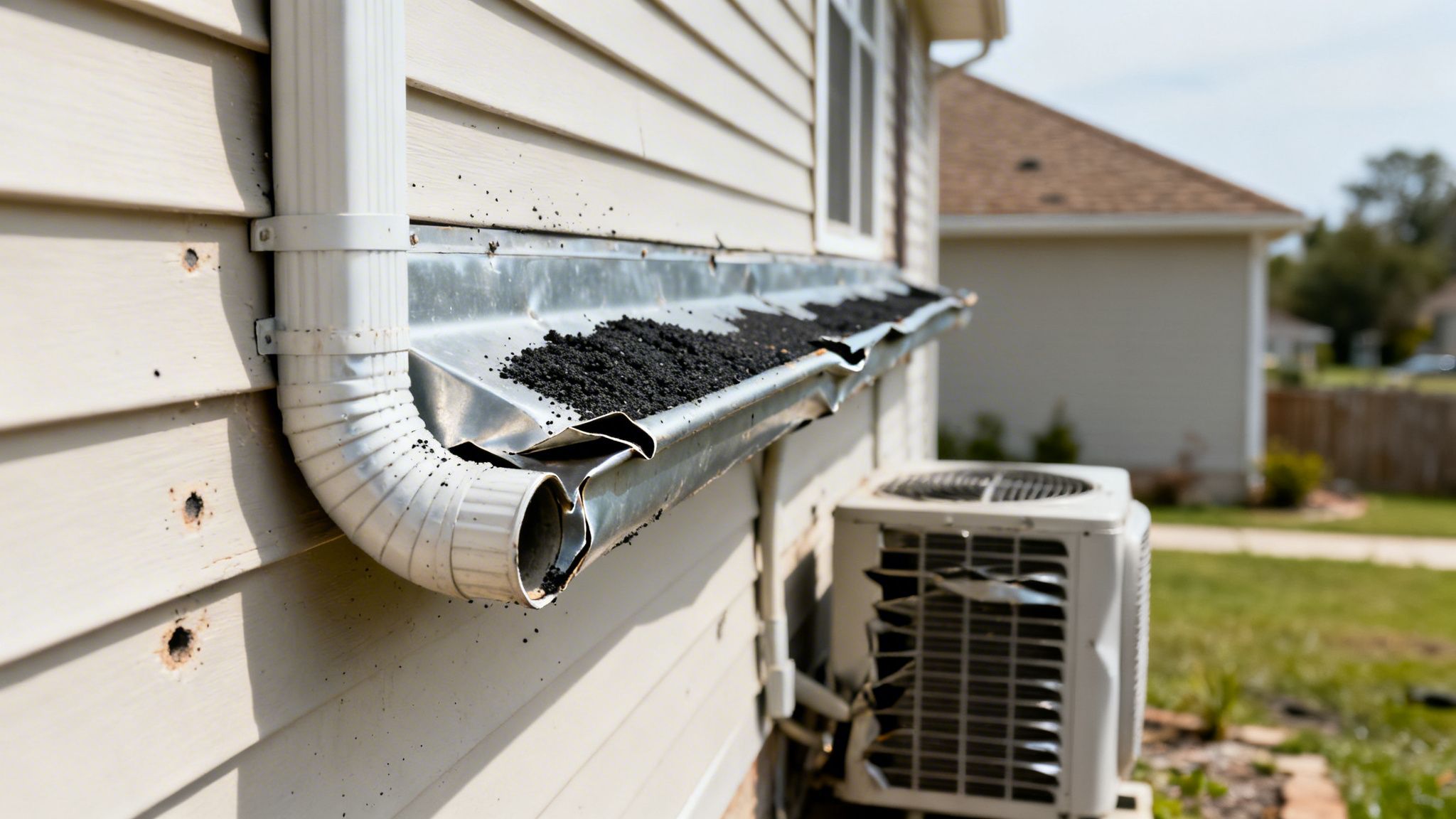
When it comes to proving a hail claim, your roof is only half the story. To build a solid case, you need to think like a seasoned claims adjuster and look for collateral damage. This is the other evidence around your property that proves a storm was powerful enough to cause real harm.
Think about it this way: explaining a car crash with a single photo of a dented door is tough. But if you show pictures of skid marks, shattered glass on the road, and a broken stoplight, you paint a much clearer picture. That's exactly what collateral damage does for your hail claim.
If softer materials all around your home are dented and battered, it’s a sure bet your roof took a beating, too.
Your Collateral Damage Inspection Checklist
A quick walk around your property can reveal a goldmine of evidence. Many items are made of softer, more fragile materials than your roof, which makes them perfect indicators of the hail's size and force. Start looking for dings, dents, and cracks on these key features.
Here's a practical checklist of what to inspect:
- Gutters and Downspouts: These are often the first and most obvious victims. Check for dents on the horizontal runs and vertical downspouts. Their soft aluminum or vinyl shows impacts clearly.
- Roof Vents and Flashing: Get a good look at all the metal on your roof. Turbine vents, plumbing boots, and valley flashing will show dents, providing direct evidence of what was happening on the roof's surface.
- Window Screens and Frames: Fine mesh screens can be easily torn or dented by hail. Don't forget to check the soft aluminum or vinyl window frames for small, circular impact marks.
- Siding: Your siding can tell a big story. Vinyl siding often cracks or gets holes punched right through it, while aluminum siding will be covered in dents.
- Air Conditioning Unit: The thin aluminum fins on the side of your AC condenser are incredibly delicate. Even small hailstones can leave them flattened, which is a powerful piece of evidence.
- Mailbox and Exterior Light Fixtures: These are the unsung heroes of a hail inspection. Dents on a metal mailbox or cracks on a plastic light fixture are unmistakable signs of forceful impacts.
Building Your Case with Evidence
Every dent on your gutters and each crack in your siding helps weave a clear story for the insurance adjuster. This collateral damage is undeniable proof that the impacts on your roof aren't from normal wear and tear, blistering, or some manufacturing defect. It confirms the "when" and "how."
Key Insight: Collateral damage is crucial for establishing a "date of loss." When damage is consistent across multiple surfaces—from the AC unit to the roof vents—it becomes much harder for an insurer to argue that a single, powerful storm wasn't the cause.
When you're documenting, take photos of everything. A close-up of a dented downspout paired with a wide shot of that entire side of the house provides essential context. This is the thorough approach professionals use to make sure an assessment is airtight.
While hail is a common event covered by homeowners insurance, other things like falling trees can cause major problems, too. Knowing how insurance covers tree damage gives you a fuller picture of how to protect your property. Finding these additional signs of damage is what turns a simple observation into a strong, evidence-backed claim.
Your Next Steps After Finding Hail Damage
Finding the telltale signs of hail damage on your roof is a big moment, but it’s just the beginning. What you do next is every bit as important as identifying the damage in the first place. Quick, smart actions can save your home from more problems and make the insurance claims process go a whole lot smoother.
Think of yourself as the first responder to an accident. Your job is to stop things from getting worse and to gather the right information for the experts. That boils down to two key goals: immediate damage control and rock-solid documentation.
Prioritize Safety and Temporary Repairs
First things first: safety. Never climb onto a roof that's steep, wet, or looks unstable. It’s simply not worth the risk. If you can see major cracks, broken tiles, or missing shingles from the ground, your immediate mission is to stop water from getting inside.
This is where emergency repairs are essential.
- Tarping: The go-to temporary fix is covering the damaged section with a heavy-duty tarp. This acts as a barrier against rain, keeping water out of your attic where it can cause rot, mold, and ugly stains on your ceiling.
- Minor Fixes: For a small, isolated crack or hole that you can reach safely, a quick patch or sealant can work as a stopgap. Just remember, these are not permanent solutions.
Insurance carriers know these temporary fixes are necessary to mitigate further loss. In fact, most policies will cover the cost of these emergency services, so don't think twice about calling a professional for help—especially for a high or complex roof.
Document Everything Thoroughly
Once you’ve managed the immediate threat of water, it’s time to put on your detective hat. Great documentation is the bedrock of a successful insurance claim. A few blurry photos and a vague story won't get you very far. You need to build a case with undeniable evidence.
Start by taking plenty of clear, high-resolution photos and videos.
Pro Tip: When you’re documenting, think in angles. Get close-up shots of individual dents, cracks, and bruises. Then, step back and take wider shots that show the damaged areas in the context of the whole roof.
Next, create a detailed log that includes:
- Date of the Storm: Pinpoint the exact date the hailstorm happened.
- Photo and Video Log: Number your photos and write a short description for each (e.g., "Photo 1: Cracked tile on the west-facing slope").
- Written Notes: Describe the damage you see, noting its location, size, and type. Don't forget to list any collateral damage to gutters, siding, or AC units—it all helps build your case.
Contact Your Insurance Provider and a Professional
With your initial evidence gathered, it’s time to make two calls. First, call your insurance provider to open a claim. The sooner you report the damage, the sooner the process can get rolling. Give them the storm date and a quick rundown of what you found.
Your second call should be to a trusted professional. Navigating an insurance claim can feel like a maze, and having an expert in your corner is a massive advantage. They provide an unbiased, professional assessment that closes the gap between finding damage and getting it resolved fairly.
For a deeper look at how an expert can help, you can learn about the benefits of professional insurance claims assistance and how it can make your life easier. A professional ensures your documentation is complete and accurate, dramatically reducing the odds of frustrating disputes and delays.
Common Questions About Hail Damage on Roofs
After a hailstorm passes, the questions start rolling in. Homeowners are often left looking at their roof, wondering what's a real problem and what isn't.
We hear these questions all the time. Here are the clear, straight-to-the-point answers you need to navigate the aftermath of a storm.
How Can I Tell Hail Damage From Normal Aging?
This is a big one. The easiest way to think about it is consistency versus randomness. Normal aging—like weathering from the sun and rain—shows up pretty uniformly across your entire roof.
Hail damage, on the other hand, is completely random. It’s defined by the chaos of the storm. You’ll see sporadic dings, dents, and circular "bruises" that often appear on just one side of the roof, following the direction of the wind and hail. An old roof has widespread granule loss; a hail-damaged roof has distinct impact marks.
What Size Hail Actually Causes Roof Damage?
While even small, wind-driven hail can strip away protective granules, the real trouble usually starts with hailstones around 1 inch in diameter—roughly the size of a quarter. This is when you'll start to see bruising on asphalt shingles and dents in soft metals like gutters and roof vents.
Once you get to 1.75 inches (golf ball size), the damage gets serious. We’re talking about cracked shingles and fractured siding. Anything bigger is a major threat, often leading to severe, widespread issues that demand a full roof replacement. Of course, the severity always depends on the hail's density, wind speeds, and your specific roofing material.
Key Insight: Don’t assume small hail means no damage. Even pea-sized hail, when driven by high winds, can strip away enough granules to accelerate your roof's aging process significantly.
Is It Safe to Inspect My Own Roof?
For most homeowners, the answer is a hard no. Getting on a roof is dangerous work, especially after a storm when surfaces can be wet, slippery, or structurally compromised. A fall can cause life-altering injuries. It's just not worth the risk.
What you can do is a thorough inspection from the ground. Grab a pair of binoculars and scan your roof for any obvious signs of damage. Don't forget to check for "collateral damage" on your gutters, window screens, and AC unit. If you see anything concerning from the safety of the ground, your next call should be to a professional for a safe, on-roof assessment.
How Long Do I Have to File an Insurance Claim?
This is time-sensitive. Every policy is different, but most include a time limit for filing a claim—often called a "statute of limitations." In many cases, you have one year from the date of the storm to file. However, some policies might give you as little as six months.
If you wait too long, your claim will likely be denied. The moment you suspect damage, start documenting everything and notify your insurance carrier. Acting quickly protects your right to coverage and gets the ball rolling on a resolution.
When navigating the complexities of a storm damage claim, you need a partner who can deliver clear, unbiased facts. Fox Claims Consultants LLC provides expert steep and tall roof inspections, delivering the detailed documentation required to move claims forward with confidence. If you need a reliable assessment, get in touch with our team today.
Leave a Reply