
When the storm passes, the real work begins. The first 24 hours are a blur of shock, stress, and trying to figure out what to do next. Your home is damaged, your family is rattled, and it's easy to feel overwhelmed.
But this isn't the time for frantic, random action. What you do in these first critical hours will set the stage for your entire recovery and insurance claim. It’s time to take a breath and move with purpose.
This is your roadmap for the immediate aftermath.
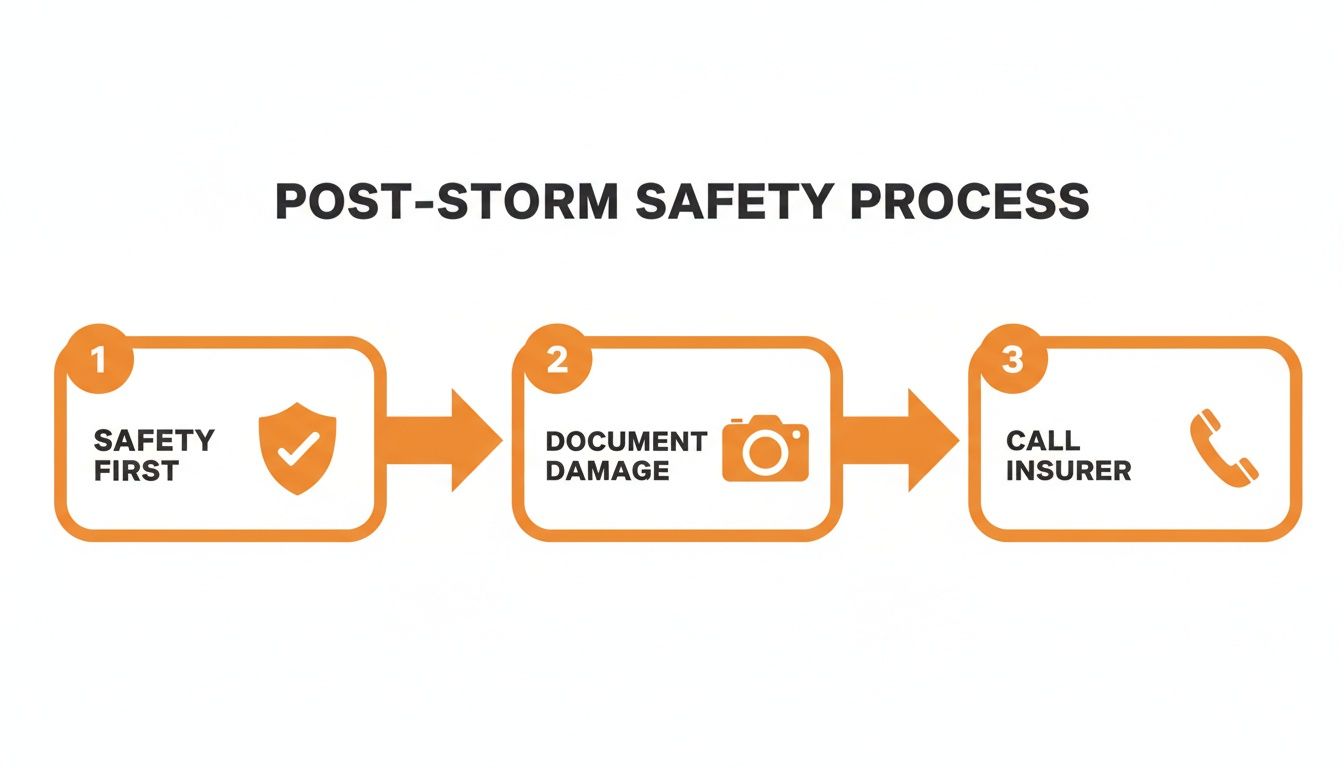
As the graphic shows, it all boils down to three things: stay safe, document the damage, and then call your insurer. Everything else can wait.
Your Immediate Post-Storm Action Checklist
This isn't just a list; it's a prioritized sequence of actions. In the chaos following a storm, a methodical approach is your best defense against making costly mistakes. Follow these steps in order to secure your property, protect your family, and build a strong foundation for your claim.
| Priority | Action Item | Why It's Critical |
|---|---|---|
| 1 | Assess for Hazards | Downed power lines, gas leaks, and structural instability are immediate threats. Your safety comes before any property assessment. |
| 2 | Full Photo/Video Documentation | Before you move a single piece of debris, document everything. This visual evidence is the bedrock of your insurance claim. |
| 3 | Emergency Tarping (If Necessary) | Mitigate further damage by covering holes in the roof or broken windows. This shows the insurer you're protecting the property. |
| 4 | Notify Your Insurance Carrier | Make the first notice of loss to get your claim in the queue. This starts the official process. |
| 5 | Log All Communications | Keep a detailed record of every call, email, and conversation with your insurer, including names, dates, and times. |
This checklist isn't about being perfect—it's about being prepared. Following these steps ensures you don't miss anything critical when it matters most.
Start with a Safety Sweep
Before you even think about grabbing a tarp or a camera, stop. Look around. The most serious dangers after a storm are often the ones you don’t see right away.
- Downed Power Lines: Never assume a fallen wire is dead. Stay far back, keep others away, and call your utility company immediately.
- Gas Leaks: If you smell gas or hear a distinct hissing sound, get out. Evacuate everyone from the area and call 911 and the gas company from a safe distance.
- Structural Damage: Look for obvious signs of trouble—a sagging roofline, cracked foundation walls, or splintered support posts. If you have any doubt about the building's integrity, do not go inside.
The chaos following a severe weather event is becoming more common and costly. The U.S. shattered records in 2026 with 21 billion-dollar disasters from severe weather. These events, mostly from tornado outbreaks and high winds, underscore the increasing frequency and intensity of storms that homeowners face.
Document Everything Before You Touch Anything
Once you've cleared the area for safety hazards, your next job is to become a crime scene investigator for your own property. Your phone is your most important tool right now.
Do not move, clean up, or repair anything until you have a complete visual record. This evidence is non-negotiable for a smooth claims process.
Start with wide shots from the street, capturing the whole scene. Then, get methodical. Move in for close-ups of every single point of damage: hail impacts on siding, missing shingles, shattered windows, and especially where any trees or large debris hit the structure. The more photos and videos you have, the stronger your claim will be.
Make the First Call to Your Insurer
With your initial documentation in hand, it's time to get the ball rolling. Call your insurance carrier to report the loss. This gets you into their system and, crucially, in the queue for an adjuster, which is vital when a storm causes widespread damage in a region.
Have your policy number handy and be ready to give a clear, simple summary of the damage. Make sure they have your best contact number.
From here on out, log every single interaction. Note the date, time, and the name of every representative you speak with. This first call is just the starting point, and navigating the rest of the process can be tricky. Understanding what's involved in insurance claims assistance can give you a major advantage. This single phone call kicks off the entire emergency storm damage repair process.
Securing Your Property with Temporary Repairs
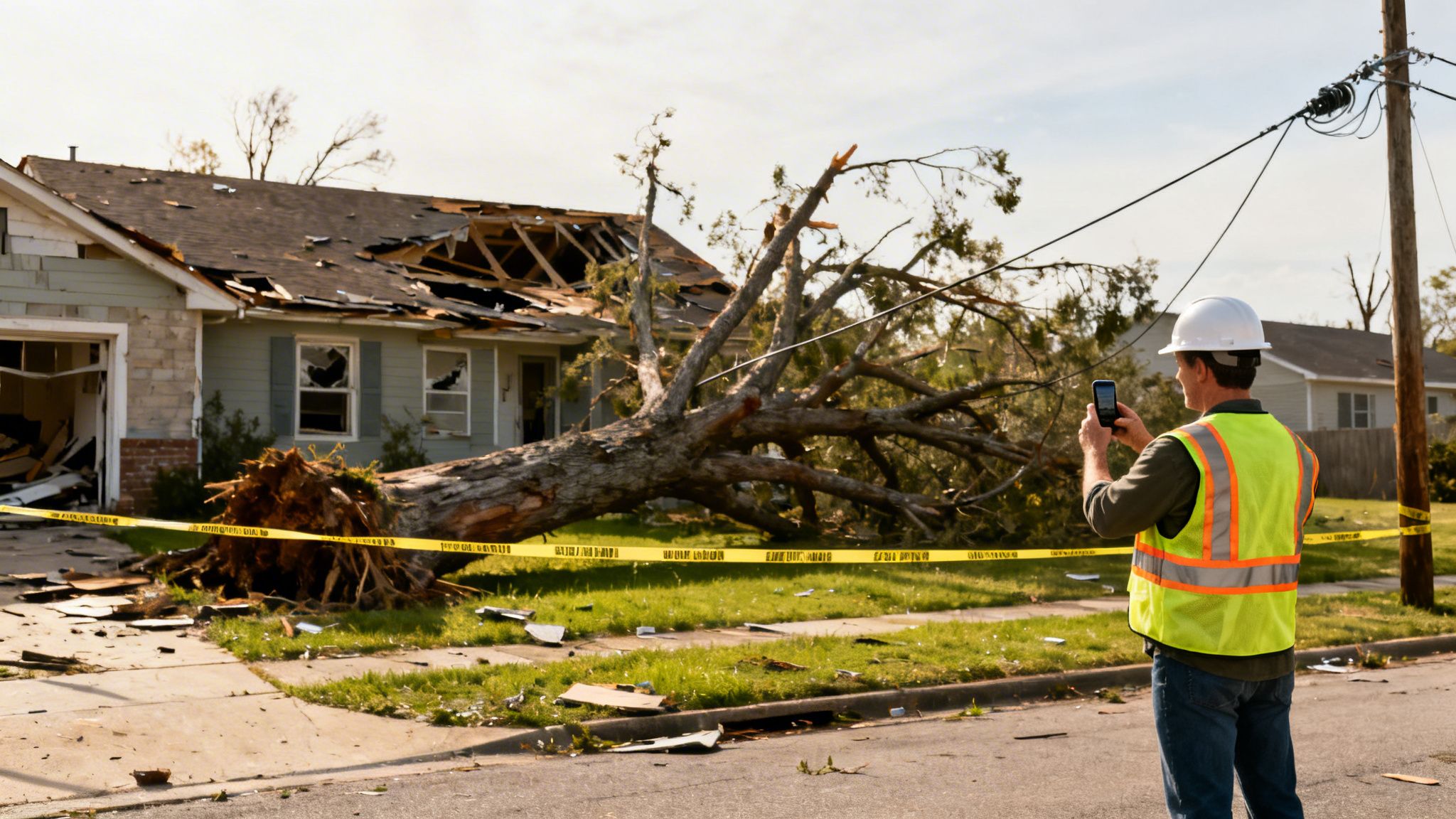
Once everyone is safe and you’ve documented the scene, the clock starts ticking on damage control. Your insurance policy actually requires you to take reasonable steps to mitigate further harm—fail to do this, and you could complicate your own claim. This is the emergency storm damage repair phase, where quick action stops a bad situation from getting exponentially worse.
Every minute water pours into a home, the risk of expensive secondary damage skyrockets. We’re talking about wood rot, ruined insulation, and the big one: mold. Restoration pros will tell you that mold can start growing in as little as 24-48 hours in damp conditions. Acting fast isn’t just a good idea; it’s a financial imperative.
The Critical Role of Emergency Roof Tarping
When a storm rips a hole in a roof, it’s like leaving the front door wide open in a hurricane. A professionally installed emergency tarp is the single most important action you can take to stop water intrusion in its tracks.
Let’s be clear: this is not a job for a homeowner. Getting on a wet, steep, or structurally compromised roof is incredibly dangerous. Plus, the tarp you buy at a hardware store just won't cut it. Professional teams have the right gear and know-how to make sure that tarp stays put, even in high winds and driving rain. You can see the details that go into professional emergency roof tarping services and why it's a non-negotiable first step.
A properly installed roof tarp does more than just cover a hole. It’s a carefully secured system designed to channel water away from the damaged area, protecting the underlying decking and your home's interior while the claim process moves forward.
A pro-level tarp job is a science. Here’s what a proper installation actually involves:
- Strategic Material Choice: We use heavy-duty, reinforced tarps built to handle high winds and UV rays, not flimsy plastic sheeting.
- Secure Fastening: The tarp is anchored with wooden furring strips and specific fasteners that hold tight without causing more damage to the roof.
- Proper Overlap and Sealing: It’s installed to hang over the roof ridge and sealed to create a watertight barrier, keeping wind-driven rain from sneaking underneath.
This professional approach is essential for any emergency storm damage repair. It provides far better protection and shows the insurance carrier you’re taking your duty to mitigate seriously.
Securing Other Vulnerable Areas
The roof gets all the attention, but don't forget about the other weak spots. Overlooking these can lead to just as much damage.
Shattered windows or broken sliding glass doors are an open invitation for rain, pests, and security issues. The immediate fix is to board them up securely with plywood. Cut the plywood to fit inside the frame or overlap it slightly, then fasten it firmly from the outside.
Also, keep an eye out for loose or detached siding. If it’s flapping in the wind, it’s only a matter of time before it rips off entirely, exposing the sheathing underneath to moisture. A few well-placed nails or screws can hold it in place and prevent a small siding problem from becoming a massive water damage headache.
Coordinating with Your Insurance Carrier
Here’s a tip we give every client: keep every single receipt. Whether it’s for tarps, plywood, or screws, these costs are almost always reimbursable under the policy because you’re mitigating damages.
When you bring in a professional service like Fox Claims for emergency tarping or board-ups, they will document everything—the materials used, the labor, and the finished work. That documentation, paired with your receipts, becomes powerful evidence for your claim.
Always keep your adjuster in the loop. Let them know what you’ve done to protect the property. It shows you're being responsible and helps justify the costs when it's time to settle the claim.
Building an Undeniable Insurance Claim
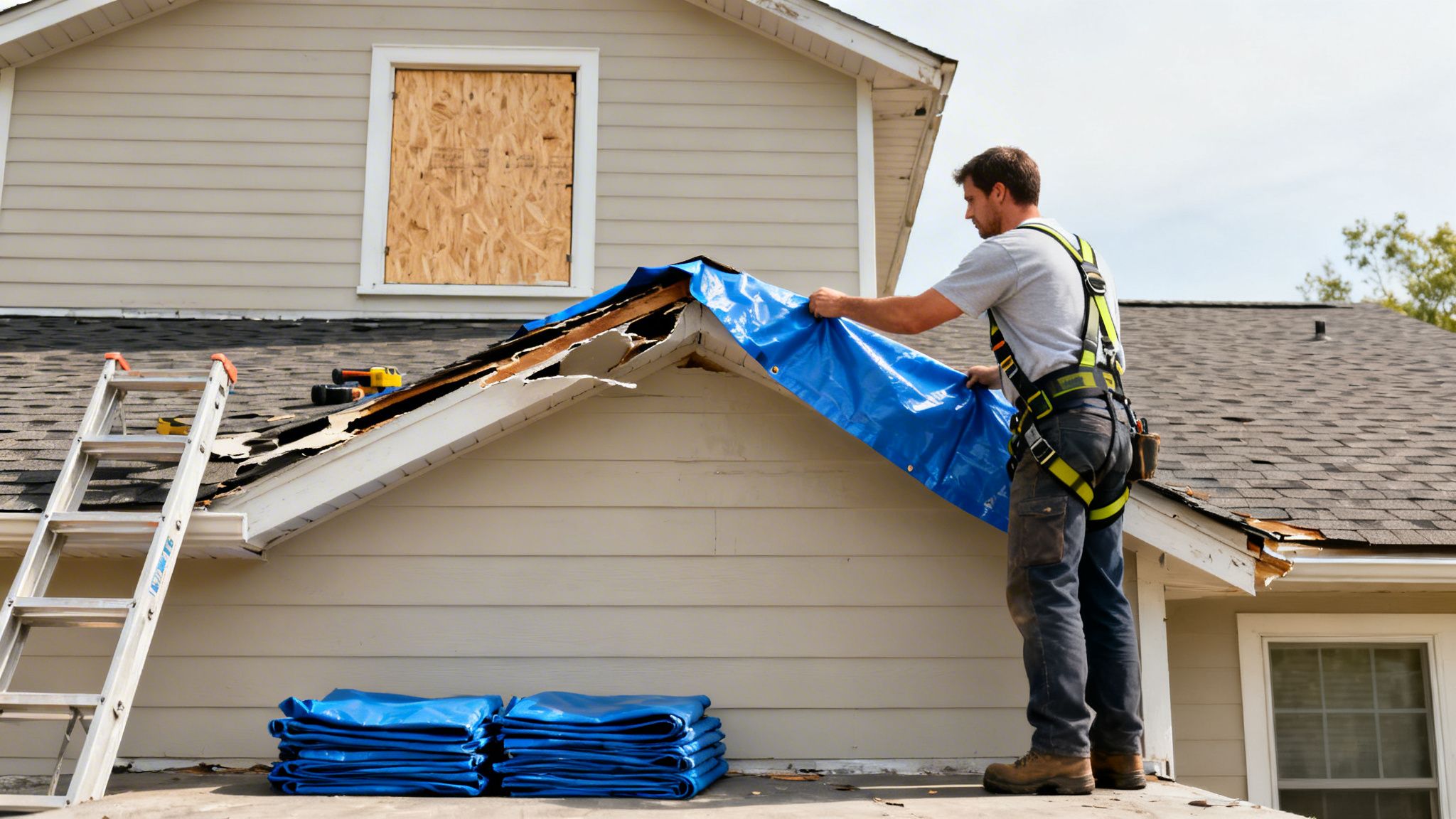
Think of it this way: an insurance claim is a negotiation. The person with the best evidence usually comes out on top. Once you’ve secured your property with temporary fixes, your entire mission shifts to building a mountain of undeniable proof.
A sloppy, disorganized claim is an open invitation for delays and disputes. A meticulously prepared file, on the other hand, sets the stage for a fair and fast settlement. You’re essentially building a case file that gives the carrier a clear, logical, and undeniable picture of the storm's impact. This proactive approach answers the adjuster's questions before they even have to ask, speeding up the whole emergency storm damage repair cycle.
Master the Art of Damage Photography
Your smartphone is your single most important tool right now. But just snapping a few random pictures isn't going to cut it. You need to think like an inspector and document the damage with a photographer’s eye for detail, creating a complete visual narrative that leaves no room for doubt.
We've seen it time and again: good photos speed up claims. Bad photos lead to arguments.
Follow a "macro to micro" approach with your photos and videos.
- The Big Picture: Start from the street. Get wide-angle shots of the entire property to establish the scene and show the overall context of the storm's impact.
- Each Elevation: Go methodically around your house and photograph all four sides. This shows the damaged areas in relation to the untouched sides, which is critical for proving the cause of loss.
- Detailed Close-Ups: This is where claims are won or lost. Get up close and personal with every dent, crack, and hole. For roofing, that means crystal-clear pictures of lifted shingles, hail impacts, and any exposed underlayment.
- Show Scale: This is a pro tip. Place a coin, a ruler, or a measuring tape next to hail dents or cracks. This gives the adjuster an immediate and objective sense of the damage's size and severity. No guesswork needed.
Create a Detailed Inventory of Damaged Belongings
Storms don't just damage the outside of your home; they often ruin your personal belongings. Creating a detailed inventory of these items is non-negotiable for the "contents" portion of your claim.
Go room by room and make a list of every single damaged item. Be specific.
- Item Description: Not just "TV," but "Samsung 55-inch 4K TV." Not just "sofa," but "West Elm mid-century modern sofa."
- Original Purchase Price: Find those receipts or credit card statements if you can. If not, a solid estimate is your next best bet.
- Age of the Item: How old was it? Be honest.
- Condition Before the Storm: Was it brand new, in good shape, or showing its age?
And please, don't throw anything away until the adjuster gives you the green light. It’s tempting to clean up the mess, but a discarded item is an item the insurance company can’t verify—and likely won’t pay for.
Save Every Single Receipt
From this moment on, you are a meticulous record-keeper. Every single dollar you spend as a direct result of the storm could be reimbursable. This isn’t just about the plywood and tarps.
Keep a dedicated folder, envelope, or even just a shoebox for all storm-related expenses. This means receipts for temporary repairs, materials, and any Additional Living Expenses (ALE) if the damage forced you out of your home. Think hotels, meals, and even laundry services.
These receipts aren't just for your records; they are direct evidence to support your claim for reimbursement. When an adjuster sees an organized collection of expenses, it makes their job easier and gets you paid faster. Without proof of purchase, you’re just making it harder to get back every dollar you're owed. This organized approach is a cornerstone of a successful emergency storm damage repair claim.
Working with Adjusters and Inspection Partners
Once the storm passes, the real work begins. Your property is now a claim site, and a whole cast of characters is about to show up. Navigating the maze of adjusters and inspectors can feel like a full-time job, but understanding who does what is the key to a smooth and fair recovery.
You’re going to meet several types of adjusters, and each has a different role. Knowing who they work for is the first step in protecting your interests and making sure the assessment of your emergency storm damage repair is complete.
Understanding the Key Players
The first call you get from the insurance company will likely be from an adjuster. But not all adjusters are created equal. Their title tells you exactly who they represent in the claims process.
- Staff Adjusters are direct employees of your insurance carrier. They evaluate the damage, determine the cause, and write the estimate based on your policy.
- Independent Adjusters are third-party contractors hired by insurance companies. Carriers bring them in to handle the massive surge of claims after a major storm. They do the same job as a staff adjuster but aren't on the carrier's payroll.
- Public Adjusters are the only adjusters who work directly for you, the policyholder. You hire them to manage your claim and negotiate on your behalf, and they typically take a percentage of the final settlement.
For most claims, you’ll be dealing with a staff or independent adjuster. Your role is to provide them with your documentation and be there when they inspect the property.
A critical reality check: In a recent year, global natural disaster damages hit $224 billion, but insurers only covered $108 billion. That staggering $116 billion uninsured gap, detailed in Swiss Re Institute findings, shows just how much financial pressure storms put on everyone.
This pressure means that after a big event, adjusters are often slammed with massive caseloads. They simply can't be everywhere at once. This is where specialized inspection partners become absolutely essential.
The Role of Specialized Inspection Partners
Desk adjusters managing claims from an office and field adjusters buried in appointments both need one thing: reliable data. They need eyes on the ground they can trust. That’s the gap expert inspection partners like Fox Claims fill, providing critical support that helps the carrier and the homeowner.
For an adjuster juggling hundreds of post-storm claims, a trusted partner for ladder assist on a steep, complex, or high roof is a game-changer. These are high-risk environments. Sending a specialized, insured team to handle the difficult climb and detailed inspection isn’t just about efficiency—it’s about safety.
This is what a top-tier inspection service delivers:
- Thorough, Safety-First Evaluations: Certified inspectors have the training and gear to safely access and document damage in hard-to-reach areas.
- Precise Data and Estimates: They provide high-quality photo documentation and accurate measurements that a desk adjuster can use to write a confident, precise estimate without ever leaving their desk.
- Faster Cycle Times: Getting an expert on-site fast means carriers can close claims faster. For the homeowner, that means getting your life back to normal sooner.
This collaborative model is changing how the industry responds to storms. You can learn more about how Fox Claims Consultants transforms property inspections with innovative solutions that bridge the gap between the field and the desk.
What to Expect During the Inspection
When the adjuster or an inspection partner arrives, be ready. Have your photos, videos, and any receipts from temporary repairs organized. Walk the property with them and physically point out every area of concern you’ve found.
This is your home. Don’t be afraid to ask questions.
- "Can you show me what you’re seeing on the roof?"
- "Did you check the siding on the north side? The wind hit us hard there."
- "Are you documenting the damaged window screens and gutters, too?"
Active participation is the best way to ensure nothing gets missed. The goal is to work with the adjuster and their partners to build the most accurate picture of the damage possible. That teamwork is what a successful emergency storm damage repair and a fair settlement are built on.
When to Call for Backup
After a major storm, the chaos is immediate. Every local contractor's phone is ringing off the hook. Adjusters find themselves buried under hundreds of new claims overnight. In that environment, waiting is a gamble—one that can turn a simple roof repair into a catastrophic secondary loss.
Knowing when to bypass the local logjam and call in a specialized emergency team is more than just a good idea; it's a critical decision. Not all damage is the same. A few missing shingles can probably wait. But some situations are red flags, signaling you need an expert team on-site, right now.
Tall, Steep, and Complex Roofs
There's a world of difference between a single-story ranch and a three-story Victorian with a steep, complex roof. These roofs are dangerous on a good day. After a storm, they're wet, slippery, and their structural integrity is a complete unknown.
Most local adjusters or contractors simply aren't equipped for it. They don't have the gear, the safety training, or frankly, the insurance to get on that roof. That's your first major sign to call for ladder assist.
- Safety is everything. Our pros use specific rope and harness systems to safely navigate any roof pitch over a 7/12. Going up there without the right gear is asking for a tragedy.
- You can't see it from the ground. It’s impossible to spot subtle but serious issues like creased shingles, popped nail heads, or compromised flashing around chimneys from a ladder at the eave. You have to get hands-on.
An emergency team with certified ladder assist inspectors gets you the accurate data you need without putting anyone at risk, keeping the claim moving forward.
When Trees and Structures Collide
A tree on a house isn't just a hole in the roof—it's a full-blown structural crisis. The immense weight can crack rafters, shatter trusses, and compromise the load-bearing walls holding the whole thing up. It's an unstable, dangerous mess.
Never, ever try to assess or remove a tree from a structure on your own. As the tree is cut, the weight distribution shifts, which can cause an unexpected and catastrophic collapse. This job requires a coordinated effort between a professional tree service and an inspection team.
A rapid deployment team can get on-site, document the complex points of impact for the carrier, and work with the tree crew to get the structure safely tarped and stabilized the moment the tree is clear. This is absolutely critical for scoping the emergency storm damage repair correctly from the start.
Overwhelmed by Widespread Catastrophe
The numbers don't lie. In the first half of 2026 alone, global insured catastrophe losses from storms hit a staggering $100 billion, largely driven by severe storms in the U.S. You can read more about these storm-driven financial impacts and see how two massive storm systems each left at least $8 billion in damages.
When an event hits that scale, the local infrastructure is completely swamped.
This is precisely when an emergency deployment team provides the most value. While local resources are stuck in a queue that can stretch for weeks, a national partner like Fox Claims can have boots on the ground anywhere in the country within 24-48 hours.
For carriers, that means getting the critical data you need to start making decisions. It means mitigating further loss with immediate stabilization. And it means slashing claim cycle times when policyholders need you most. From the emergency tarp to the final report, this is how you bring order to the chaos.
Clearing Up the Chaos: Your Storm Damage Questions Answered
After a storm, the questions come fast. With so much happening at once, it's easy to feel overwhelmed. We've been there.
We’ve gathered the most common questions we hear in the field from both homeowners and adjusters. Here are the straight-up answers you need to move forward.
How Long Do I Have to File an Insurance Claim After a Storm?
This is where people get confused, and the clock is always ticking. The answer really depends on your state and your specific policy.
Most insurance policies demand you notify them "promptly" or "as soon as reasonably possible." This isn't the full claim—it's just the first notice of loss to get the ball rolling.
But the real deadline is for your full, documented claim. This is called the statute of limitations, and it can range from one year to several years. Don't risk it. The best practice is always to report the damage right away. If you wait, an insurer might argue that any later issues aren't actually from the storm.
My Roof Is Damaged but It Is Not Actively Leaking. Should I Still File a Claim?
Yes. Without a doubt. Damage that looks minor—like lifted shingles, a few creases, or some hail bruises—is a ticking time bomb for your entire roofing system.
This kind of "hidden" damage compromises the roof's ability to protect your home. Over time, it can lead to slow leaks you don't even see, causing wood rot, mold, and major structural problems. If you wait, an insurance carrier might later deny the claim, calling it a maintenance issue instead of storm damage.
A professional inspection is the only way to know for sure. It's far better to have an expert confirm the true extent of the damage than to risk thousands of dollars in repairs later for a problem you thought was minor.
Getting an expert opinion is the smartest move you can make for any emergency storm damage repair scenario.
Can I Start Repairs Before the Adjuster Has Seen the Damage?
You can—and should—perform temporary repairs needed to prevent more damage from happening. This is called mitigating your damages, and it's your responsibility as a policyholder. Go ahead and tarp the roof, board up a window, or shut off a leaking water line.
Before you do anything, document everything. Take tons of photos and videos of the original damage. Keep every single receipt for tarps, plywood, and labor. These costs are almost always reimbursable.
But do not start permanent repairs. The adjuster needs to see the initial damage firsthand to accurately scope the loss. Starting major work too early can put your whole claim in jeopardy and may give the insurance company a reason to deny payment for that work.
What if My Insurance Company's Settlement Offer Is Too Low?
Don't panic, and don't accept the first offer if it feels wrong. Your first step is to calmly review the adjuster's report and estimate, line by line.
Compare it against the quotes you've gotten from your own trusted contractors. We see discrepancies happen all the time, usually from:
- Missed Damage: Items that were just plain overlooked during the first inspection.
- Incorrect Measurements: Inaccurate square footage for roofing or siding is a classic one.
- Outdated Pricing: Using national average costs that don’t reflect the reality of local labor and material prices, especially after a major storm.
You absolutely have the right to dispute the offer. The key is to do it with evidence. Provide your contractor's quotes and a detailed report from an independent inspection partner like Fox Claims. A professional, third-party assessment gives you the objective data needed to negotiate for a fair settlement. If you're still at a stalemate, you may need to invoke your policy's "appraisal clause" or bring in a public adjuster.
When your claim involves a complex, steep, or dangerous roof, Fox Claims Consultants LLC provides the expert ladder assist and inspection services you need to get the facts right. We get boots on the ground fast to deliver thorough, safety-focused evaluations for any emergency storm damage repair situation. Learn more at https://foxclaimsconsultants.com.
Leave a Reply