
A tree has come through a roof. The tarp crew is waiting. The desk adjuster needs photos, measurements, occupancy notes, and a damage summary before reserves can move. The homeowner wants one straight answer: what happens next?
That’s where a field inspector steps in.
If you’ve searched what does a field inspector do, you’ve probably seen a simplified version of the job. It usually sounds like someone drives to a property, snaps a few photos, fills out a form, and leaves. That describes the lightest version of the role. It does not describe what serious inspection work looks like when the property is steep, unstable, storm-hit, or dangerous to access.
A professional field inspector is the person who converts site conditions into usable facts. For carriers and adjusters, that means reliable documentation. For homeowners, it means clarity. For contractors, it means a cleaner starting point. On difficult losses, it also means safety decisions that have to be right the first time.
Beyond the Clipboard The Modern Field Inspector
After a storm, confusion spreads fast. Water keeps moving, debris hides damage, and people start making decisions before anyone has a dependable record of what happened. A good field inspector brings sequence back to the loss. The job isn’t just observation. It’s controlled evidence gathering under time pressure.
That distinction matters because the market still understates the role. Existing content often treats field inspection as a low-barrier job, while skipping the safety and liability realities of dangerous assignments. Mainstream guidance also leaves a gap around how carriers and adjusters should vet qualifications for high-risk assessments, especially when steep roofs and unstable structures are involved, as noted in this discussion of field inspection safety and qualification gaps.
What the average inspector does
The average inspector handles straightforward site visits reasonably well. They confirm visible conditions, take standard photos, note basic hazards, and submit a report. On a low-complexity property, that can be enough.
But that same approach breaks down on taller structures, slick roof systems, tree impact losses, or emergency stabilization calls. In those situations, simple documentation isn’t the whole job. The inspector has to judge access, preserve evidence, avoid making the loss worse, and communicate what can and cannot be safely verified that day.
Practical rule: If the structure is high-risk, the inspection method matters as much as the inspection result.
What the expert professional does differently
An expert inspector thinks in layers:
- Safety first: Can the site be accessed without creating a new injury or liability problem?
- Damage logic: Does the visible pattern match wind, impact, wear, deferred maintenance, or multiple causes?
- Documentation quality: Will the file answer the next round of questions, or create them?
- Communication: Can the inspector give the desk team facts they can act on immediately?
That’s why the work often includes more than boots and a clipboard. Teams handling difficult properties rely on communication gear, route discipline, and field coordination tools. Even basics like dependable new sealed walkie-talkies for field communication matter when crews are split between ground support and roof access.
The short answer to what does a field inspector do is this: they verify conditions on site and turn them into a decision-ready record. Effective inspectors accomplish this without guessing, without overreaching, and without putting people at unnecessary risk.
A Day in the Life The Core Duties of an Inspector
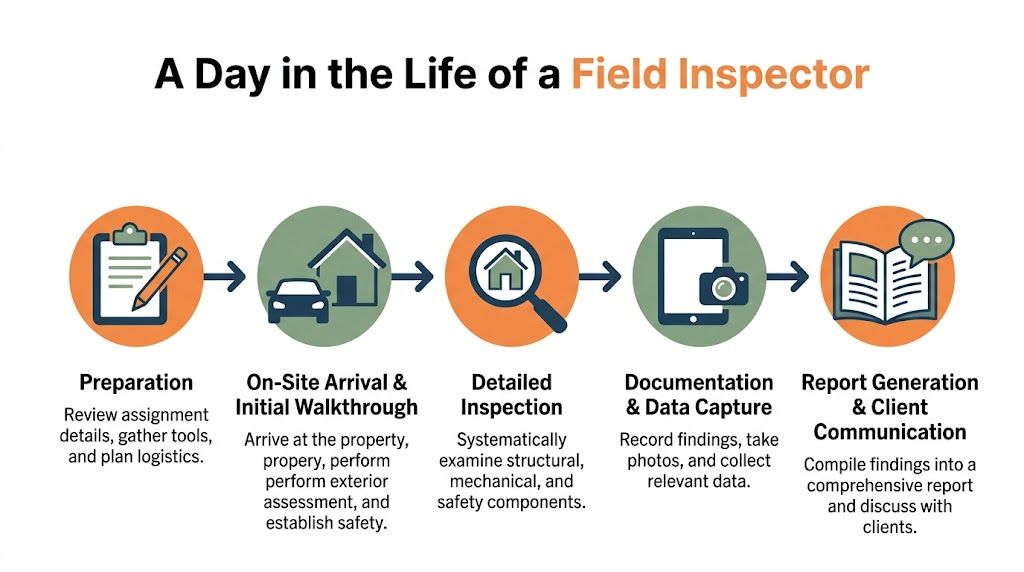
The work starts before anyone leaves the truck. A field inspector’s day is built around preparation, site assessment, documentation, and reporting. The inspector is the eyes and ears for people who aren’t on the property, so every missed detail creates downstream friction.
According to Indeed’s overview of what field inspectors do on the job, the role combines on-site assessment with detailed reporting. Duties include planning travel routes, evaluating property conditions, checking for damage or hazards, verifying compliance with project plans, and communicating findings through concise reports for decision-makers in insurance, lending, and construction.
Before the site visit
A disciplined inspector reviews the assignment carefully. That means reading the loss description, checking address accuracy, confirming contact instructions, and understanding what the client needs. Some assignments call for condition verification. Others require storm damage documentation, occupancy confirmation, code-related observations, or a limited scope tied to a lender or carrier request.
Preparation usually includes:
Reviewing the scope
If the request is vague, the inspector clarifies it before rolling. A vague assignment creates vague reporting.Planning access and travel
Route planning matters more than people think. It affects arrival time, daylight, crew coordination, and whether the inspector can complete the job in one trip.Checking tools and forms
Cameras, measurement tools, PPE, and reporting templates need to be ready before the first stop. Even a simple weekly and monthly appointment book for route scheduling can help keep a field day from turning into missed windows and rushed notes.
On site
The first few minutes on a property set the tone. A professional doesn’t rush straight to the most obvious damage. They start with orientation and hazard awareness.
That usually means a quick exterior pass, noting structural concerns, access limits, downed limbs, power hazards, unstable surfaces, or signs that more specialized access may be needed. Then the inspection becomes systematic.
A competent workflow often looks like this:
- Exterior review: Roofline, elevations, outbuildings, fencing, drainage, impact points, and visible openings.
- Condition checks: Damage, deterioration, displacement, moisture indicators, and safety issues.
- Compliance observations: Where required, compare visible conditions to plans, diagrams, or stated standards.
- Photo capture: Wide shots first, then mid-range context, then close-ups with scale.
- Field notes: Record what was observed, where it was observed, and any access limits.
The best inspectors don’t just collect images. They collect context.
After the visit
The final part of the day happens at the keyboard. Raw field data has to become a usable report. That means clean photo labeling, concise findings, a damage summary, and clear statements about what was confirmed versus what remained inaccessible.
Poor inspectors dump files. Good inspectors build a record.
That difference is what clients pay for.
Specializations From Standard Homes to High-Risk Structures
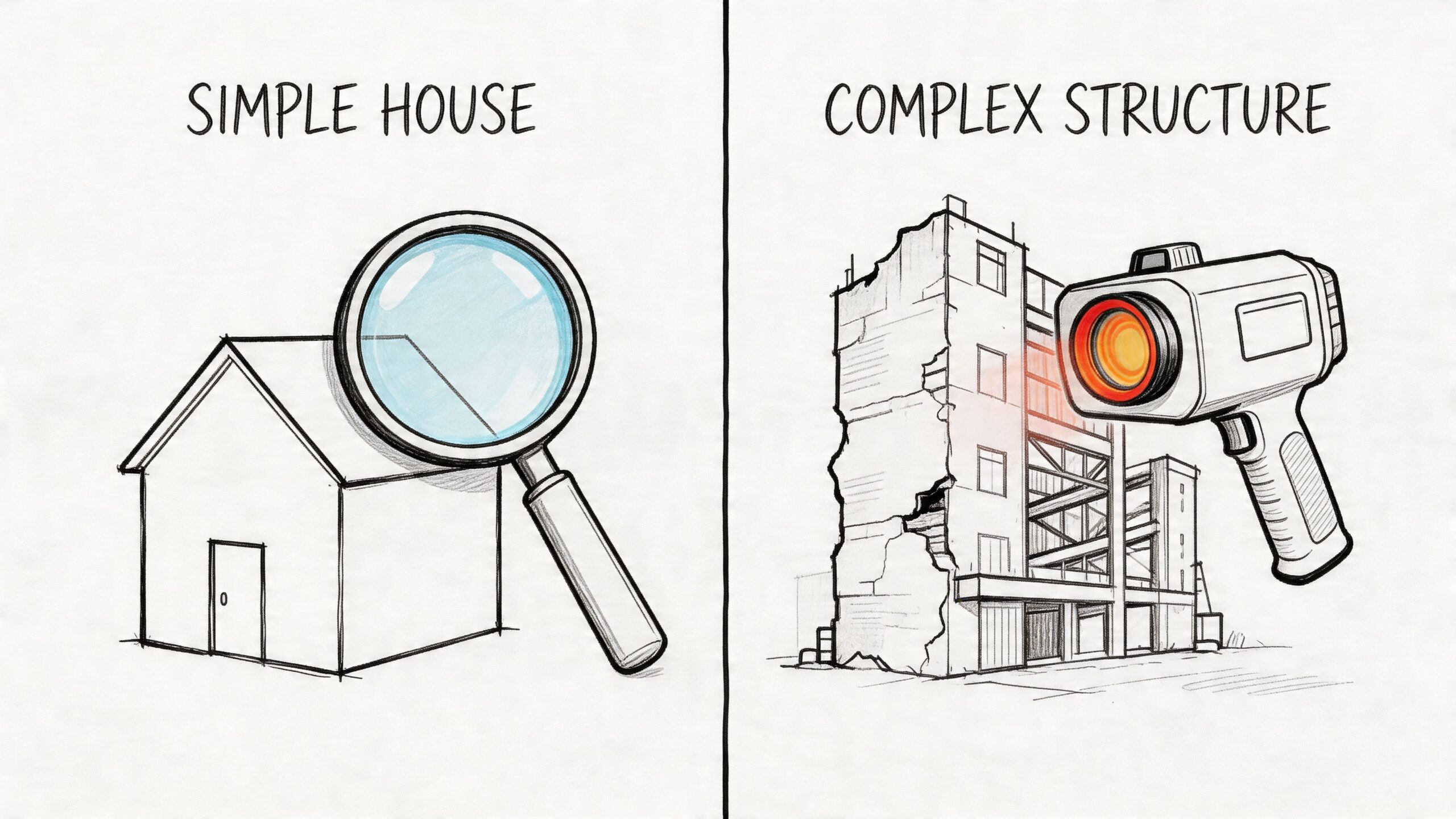
Not every field inspection is complex. Some are routine property condition checks for lenders, insurers, or asset managers. Those assignments still require accuracy, but the site conditions are often stable and the access straightforward.
The problem starts when people assume all inspections are basically the same.
Standard inspections versus specialized inspections
A standard residential inspection might focus on visible condition, occupancy indicators, exterior damage, and a clean photo set. That’s important work. But it doesn’t automatically qualify someone to inspect a steep roof after a storm or document tree impact on a compromised structure.
High-risk inspections demand technical judgment. On steep roofs, inspectors work under building code and safety constraints that generalists often never touch in ordinary property visits. For storm losses, the job shifts from simple observation to cause-and-effect analysis.
The Bureau of Labor Statistics material referenced in this field notes brief on steep roof inspection standards and methods points to several practical realities. For steep roofs, 7:12 pitch or greater falls into a category where inspectors apply IBC specifications and must use OSHA-compliant personal fall arrest systems. That safety approach is associated with reducing fall injuries by up to 78%. The same source set also notes that inspectors use ASTM-based analysis for wind uplift and nail pullout failures, and that drone-assisted photogrammetry can accelerate claims by 40% when used correctly.
Where specialization changes the result
On a complex roof loss, the essential work isn’t just spotting broken materials. It’s determining whether the damage pattern makes sense. A specialist looks at uplift behavior, fastening issues, sheathing response, slope-related access limits, and whether direct access is even the right method for that structure.
Tree damage creates another jump in complexity. Limb strike isn’t just “tree on roof.” The inspector may need to assess impact direction, affected area, puncture points, and whether temporary protection is required before the next weather event.
Here’s the practical difference:
| Inspection Type | Primary Focus | Key Risks | Required Expertise |
|---|---|---|---|
| Standard property condition | Visible exterior and interior condition, documentation, occupancy, basic hazards | Missed details, incomplete photo context, limited access notes | Site observation, photo discipline, concise reporting |
| Mortgage or lender field work | Condition verification, status updates, property documentation | Inaccurate status reporting, weak documentation | Consistent process, route planning, reporting accuracy |
| Steep and tall roof inspection | Roof condition, storm-related damage, access planning, safety compliance | Falls, incomplete roof evidence, misread damage cause | IBC awareness, OSHA fall protection, ladder assist judgment, photogrammetry use |
| Storm and tree damage assessment | Impact documentation, hazard identification, emergency stabilization inputs | Unstable structures, hidden openings, secondary water intrusion | Cause-effect analysis, damage mapping, tree impact interpretation, emergency site judgment |
A specialist also knows when not to force access. That’s where support equipment can matter. Survey and measurement tools, including gear like a silver-coated mini prism for total station surveying, can support more precise site documentation when direct measurement is awkward or unsafe.
A generalist tries to complete the assignment. A specialist completes it without creating a bigger problem.
That’s the line between average and expert inspection work.
The Modern Inspector's Toolkit and Technology
The old stereotype is a ladder, a clipboard, and a camera. That still covers part of the job, but it doesn’t cover enough of it. Modern inspection work relies on two categories of equipment: field gear that keeps the inspector safe and productive, and technology that improves evidence quality without forcing unnecessary exposure.
Essential gear for real field work
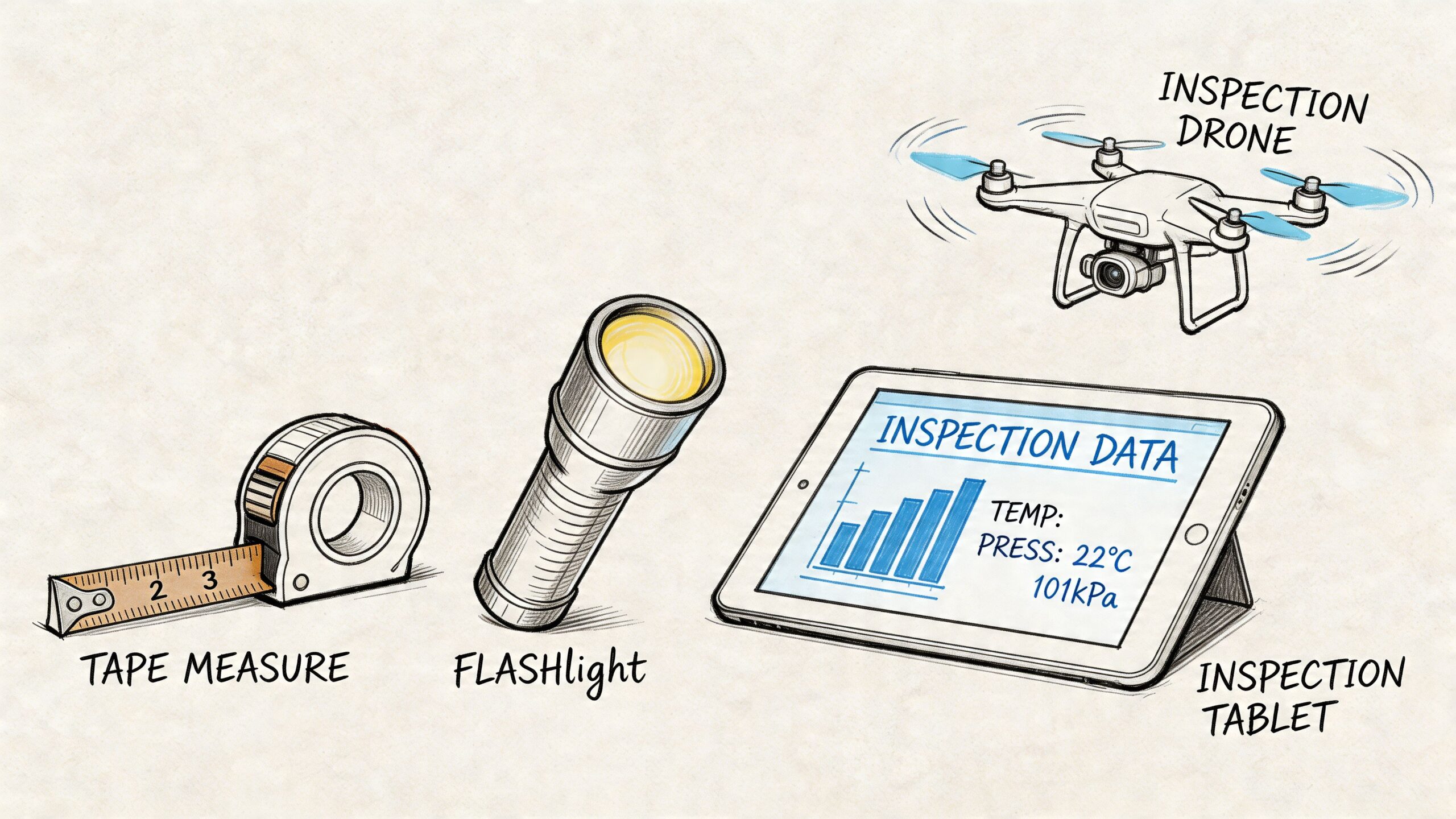
At a minimum, a professional inspector needs dependable PPE, ladders suited to the assignment, measuring devices, lighting, and a way to document findings cleanly in the field. On higher-risk jobs, that list expands quickly to harnesses, anchors, roof access gear, marking tools, tarping materials, and equipment for temporary protection.
Storm work adds another layer. Tree damage assessments use TRAQ methodology to evaluate failure risk. On steep roofs, inspectors document impact vectors from limbs and measure dent depths to determine whether they indicate structural compromise under ICC-related standards. Emergency tarping also follows ARMA guidelines, and that process has been shown to cut interior damage by 70% in the first 72 hours, based on the field summary published here on tree damage assessment and emergency tarping practice.
That’s why the toolkit can’t be random. It has to support the assignment.
A few examples:
- Access equipment: Used only when site conditions justify direct access.
- Measurement tools: For dimensions, slope-related observations, and damage mapping.
- Lighting and moisture-oriented support tools: Helpful in dim interiors or areas with possible water migration.
- Document handling tools: Physical paperwork still matters in the field. Even small maintenance items like a roller set for ScanSnap document scanners support cleaner back-office processing when teams convert field paperwork into claim files.
Technology that changes the job
The biggest shift in recent years is that inspectors no longer have to put boots on every surface to produce useful evidence. Drones, high-resolution imaging, 3D capture, and cloud reporting tools reduce guesswork and limit unnecessary exposure.
For a look at how visual documentation technology supports field work, this short clip is useful:
Technology works when it solves a field problem, not when it’s carried for show.
What works and what doesn’t
What works is using drones for dangerous roof sections, structured photo sets for fast desk review, and mobile reporting systems that keep notes tied to the right location. One option in that category is Fox Claims Consultants LLC, which provides steep roof inspections, ladder assist, storm damage assessment, and emergency tarping support as part of field operations for difficult property losses.
What doesn’t work is relying on a pile of gadgets with no inspection method behind them. The gear should make the file safer, clearer, and more defensible. If it doesn’t do one of those three things, it’s baggage.
The Final Report What a Deliverable Should Contain
An inspection isn’t finished when the inspector leaves the property. It’s finished when the client receives a report they can use without calling back for basic missing pieces.
That report is the deliverable. A weak report creates reinspection, delay, and argument. A strong one gives the claim team a workable record of condition, damage, access, and next-step needs.
The parts that matter
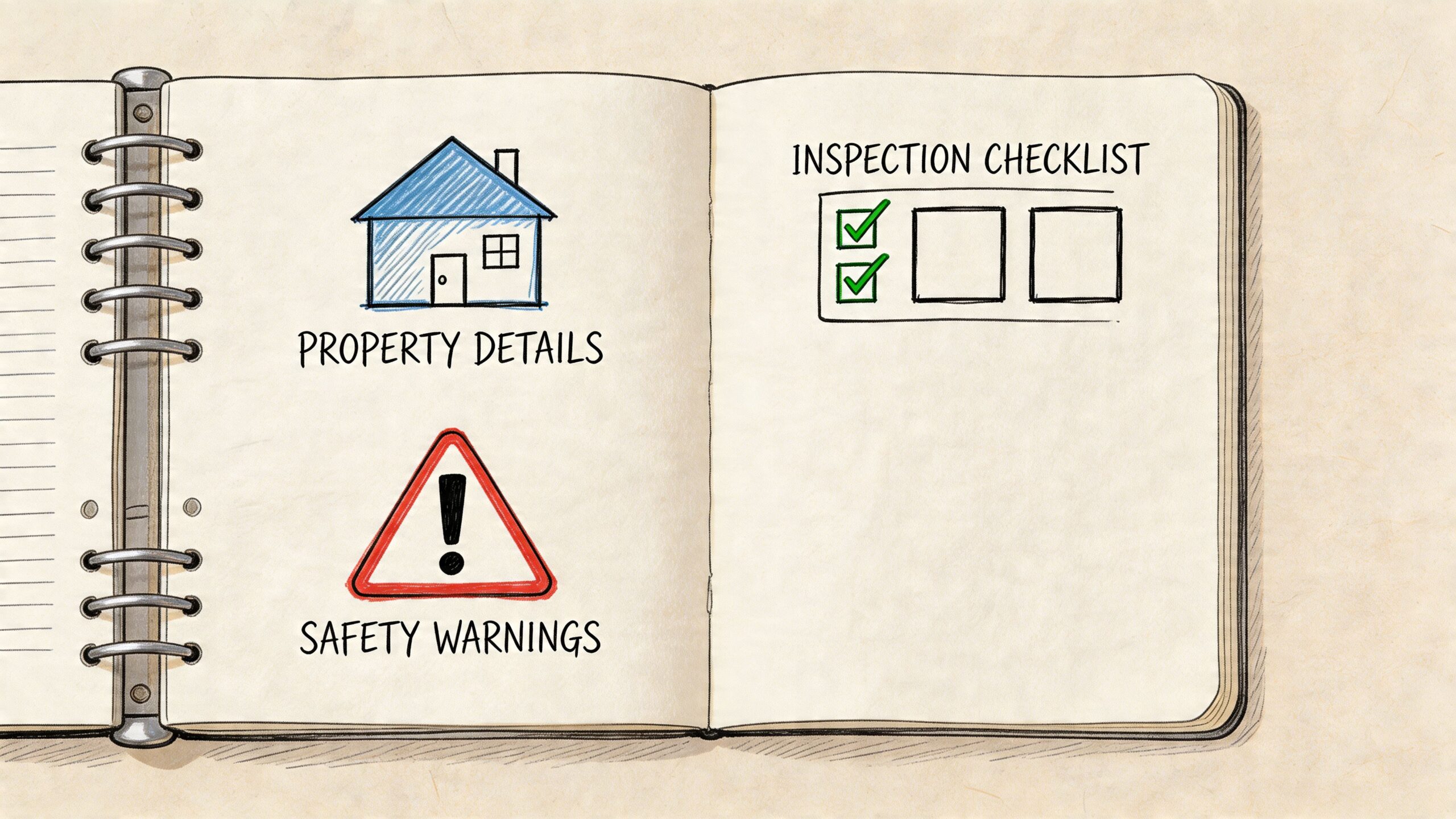
A professional report should include enough structure that another reviewer can follow the property without ever being on site.
That usually means:
Property and assignment identifiers
Correct address, date of inspection, contact notes, and scope requested.Access and safety notes
State what areas were inspected, what areas were inaccessible, and why. If roof access was limited by pitch, height, debris, weather, or safety concerns, that should be explicit.Photo documentation with logic
Photos should tell a story. Start broad, narrow down, and label locations clearly. Random close-ups without context slow everyone down.Condition and damage summary
The report should separate observed facts from assumptions. It should also distinguish active damage, prior conditions, and unresolved questions.Scope-oriented observations
If the assignment supports repair planning, the findings should help define the likely work area and affected components.
What good reporting looks like in practice
The best reports answer common follow-up questions before they get asked.
For example, if a limb struck the rear slope, the report should show where the limb hit, what materials were affected, whether interior staining aligns with that opening, and whether temporary dry-in is needed. If the inspector used remote imagery rather than direct roof access, the file should say that plainly.
Clear reporting isn’t about sounding technical. It’s about making the next decision easier.
Common report failures
Most bad inspection reports fail in familiar ways:
| Report Problem | Why it causes trouble |
|---|---|
| Unlabeled photos | Reviewers can’t tie the image to a location or issue |
| No access statement | Clients assume uninspected areas were clear |
| Vague damage language | Creates disputes and repeat questions |
| Missing hazard notes | Increases risk for adjusters, contractors, and owners |
| Mixed facts and assumptions | Weakens credibility of the whole file |
A report should reduce friction. If it creates ambiguity, it hasn’t done its job.
The Professional Inspector Skills Certifications and Safety
A lot of people can visit a property. Far fewer can inspect one professionally.
That difference shows up in judgment, communication, and restraint. A professional knows when evidence is sufficient, when another method is needed, and when site conditions require a hard stop. They don’t bluff through uncertainty, and they don’t confuse confidence with competence.
The workforce itself reflects a mature trade. The United States has over 15,674 field inspectors, and the average field inspector is 50 years old, according to this demographic summary of field inspector employment and compensation. The same source notes that many roles require only a high school diploma, while specialized roles carry stronger compensation. For building inspectors, the Bureau of Labor Statistics reports a median annual salary of $72,120, a useful reminder that expertise has market value.
Skills that separate professionals from casual operators
The first skill is observation, but that’s not enough on its own. Skilled inspectors also need disciplined note-taking, photo sequencing, client communication, and the ability to recognize the limits of a visual inspection.
The second is integrity. If an area couldn’t be accessed safely, the report has to say so. Good inspectors don’t fill gaps with guesswork.
The third is calm field judgment. That matters when the homeowner is stressed, the site is unstable, or the carrier wants a fast answer. Fast is good. Fast and sloppy is expensive.
Why training matters more than marketing
Specialized work should be matched with specialized preparation. For high-risk structures, firms should care about fall protection, site hazard awareness, equipment use, and documented procedures. The details of a firm’s credentialing can vary, but the standard should be simple: nobody should be sent onto a difficult property because they “usually handle inspections.”
Visual identification and safety labeling also play a role in the field. Even practical items like a decal set for helmets, hard hats, laptops, and equipment can support clearer crew identification and jobsite coordination when multiple responders are moving around a loss location.
The safest inspector isn’t the one who never takes hard assignments. It’s the one who knows which method fits the risk.
What carriers and adjusters should demand
When assigning difficult inspections, ask for more than turnaround promises.
Look for:
- Documented safety practices
- Clear limits on when direct access is used
- Consistent reporting standards
- Inspectors who can explain their method
- Evidence that the firm understands high-risk property conditions
Tools matter. Experience matters. But safety culture is what keeps the file clean and the people intact.
Common Questions and Inspector Red Flags
What should a homeowner expect during a field inspection
Expect a structured visit, not a casual walkthrough. The inspector should identify themselves, explain the scope in plain language, document visible conditions, take organized photos, and note any areas that can’t be safely accessed. If the loss involves active exposure, they may also flag the need for temporary protection.
What should an adjuster or carrier ask before assigning a difficult property
Ask how the inspector handles steep access, storm damage, tree impact, and unsafe site conditions. Ask what the final report includes. Ask how they document inaccessible areas and whether they use remote methods when direct access isn’t appropriate.
Why use a third-party inspection partner
A third-party inspector gives the desk team verified field information without forcing every claim decision through guesswork or owner-supplied photos. On complex losses, that outside record can also clarify scope, preserve evidence early, and keep communication cleaner between parties.
Red flags that should make you pause
Watch for these problems:
They minimize site risk
If someone talks about steep roofs like they’re routine and needs no special handling, that’s a warning.They promise certainty before seeing the property
Good inspectors describe process first, conclusions second.Their reporting is vague
If sample files don’t show labeled photos, access notes, and clear findings, expect rework.They can’t explain method
A qualified inspector should be able to say how they inspect, what they document, and when they stop for safety reasons.They treat every assignment the same
Standard condition checks and high-risk storm losses are not interchangeable jobs.
A field inspector should make the claim clearer. If the process creates more uncertainty, you’ve got the wrong person on site.
If you need a field inspection partner for steep roofs, storm damage, ladder assist, or emergency tarping, Fox Claims Consultants LLC provides safety-focused property inspections and documentation support for carriers, adjusters, and homeowners dealing with difficult losses.
Leave a Reply